
Understanding HEC Similarity Index Rules for Thesis Submission
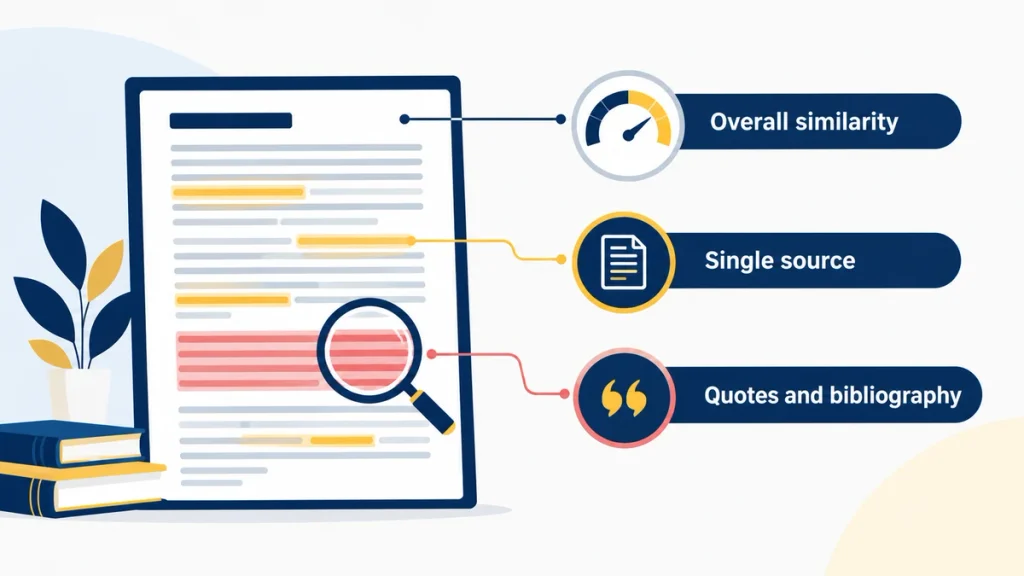
Is my thesis safe if Turnitin shows 18%? Does the 19% include my reference list? Why did my supervisor flag one paper at 7% when my total is only 15%?
These questions come up in almost every thesis submission in Pakistan. The answers sit in three HEC documents rather than one rule. Here is what each document says, what a similarity report really measures, and what to do when your numbers look wrong.
What does the HEC 19% similarity index say?
The HEC accepts an overall similarity of 19% or less. It also expects any single source to stay under 5%. The HEC Anti-Plagiarism Policy states both limits. The Graduate Education Policy 2023 repeats them for MS, MPhil and PhD work.
In that policy, a report at or below 19% gives the author the benefit of the doubt. However, a single source at 5% or more without citation needs revision. So two numbers matter, not one.
Wording also varies between institutions. Some universities and journals write “below 19%”. Some journals set a stricter single-source cap. Ask your department which wording it applies.
Position correct as of October 2026; check the HEC’s Anti-Plagiarism Policy for the current status.
Is 19% a pass mark?
No. The policy treats the score as an indication, not a verdict. A subject expert or supervisor must interpret it, because they know the context of the thesis.
Turnitin says the same. Its own guidance states that it does not check for plagiarism. It highlights text that matches its database, and a person decides what the matches mean. Its similarity score explanation also notes that correctly quoted and referenced text still shows up as a match.
Outside Pakistan, no standards body sets a universal cutoff either. The CASRAI dictionary entry on acceptable similarity describes figures like 15% or 20% as local triage rules.
Why a low score can still raise questions
A low total can hide one closely paraphrased, uncited paragraph. Text-matching tools also miss borrowed ideas that were reworded. The HEC policy defines plagiarism to include near-verbatim copying and purposely paraphrasing another author’s work without citing it.
A high score can also be harmless. One editorial in the Journal of Korean Medical Science describes a manuscript with 32% similarity and no text plagiarism. As a result, the report always has to be read, not just totalled.
What the report counts, and what can be set aside
The index is the share of matched text out of all words in the document. Turnitin compares your text with web content, periodicals and a student-paper repository. It does not match graphs, tables or formulae, only text.
What the HEC guidelines allow evaluators to exclude
The HEC guidelines on Turnitin say several things may be set aside:
- Bibliography and quoted material, but only after verifying them
- Common phrases and proper nouns
- Matches with the author’s own earlier work, if it is the same work
The same guidelines add that too much quoted material is not desired. So quotes are not a safe way to pad a chapter.
Ask which version of the report your university reads
Exclusions change the percentage a great deal. Turnitin’s own example describes a qualitative study at 53% with heavy quoting and a long bibliography included. That score could have been avoided by excluding them. In many universities, the supervisor, the QEC or the library generates the report. Ask early which settings they use.
Where thesis similarity usually comes from
Similarity is rarely spread evenly. It clusters in a few places.
The literature review
This chapter carries the most risk. Summaries that follow the original sentence by sentence match easily, even with a citation. The guide on writing a literature review shows how to synthesise sources instead of retelling them.
Methodology and instruments
Standard procedures, adapted questionnaire items and sampling descriptions often match other theses. Cite every adapted scale and describe your own procedure in your own words. The same applies when choosing a research methodology and writing up why you chose it.
Your own earlier writing
A proposal, seminar paper or earlier submission can match your thesis text. The HEC guidelines say such matches may be ignored if it is the same work. Even so, keep a record of what you submitted before, so you can explain any match quickly. The thesis structure overview shows which chapters tend to reuse earlier material.
Three illustrative reports
These numbers are examples, not real cases.
- Report A: 16% overall, but one published paper accounts for 8%. The total is under 19%, yet that single source needs revision because the matching text is uncited.
- Report B: 27% overall, mostly a long reference list and block quotes. An evaluator may exclude both after verifying them. However, the quotes should still be trimmed.
- Report C: 14% overall, spread thinly across dozens of sources in definitions and standard method wording. This is usually a lower concern, but a person should still read it.
How to bring a report down without cutting corners
- Ask for a chapter-wise report early, not only at the final stage.
- Open the largest single source first, because the 5% rule makes it the priority.
- Re-read that source, close it, then rewrite the idea from your own understanding and cite it.
- Quote only where the exact wording matters, with quotation marks and a page number.
- Cite adapted scales, standard procedures and your own earlier work.
Do not swap synonyms or run text through paraphrasing tools. Reworded text still carries someone else’s idea without credit. Automated rewording can also leave odd phrasing that reviewers notice.
HEC policy lets universities apply penalties, and in serious cases these can include withdrawal of an MS, MPhil or PhD degree. The policy text also places responsibility for a plagiarised thesis on the student, not the supervisor.
Quick answers
Does the 19% apply to BS theses and assignments?
The Anti-Plagiarism Policy refers to assignments, theses and research papers across disciplines. The Graduate Education Policy covers MS and PhD work. Your department’s own rules decide how it is applied at BS level.
Can I publish from my thesis if the similarity is higher?
Journals set their own caps. Some state the same 19% limit and check manuscripts against it, including papers drawn from a thesis. Check the journal’s plagiarism policy before submitting.
What if my report is above 19%?
Go through the flagged sections with your supervisor, rewrite them, then resubmit under your university’s procedure. Do not delete matches without fixing the underlying writing.
Next step
If a supervisor has returned chapters with similarity comments, share your report and deadline and we will confirm what support fits. PhD candidates working on heavily flagged chapters can start with PhD thesis help.
Every draft is checked before delivery, and you receive the Turnitin similarity report and the AI report with each work. Our support is for reference and learning, so use it as your institution’s policy allows. More thesis guides are on the blog.