
How to Write a Research Proposal: Step-by-Step Guide for Students
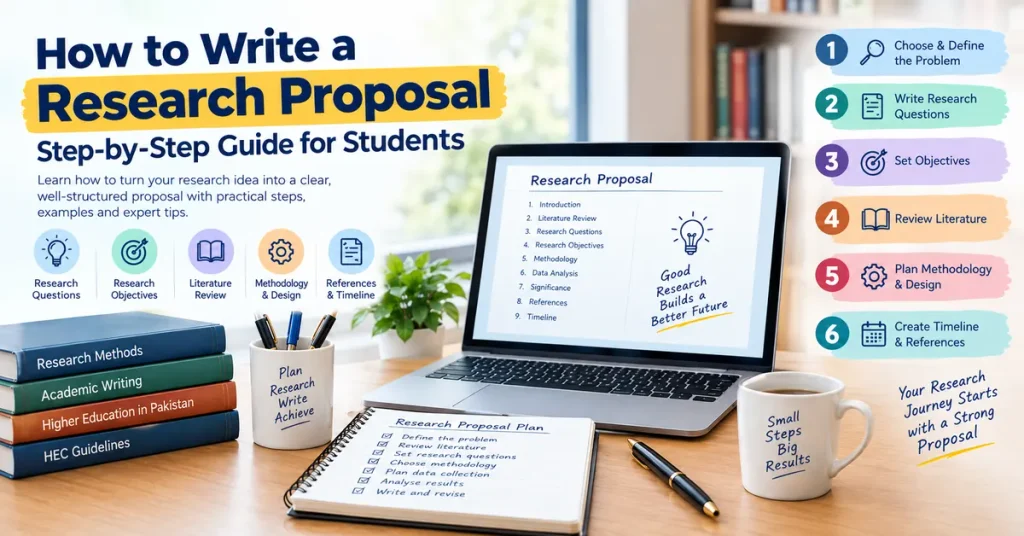
Are you unsure how to turn a research idea into a clear proposal? Are you struggling to connect your research problem, questions, objectives, literature review, and methodology? This guide explains research proposal writing step by step, with practical guidance for university students.
A research proposal is a plan for a study. It explains what you want to investigate, why the topic matters, and how you plan to conduct the research. However, the exact research proposal format can vary by university, department, degree level, discipline, and supervisor. Therefore, always check your department’s requirements before finalising your document.
For Pakistani students, this is especially important because the proposal format and approval process may differ between programmes and universities. Your supervisor or department may also require specific sections, formatting, or research methods.
What Is a Research Proposal?
A research proposal is a structured document that presents your planned research project. It gives the reader enough information to understand the research problem, its importance, the existing literature, and the proposed methodology.
In simple terms, a proposal should answer three core questions:
- What do you want to research?
- Why is the research important?
- How will you conduct the research?
University research guidance commonly uses these three questions as the foundation of a proposal. A strong proposal also needs to show that the proposed project is relevant, academically grounded, and feasible within the available time and resources. The University of Sheffield’s research proposal guidance explains these elements in detail.
Your proposal is therefore more than a description of your topic. It is an argument that your proposed study is worth conducting and that you have a realistic plan for carrying it out.
What Should a Research Proposal Include?
There is no single universal research proposal structure for every subject. Still, many proposals contain several common sections.
- Title
- Introduction and research background
- Research problem or problem statement
- Research gap and rationale
- Research questions
- Research aim and objectives
- Literature review
- Theoretical or conceptual framework, where relevant
- Research methodology
- Research design
- Study population and sampling
- Data collection methods
- Data analysis plan
- Research significance
- Scope and delimitations
- Research limitations
- Research ethics
- Research timeline
- References
Some proposals also require an abstract, hypothesis, budget, expected outcomes, or other discipline-specific sections. For example, Queen’s University Belfast explains that proposal requirements can vary by school or department. Its guidance also separates areas such as the title, abstract, aims and objectives, introduction, literature review, research questions, methods, and timetable. Read the Queen’s University Belfast research proposal guide.
Step 1: Start With a Focused Research Idea
Before writing paragraphs, decide exactly what you want to investigate. A broad subject is not automatically a research problem.
For example, social media marketing is a broad area. A more focused idea could examine how influencer credibility affects purchase intention among university students in Pakistan.
The second topic gives you several elements that can be studied:
- A defined phenomenon: influencer credibility
- An outcome: purchase intention
- A population: university students
- A context: Pakistan
This makes the proposed study easier to design.
At this stage, ask yourself:
- What exactly interests me?
- Who or what will I study?
- Where will the study take place?
- What problem am I trying to understand?
- Can I realistically collect the required evidence?
If you are still choosing between several research directions, first narrow your subject before attempting to write the full proposal.
Step 2: Develop the Research Problem
The research problem is the issue, uncertainty, inconsistency, or knowledge need that your study will investigate.
A weak research problem may simply state that a topic is interesting. A stronger problem explains what is not sufficiently understood or what needs further investigation.
For example:
Broad topic: Online learning in universities.
More focused problem: Although online learning is widely used in higher education, students may experience different levels of engagement depending on course design, interaction, and access to learning resources.
The final research problem should be supported by scholarly literature rather than personal assumptions.
Step 3: Write a Clear Problem Statement
A problem statement turns the research problem into a concise explanation of what needs to be investigated.
A useful problem statement usually establishes four things:
- What is currently known?
- What problem or uncertainty remains?
- Why does that problem matter?
- What does the proposed study intend to investigate?
For example, instead of writing:
“Social media is important for businesses, so this study will investigate social media.”
You could develop a more focused statement around a specific population, variable, relationship, or context.
The problem statement should lead naturally toward your research questions and objectives. If these sections feel disconnected, the problem statement probably needs more refinement.
Step 4: Identify the Research Gap
A research gap is an area where existing research does not fully answer a question, leaves an issue underexplored, or produces findings that require further investigation.
Do not claim that “no research exists” unless you have strong evidence for such a statement. In most academic subjects, there will be some existing literature.
Instead, look for gaps such as:
- A population that has received less attention
- A different geographical or institutional context
- Conflicting findings between previous studies
- A method that could provide additional evidence
- A relationship that needs further testing
- A theoretical perspective that has not been sufficiently explored
- A recent change that creates a new research question
Your literature review should help you establish this gap. The University of Sheffield notes that a proposal should demonstrate familiarity with existing research and explain how the proposed project fits into or contributes to that knowledge. See the university’s guidance on literature and research design.
Step 5: Write the Research Questions
Research questions define what your study will attempt to answer.
A good research question is focused, researchable, and connected to the problem you identified.
For example:
Research topic: Influencer marketing and purchase intention.
Possible research question: How does influencer credibility affect the purchase intention of university students in Pakistan?
You could then develop supporting questions if your research design requires them.
When writing research questions, avoid questions that are too broad. A question covering an entire country, industry, population, or social problem may be difficult to answer within a student research project.
Queen’s University Belfast specifically warns that research questions can become too expansive and recommends developing questions that are sufficiently focused to be carried out within the proposed research design. Review its guidance on research questions.
Step 6: Define the Research Aim and Objectives
The research aim describes the overall purpose of the study. Research objectives break that aim into specific steps.
For example:
Aim: To examine the relationship between influencer credibility and purchase intention among university students in Pakistan.
Objectives:
- To examine the relationship between influencer credibility and purchase intention.
- To identify the dimensions of influencer credibility relevant to the target population.
- To assess the effect of perceived influencer trustworthiness on purchase intention.
- To examine whether influencer expertise is associated with purchase intention.
Objectives should be specific and achievable. They should also connect directly with your research questions.
A useful test is simple: if an objective does not help answer a research question, ask whether it belongs in the proposal.
Step 7: Write the Research Proposal Introduction
The research proposal introduction gives the reader the context needed to understand your project.
A practical introduction can move from the broad research area toward the specific research problem.
For example, you can structure the discussion like this:
- Introduce the general subject.
- Explain the relevant context.
- Present the specific research problem.
- Identify the gap in existing knowledge.
- Explain why the issue matters.
- Introduce the research aim and questions.
Avoid filling the introduction with unrelated background information. Every paragraph should help the reader understand why your proposed study is necessary.
Sheffield describes the introduction as the initial pitch for the project and recommends explaining the topic, research questions, background, existing knowledge, missing knowledge, and potential contribution. Read the detailed introduction guidance.
Step 8: Conduct the Literature Review
The literature review demonstrates that you understand the existing research related to your proposed study.
It should not become a list of article summaries. Instead, organise the literature around ideas, themes, theories, methods, findings, or debates that are directly relevant to your research problem.
A useful literature review can:
- Define important concepts.
- Identify major theories.
- Compare findings from previous studies.
- Highlight methodological differences.
- Identify limitations in previous research.
- Show areas of agreement or disagreement.
- Establish the research gap.
- Explain how your proposed study fits into the literature.
For a proposal, you usually do not need to reproduce the complete literature review that will appear in your final thesis. Instead, focus on the literature that helps justify your proposed research.
Use credible scholarly sources and keep accurate records of every source you cite.
Step 9: Choose a Theoretical or Conceptual Framework
A theoretical framework uses an established theory or theories to guide the research. A conceptual framework can show how important concepts or variables are expected to relate to one another.
Whether you need one depends on your discipline and research design.
For example, a quantitative marketing study might examine relationships between influencer credibility, brand trust, and purchase intention. A conceptual framework could visually represent these relationships before the data is collected.
In contrast, some qualitative studies may use a theoretical perspective to guide interpretation rather than testing a fixed set of variables.
Do not add a framework simply because another student’s proposal contains one. Select a framework because it genuinely supports your research problem and questions.
Step 10: Write the Research Methodology
The research methodology explains how you plan to answer your research questions.
This is one of the most important parts of the proposal because your methods must fit your research questions.
Start by identifying your overall approach:
- Qualitative research
- Quantitative research
- Mixed-methods research
Then explain the research design and practical procedures.
Qualitative Research
Qualitative research can be appropriate when you want to explore experiences, meanings, perceptions, processes, or perspectives in depth.
Potential methods include interviews, focus groups, observations, document analysis, or other qualitative approaches, depending on the research question.
Quantitative Research
Quantitative research can be appropriate when the study involves measurable variables and numerical analysis.
Depending on the research problem, a quantitative study may use surveys, experiments, existing datasets, or other structured sources of numerical evidence.
Mixed-Methods Research
Mixed-methods research combines qualitative and quantitative approaches within one study. It can be useful when numerical evidence and detailed contextual information are both important to answering the research questions.
Do not select mixed methods simply because it sounds more advanced. The approach should be justified by the research problem.
Step 11: Explain Your Research Design
The research design is the practical structure of your study.
Depending on your discipline, it may involve descriptive, correlational, experimental, case study, survey-based, phenomenological, exploratory, or another design.
Your proposal should explain why the selected design is appropriate.
For example, if your question asks whether two measurable variables are related, a correlational design may be relevant. If your question focuses on how people experience a particular phenomenon, a qualitative design may be more suitable.
The method should follow the question, not the other way around.
Step 12: Define the Study Population and Sampling
If your study involves participants, clearly identify the study population.
For example, instead of saying:
“Students will be selected for the study.”
specify the relevant population more clearly, such as students enrolled in particular types of programmes or institutions, if that matches your research question.
You should then explain how participants will be selected.
Possible approaches include probability and non-probability sampling. The appropriate choice depends on your research design, population, access, research objectives, and methodological requirements.
Your proposal should also explain why the planned sample or source selection is feasible.
Step 13: Describe Data Collection Methods
Explain exactly how you plan to obtain the evidence required for your study.
Depending on the research design, this could involve:
- Questionnaires
- Semi-structured interviews
- Focus groups
- Observations
- Experiments
- Documents
- Published datasets
- Archival sources
- Systematic or structured literature searches
Do not simply list the method. Explain why it can answer your research questions and how you plan to use it.
Step 14: Explain Data Analysis
Your proposal should also explain how the collected evidence will be analysed.
For quantitative research, the analysis may involve descriptive statistics, tests of relationships, regression, or other statistical procedures appropriate to the research design.
For qualitative research, analysis may involve coding, categorisation, thematic analysis, or another suitable approach.
Mixed-methods projects require a clear explanation of how qualitative and quantitative findings will be analysed and, where relevant, brought together.
The important point is alignment. Your data analysis method should be capable of answering the research questions and should match the type of data you plan to collect.
Step 15: Explain Research Significance
The research significance section explains why the proposed study matters.
Potential significance can be academic, practical, professional, social, or policy-related, depending on the subject.
For example, a study may:
- Extend understanding of a theoretical issue.
- Provide evidence about an underexplored population.
- Help practitioners understand a specific problem.
- Provide evidence that may inform future research.
- Examine an issue within a Pakistani context.
Be careful not to promise results before conducting the research. Your proposal can explain the potential contribution without claiming that a particular result will definitely occur.
Step 16: Define the Scope and Limitations
The scope of study defines what your research will cover.
You can define the scope through factors such as:
- Population
- Location
- Time period
- Variables or concepts
- Industry or institution
- Research method
- Type of data
Limitations are factors that may affect the study but cannot be fully controlled by the researcher.
For example, access to participants, limited time, available data, or the characteristics of a selected sample may create limitations.
A limitation does not automatically make a study weak. The important point is to recognise relevant limitations and explain how you will manage them where possible.
Step 17: Address Research Ethics
If your research involves people, personal information, sensitive topics, organisations, or other ethical concerns, explain how these issues will be handled.
Depending on the study, ethical considerations may include:
- Informed consent
- Participant confidentiality
- Privacy
- Secure handling of data
- Voluntary participation
- Potential risks to participants
- Responsible reporting of findings
Follow the ethical requirements of your university, department, research setting, and relevant approval process.
Step 18: Prepare a Research Timeline
A research timeline shows how you plan to complete the project.
A simple timeline may include:
| Research Stage | Planned Activity |
|---|---|
| Topic development | Refine the research problem and questions |
| Literature review | Identify and analyse relevant scholarly sources |
| Methodology | Finalise research design, sampling and instruments |
| Data collection | Collect the required research evidence |
| Data analysis | Analyse and interpret the collected data |
| Writing | Develop the research chapters and final document |
| Revision | Review the work and respond to supervisor feedback |
Your actual schedule should reflect your degree requirements and the practical time available to you.
Step 19: Add Accurate References
Every academic source used in your proposal should be cited correctly. Your reference list should follow the referencing style required by your department.
Depending on your field, this may include APA, Harvard, Vancouver, Chicago, MLA, or another style.
Do not mix styles randomly. Also, check every citation against the final reference list before submitting the proposal.
How Research Questions, Objectives and Methodology Connect
One of the most common problems in research proposal writing is poor alignment between sections.
Think of your proposal as a chain:
Research Problem → Research Questions → Objectives → Methodology → Data Collection → Data Analysis → Contribution
For example, if your research question asks how university students experience online learning, a qualitative approach may be appropriate if you want detailed accounts of their experiences.
If your question instead asks whether a measurable relationship exists between online learning engagement and academic performance, a quantitative design may be more appropriate.
Therefore, do not choose your research methodology first and then force your research question to fit it. Start with the research problem and question.
Research Proposal Format for Different Degree Levels
Undergraduate Research Proposals
An undergraduate proposal generally needs a clearly focused research problem, relevant literature, research questions or objectives, and a feasible methodology.
Keep the project manageable. A smaller and clearly defined study is often easier to execute than a very broad project.
MS/MPhil Research Proposals
For MS or MPhil research, students normally need to demonstrate stronger engagement with scholarly literature, research methodology, and the specific research gap.
The proposal should show that the proposed study is sufficiently focused and feasible for the programme.
PhD Research Proposals
A PhD proposal generally requires a more developed research problem, stronger engagement with the existing literature, a clear methodological plan, and a convincing explanation of the proposed contribution.
However, exact requirements vary between universities and disciplines. For example, university-level doctoral guidance can specify different proposal lengths and components. The University of Sheffield’s PhD proposal guidance illustrates why applicants should check the requirements of their specific school or programme.
Research Proposal Example: A Simple Model
Suppose your proposed study is about social media and purchasing behaviour among university students.
A simplified proposal could follow this logic:
Topic: Influencer marketing and purchase intention.
Problem: The relationship between influencer characteristics and students’ purchase decisions requires examination within the selected research context.
Research Question: How does influencer credibility affect purchase intention among university students?
Aim: To examine the relationship between influencer credibility and purchase intention.
Methodology: A quantitative design using a structured questionnaire with an appropriately selected student population.
Data Analysis: Statistical analysis appropriate to the research questions and collected data.
Significance: The study may provide evidence about influencer marketing within the selected population and contribute to understanding the relationship between credibility and purchase intention.
This is only a simplified example. Your actual proposal should be supported by relevant scholarly literature and a methodology appropriate to your specific research question.
Common Research Proposal Writing Mistakes
1. Choosing a Topic That Is Too Broad
A topic covering an entire country, industry, population, or social problem may be difficult to complete.
Fix: Narrow the study by population, location, variables, period, theory, setting, or research method.
2. Writing a Weak Research Problem
A general statement about why a topic is interesting is not enough.
Fix: Use scholarly literature to identify a specific problem, uncertainty, gap, or unresolved issue.
3. Making Research Questions Too Large
A question can sound impressive but still be impossible to answer within the available time.
Fix: Ask whether you can realistically collect and analyse the evidence required.
4. Listing Methods Without Justification
Simply writing “the study will use a questionnaire” does not explain why that method fits the research question.
Fix: Explain the relationship between the question, research design, data source, collection method, and analysis.
5. Treating the Literature Review as a Source List
A literature review should not become one paragraph per article.
Fix: Compare studies, identify themes, discuss differences, evaluate approaches, and connect the literature to your research gap.
6. Promising Results Before Conducting the Study
Your proposal describes what you intend to investigate. It does not prove what your final findings will be.
Fix: Discuss expected contribution carefully without presenting an untested result as a fact.
7. Ignoring University Requirements
A generic research proposal format may not match your department’s requirements.
Fix: Check your university guidelines and confirm any uncertain requirements with your supervisor.
How to Make Your Research Proposal More Coherent
After writing the first draft, read the proposal from beginning to end and check the logic.
Start with your research problem. Then ask:
- Does the research gap logically follow from the literature?
- Do the research questions address the problem?
- Do the objectives answer the questions?
- Does the methodology allow those questions to be answered?
- Can the proposed data actually be collected?
- Does the planned analysis match the data?
- Does the significance section explain why the study matters?
- Can the entire project be completed within the available timeframe?
If the answer to one of these questions is no, revise the relevant section before submitting the proposal.
Final Research Proposal Checklist
Before submitting your proposal, use this checklist:
- ☐ The title clearly represents the proposed study.
- ☐ The research problem is specific and supported by literature.
- ☐ The research gap is clearly explained.
- ☐ The rationale explains why the research matters.
- ☐ The research questions are focused and researchable.
- ☐ The objectives directly relate to the research questions.
- ☐ The literature review uses relevant scholarly sources.
- ☐ The theoretical or conceptual framework is appropriate, where required.
- ☐ The methodology matches the research questions.
- ☐ The research design is clearly explained.
- ☐ The population and sampling approach are appropriate.
- ☐ Data collection methods are clearly described.
- ☐ The data analysis plan matches the proposed data.
- ☐ Ethical considerations have been addressed.
- ☐ The scope and limitations are realistic.
- ☐ The research timeline is feasible.
- ☐ All cited sources appear in the reference list.
- ☐ The required referencing style has been followed.
- ☐ The proposal follows your department’s required format.
- ☐ The document has been proofread for clarity, grammar, and consistency.
Frequently Asked Questions About Research Proposal Writing
How long should a research proposal be?
There is no single correct length. Requirements differ by university, department, degree level, and purpose. Some university guides give specific word ranges, while larger doctoral or funding proposals may require more detail. Always follow the requirements provided by your department or supervisor.
What is the difference between a research proposal and a research plan?
A research plan can primarily help the researcher organise the project. A research proposal is also written for an academic reader, such as a supervisor, department, admission committee, or funding body. Therefore, it must explain why the proposed study is worthwhile and how it can realistically be conducted.
Can I change my research proposal later?
A research proposal is normally a plan rather than a guarantee that every research decision will remain unchanged. Your topic, questions, methods, or scope may require refinement after discussion with your supervisor or further literature review. However, follow your programme’s approval requirements before making major changes.
Should I include a hypothesis in my research proposal?
Include a hypothesis when it is appropriate to your research design and discipline. Not every study requires one. Exploratory and some qualitative studies may instead use research questions or other guiding concepts.
Should Pakistani students use a specific research proposal format?
There is not one universal format that applies to every Pakistani university or discipline. Your department, degree programme, supervisor, or research office may provide specific requirements. Use those requirements as the primary guide for your final document.
Need Academic Support With Your Research Proposal?
Writing a proposal becomes easier when the research problem, questions, objectives, literature, and methodology are properly aligned. If you need support with research structure, academic writing, methodology planning, or proposal development, you can submit your requirements for academic support after confirming your university’s instructions and research scope.
You can also explore PhD thesis research support if your proposal is part of a doctoral research project. For general questions about available academic support, contact the TWS team.
Key Takeaway
A strong research proposal connects a clear research problem with focused research questions, realistic objectives, relevant literature, and a suitable methodology. It should also demonstrate significance, feasibility, ethical awareness, and a practical plan for completing the study.
Most importantly, do not treat the proposal as a formality. Use it to test whether your research idea is focused enough, whether the evidence is accessible, and whether your proposed method can genuinely answer your research questions. Before submission, compare your document with your department’s current requirements and discuss any uncertain points with your supervisor.