
Thesis Acknowledgement and Dedication: Format, Wording and Samples
Your supervisor has approved the final draft, and the department checklist now asks for an acknowledgement page. Who comes first, the supervisor or the funder? Does the dedication need a heading? Should either page carry a number?
A thesis acknowledgement thanks the people and bodies who helped the research, starting with the supervisor and moving towards personal support. A dedication is a short personal tribute, often a single line. Your university’s thesis manual decides the heading, the numbering and the position of both pages, so read it before you format anything.
Acknowledgement or dedication: what each page does
The two pages sit side by side but do different jobs. The acknowledgement expresses professional gratitude to the supervisor, the committee, the funder, the participants and anyone else who made the work possible. The dedication is personal. It offers the whole thesis to someone, usually without explanation.
Many manuals treat both pages as optional. The UNC Chapel Hill thesis guide, for example, lists the dedication, acknowledgements and a preface as optional extras, and defines the preface as a statement of why you took on the work. Even so, a supervisor who gave months of feedback deserves a thank-you, whatever the manual says. Both pages belong to the front matter that comes before Chapter 1, and the thesis structure guide shows where the rest of that sequence sits.
Acknowledgement format for a thesis: order, spacing and page numbers
No single national format exists for these pages, and the Pakistani manuals do not even agree with each other. Here is how three manuals treat the same two pages.
| Point | NUST MS thesis template (version MS1.0, January 2024) | UAF postgraduate formatting manual (undated) | UNC Chapel Hill (a US example) |
|---|---|---|---|
| Order of the two pages | Dedication first, then acknowledgements, both before the contents | Acknowledgement first, then dedication, after the declaration and before the contents | After the abstract and before the contents; each page is optional |
| Dedication heading and layout | No heading; short text centred on the page, single-spaced | Not stated in the manual | No heading; short text centred, starting two inches from the top |
| Acknowledgement heading and spacing | Heading ACKNOWLEDGEMENTS; double-spaced; complete sentences | Not stated in the manual | Heading in capitals, centred two inches down; double-spaced |
| Page numbers | Dedication is counted but not numbered; acknowledgements carry a roman numeral and appear in the contents | No page number on either page | Both numbered with consecutive lower-case roman numerals |
Position correct as of October 2026. Manuals change, so check your department’s latest copy. The NUST file is the National University of Sciences and Technology’s Word template as hosted on Overleaf, not a document on NUST’s own website.
Two points follow from the comparison. First, the order of the pages differs, so do not copy it from a friend’s thesis at another university. Second, the numbering rules differ as well: NUST counts the dedication without printing its number, whereas the University of Agriculture Faisalabad prints no number on either page. The UAF thesis format explained covers the rest of that manual, and official thesis formats of Pakistani universities compares several more.
Whom to thank in a thesis acknowledgement, and in what order
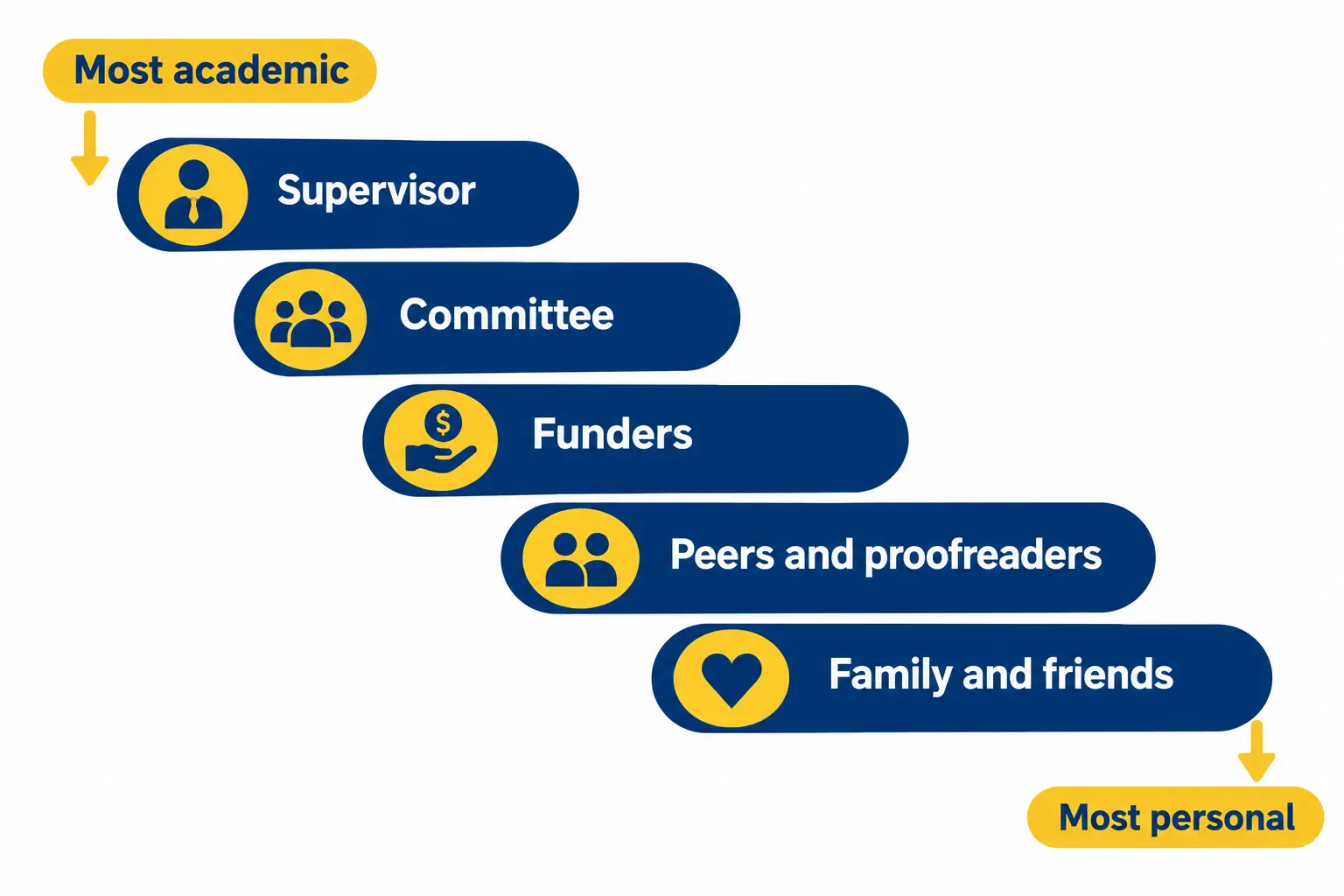
Move from academic support to personal support. That ladder, from the most formal contribution to the least, is the sequence Grad Coach’s acknowledgements guide recommends, and it is the safest default unless your university sets its own order.
Supervisor, co-supervisor and committee
The supervisor comes first, even when the relationship was difficult. Scribbr’s advice on thesis acknowledgements is to give a brief thank-you instead of a skipped name, because leaving the supervisor out can read as a snub. Use the full name, designation and department. Ask your supervisor how the designation should be written, since titles change.
Co-supervisors follow, then the members of the supervisory or examination committee. Say what each person actually did, such as sharpening the research question, reviewing the synopsis or advising on the analysis.
Funders, institutions and data providers
If a scholarship, grant or fellowship supported the work, name the body and say what it funded. The same applies to a hospital, school, company or office that gave you access to participants or records. Check that the organisation is happy to be named, especially when your ethics approval promised confidentiality. If several staff members at one organisation helped, thank the organisation instead of listing everyone.
Participants, peers and proofreaders
Thank participants as a group and protect their identity. A phrase such as “the teachers who took part in the interviews” works better than a list of names. Next come fellow scholars who discussed your ideas, and anyone who edited or proofread the draft. Scribbr’s example order places editors and proofreaders after funders and other academics.
Where help with language or formatting was involved, check your university’s rules on what must be declared. If the rules allow it, name the person.
Family and friends
Family and friends come last. Name only the people who truly supported you, and add a few words on how. A long roll call dilutes the thanks, so keep the list short.
How to write the acknowledgement page, step by step
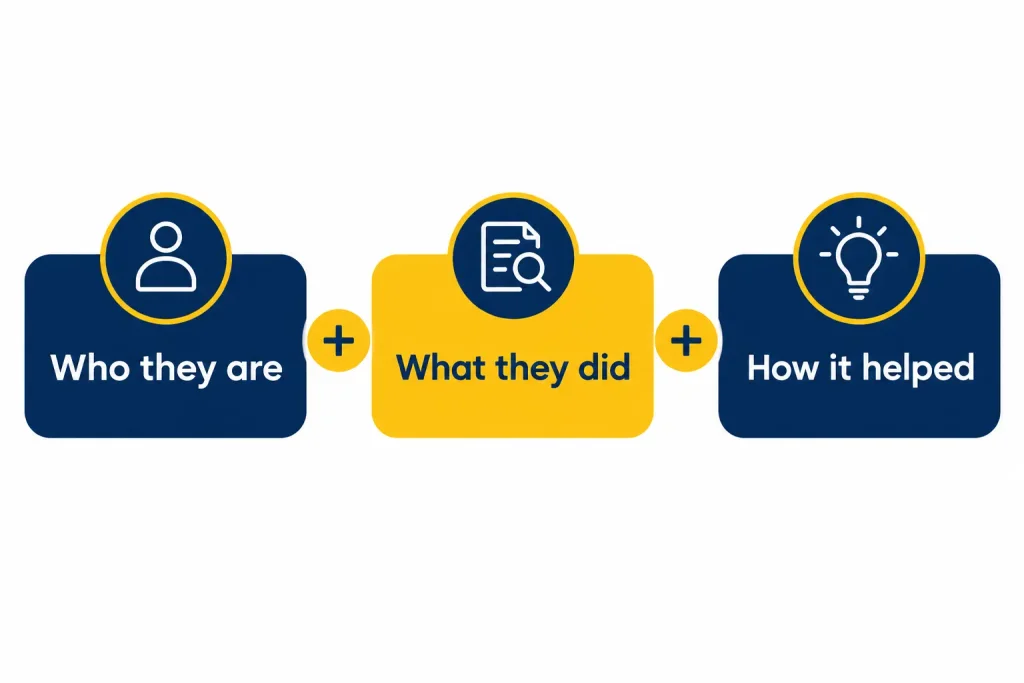
Write one specific sentence per person: who they are, what they did and how it changed your work. That single pattern keeps the page short and sincere.
- List everyone who helped, however small the contribution, then cross out those who played only a passing role.
- Sort the list from academic support to personal support.
- Draft one sentence per person or group, naming the help they gave.
- Trim the draft until it fits on one page. One to three paragraphs usually does it.
- Ask your supervisor to check names, designations and spellings before printing.
Tone, voice and length
Use first person and plain language. Slang and nicknames do not belong here, and neither does heavy jargon. Write complete sentences rather than casual shorthand, a point the NUST template makes in its own notes. As a result, the page reads as formal but warm.
Useful openers include “I am grateful to…”, “My thanks also go to…” and “I owe particular thanks to…”. You do not need a closing summary. Simply end the page with your last thank-you.
Acknowledgement samples for BS, MS/MPhil and PhD theses
Replace every bracket with real details, then rewrite each sentence in your own voice. A paragraph copied from a sample cannot thank anyone in particular. These samples are for learning, and your thanks should name your own people.
Sample for a BS final-year thesis
I am grateful to my supervisor, [Dr. Name], [Designation], Department of [Name], for guiding this project from the first proposal to the final draft. [His/Her] patient feedback shaped every chapter. I also thank my co-supervisor, [Name], for helping me with the data analysis.
My classmates in [Batch/Department] listened to my presentations and pointed out my mistakes, and I appreciate their time. Finally, I thank my parents, whose encouragement kept me going through the last semester.
Sample for an MS or MPhil thesis with participants
First, I thank my supervisor, [Dr. Name], [Designation], [Department], [University]. [His/Her] detailed comments on every chapter sharpened both my research question and my argument. I am also grateful to my supervisory committee, [Dr. Name] and [Dr. Name], for their guidance during the synopsis defence.
My sincere thanks go to the [teachers/nurses/managers] in [city or district] who gave their time to take part in this study. Their openness made the findings possible. I also thank [Name] for proofreading the final draft, and my fellow scholars in the [Department] cohort for their advice. Last, I thank my family for their patience.
Sample for a PhD thesis with funding and fieldwork
I begin by thanking my supervisor, [Prof./Dr. Name], who guided this research through coursework, synopsis approval, fieldwork and writing. I am equally grateful to my co-supervisor, [Dr. Name], for advice on the statistical analysis.
This research was supported by [scholarship, grant or fellowship name]. I thank [funding body] for the financial support that made my fieldwork possible. I also thank [organisation] for granting access to [data or site], and the participants who shared their experiences.
Finally, I thank my colleagues in [Department], who read drafts and challenged my arguments, and my family, whose sacrifice carried me through these years.
Dedication format for a thesis: heading, length and wording
What a dedication offers
A dedication gives the whole work to a person or group as a tribute. It stays short, it does not thank anyone for specific help, and it does not mention the research. Most are a single line beginning with “To…”, a pattern the UNC guide describes. Specific help belongs in the acknowledgement instead.
Heading, placement and length
The NUST template prints no heading, centres the text on the page and keeps it brief. UNC also leaves out the heading and centres short dedications two inches from the top. The UAF manual gives no layout rule for the dedication, only that the page carries no number.
If your manual is silent, a safe default is centred text with no heading, one to three lines and the same font as the body.
Dedication wording samples
Keep the wording respectful, because examiners read this page too. These lines show the range of tone, from formal to warm.
- To my parents, who gave me every chance to learn.
- For my mother, whose prayers walked beside me.
- In memory of my grandfather, who taught me to love books.
- To my teachers, who taught me to ask better questions.
- To my wife, for her patience through every late night.
Mistakes to fix before you submit
- Supervisor missing or last. Put the supervisor first, however limited the help felt.
- Slang, jokes or nicknames. Keep the tone formal with a personal touch.
- More than one page. Cut anyone whose contribution was only peripheral.
- Wrong names or designations. Confirm spellings and titles with each person.
- Hidden contributions. If someone collected data or ran part of the analysis, say what they did, and follow your university’s rules on declared help.
- Another university’s layout. Heading, order and numbering follow your own manual, not a template from the internet.
- Copied sample paragraphs. Generic thanks read as generic.
Quick answers
Can I thank Allah or God in my acknowledgement?
Yes. A short opening line of gratitude is acceptable, as long as you also thank the academic helpers, colleagues, family and friends who supported the work. Scribbr gives the same guidance in its FAQ on thanking God in a thesis. If your department has a convention, follow it.
What if my supervisor gave very little help?
Thank them briefly and factually, for example for approving the topic and the final draft. Leaving them out is riskier than a short, honest sentence.
Can I thank a proofreader or editor?
Yes. Name them where your university allows editorial help, and check its rules on what help must be declared.
Final check before the front pages go to print
Confirm each name and designation with the person concerned, and make sure your supervisor has read both pages. Then compare the layout with your department’s manual and the numbering with the contents. The margins, fonts and page order guide helps with the rest of the front matter.
For several years, students have come to us with a stalled chapter, a supervisor’s red pen and a deadline that will not move. If you would like a second reader on formatting, editing or proofreading, you can share your requirements through the order form. You can also read student reviews before you decide.