
Social Psychology Research Topics: Trust, Prejudice and Helping in Pakistan
Before I commit to a social psychology topic, I need answers to a few questions.
- Who is the outgroup in my question, and can I reach both groups without putting anyone at risk?
- Will people answer honestly about caste, sect or refugees, or do I need a vignette or forced-choice design?
- Could a public survey such as the World Values Survey answer my question without any fieldwork?
- Does my attitude scale exist in Urdu, or will adapting it become part of my thesis?
- Do I want to describe an attitude, or test whether a message, a contact or a rule changes it?
Social psychology asks how other people shape what we think, trust and do. The label covers a lot of ground, so these social psychology research topics stay with group attitudes, trust, belief, helping and marriage choice. Mental health questions sit in clinical psychology topics, and classroom questions in educational psychology questions. The wider field is in broader psychology thesis topics.
Students in this area can also use IO psychology research topics, which covers workplace behaviour and organisations. Another focused list is forensic psychology research topics, which covers courts, evidence and criminal justice.
Pick the way you will measure an attitude first
In social psychology, the measure often decides whether a topic works. People tend to give polite answers on sensitive subjects, so the design matters as much as the question.
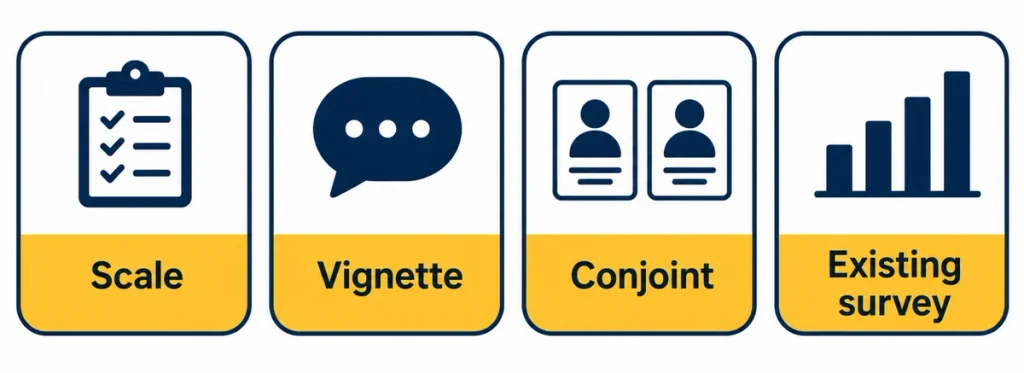
- Attitude scale: quick and familiar, but the purpose is obvious, so answers can drift towards what sounds acceptable.
- Vignette: a short scenario in which you change one detail, for example how long a refugee family has lived in Pakistan.
- Conjoint task: participants choose between two profiles that vary on several traits at once, which makes the purpose less obvious.
- Secondary data: an existing survey, so you analyse instead of collecting, and you avoid recruiting sensitive groups.
Whichever you choose, settle the choice early. Our guide to choosing a research methodology helps you match the design to your supervisor’s expertise and your access.
Who counts as “us”? Prejudice and intergroup attitudes
These four topics study how groups see each other. All of them involve sensitive identities, so read the ethics section further down before you start.
1. Do Pashtun hosts who are a local minority welcome Afghan refugees more than Pashtuns in Khyber Pakhtunkhwa?
A working paper by Malik, Siddiqui and Zhou surveyed 3,500 people in the 15 largest refugee-hosting districts in summer 2024. Pashtuns living in Khyber Pakhtunkhwa were less inclusive than Pashtuns elsewhere. For example, 77.7% of the first group would not accept a refugee as a family member, against 50.9% of the second. The authors call their explanations suggestive, so a student can test one of them on a smaller scale.
Run a vignette or conjoint survey of Pashtun and non-Pashtun students in one city. Vary the refugee’s ethnicity and years in Pakistan, then ask about acceptance as a neighbour, a friend or a family member. Pilot the instructions first, because about 20% of respondents skipped the conjoint task in the original survey. Since the source is a working paper, check whether a peer-reviewed version exists before you cite it. This suits an MS or MPhil thesis.
2. Which settings of Muslim-Christian contact are linked to a sense of safety in Lahore?
A 2023 mixed-methods study in Lahore reported mostly positive daily interaction, shared celebrations and mutual support. It also found prejudice and discrimination. The abstract gives no sample size or figures, so read the full paper before you build on it.
Contact is not one thing, so a narrower study could compare the neighbourhood, the workplace and the school. Then link each setting to perceived safety. A few interviews with Christian residents of one locality suit an MPhil better than a large survey. However, protect identities: do not name the locality, and take ethics advice before asking about specific incidents.
3. Family, peers and sectarian rigidity among university students
A 2020 survey of 250 students at two Lahore universities, one public and one private, found that socialization patterns predicted sectarian rigidity. The abstract treats socialization as one predictor. As a result, it leaves open whether family or peers matter more.
Measure family and peer influence separately. Then test whether friendships with students from another sect weaken the link. Check how the original sample was drawn and which rigidity measure it used before you copy either. Finally, offer a “prefer not to say” option on any question about sect. This works at MS or MPhil level.
4. Attitudes toward transgender people among nursing or B.Ed students
An Aga Khan University study of 249 medical students in Karachi, with a 76.6% response rate, found that 49.4% held good attitudes and 45.0% fair ones. Attitudes rose with knowledge (r = 0.323). However, the authors designed the questionnaire themselves, so it is not an established scale.
Repeat the question with another group of future professionals, such as nursing or B.Ed students, using a published attitude scale with Urdu wording that you pilot. Add contact, meaning whether a student knows a transgender person, next to knowledge, because the two may overlap. Terms such as khwaja sira and transgender may not mean the same thing to every respondent, so test the wording. Transgender people are the subject of the attitudes here, not the participants. This suits BS or MS.
Who do we trust? Trust and identity
These two topics suit students who prefer data analysis to fieldwork.
5. How far does trust travel? Family trust against trust in other nationalities
The World Values Survey Wave 7 record for Pakistan, collected in 2018, shows that 77.6% of 1,988 valid cases trust their family completely. On trust in people of another nationality, 48.6% of 1,881 valid cases trust them not at all, and 6.9% trust them completely. The catalogue stresses that these are counts in the data file, not population estimates, so weights matter.
A secondary analysis can measure the gap between family trust and outgroup trust. Then ask whether education, age or province narrows it. Ordinal regression suits four-point items. Read the survey’s data terms and citation rules before you download, and confirm that your department accepts secondary analysis. This fits MS or PhD work in SPSS, R or Stata.
6. Which identity comes first, and does the situation change it?
A PIDE-BASICS note on identity reports that religion appears in 57.4% of multi-layered identities nationally, and being Pakistani in 32.4%. Caste (29.4%) was reported as more important than ethnicity. Multi-layered identity ranged from 76% in Gilgit-Baltistan to 44.5% in Azad Jammu and Kashmir. The next question is what decides which layer sits on top.
Use short situational vignettes, such as a cricket match, a family wedding and a university admission form, and ask students to rank identity labels each time. Then compare students from different provinces if your sample allows it. Because subtle priming effects are small, use clear scenarios instead of hidden primes, and report effect sizes. This suits MS or MPhil.
What do we believe because others do? Misinformation and social influence
Belief spreads through trusted people, so these topics look at who is believed and why.
7. Safety fears versus “they want to harm us”: two kinds of vaccine conspiracy belief
In a national online survey of 2,158 respondents in January 2021, 28.4% believed the COVID-19 vaccine could harm health because it was developed quickly. Meanwhile 16.4% saw it as non-Muslim propaganda and 13.1% as designed to harm Muslims. Each belief was linked to acceptance. However, 91.9% of respondents were aged 18 to 30 and recruited by convenience sampling, so the authors caution against generalising.
Separate beliefs about safety from beliefs about hostile outgroups. Then test which one predicts acceptance once trust in doctors and government is in the model. Reach older adults offline if you can, with institutional approval. Beliefs may have changed since 2021, so measure them fresh. For the medical side of vaccine questions, see medical research topics. This suits MS.
8. Remove, correct or ignore? How users react when a false post is moderated
In a 2020 experiment on the Baang platform, 3,698 users were randomly assigned to different moderation conditions. Full control of misinformation cut daily listening time by about 41%, which the authors read as distaste for moderation. The users were mostly young men with modest education. Platform behaviour, however, is not the same as attitudes.
A student version can use vignettes of a family WhatsApp group in which a false post is deleted, corrected or left alone. Then measure trust in the group admin and the intention to stay. Randomise the vignette, keep the wording identical except for the action, and pilot it. A BS project can manage two conditions, and an MS project three.
9. Does a short misinformation explainer change what people can spot?
A registered trial at LUMS, run in Lahore between May and December 2019, tested a video explaining common features of misinformation, with and without personal feedback on a user’s own past engagement. It used 150 grids of about five households each and was powered to detect a 0.30 standardised effect. The registry says public data are not available, so you must collect your own.
Adapt the design to one community or one class: a pre-test, the explainer, then a post-test where people classify true and false items. Use politically neutral items, because strong feelings can distort the result. If your group is large enough, compare video only with video plus feedback. Otherwise, compare one explainer with a control. A power calculation tells you which is realistic. This fits MS.
10. Who persuades a household? Trusted advisers in vaccine decisions
A 2021 to 2022 ethnographic study by RADS interviewed 153 parents and caregivers in all four provinces, plus 17 polio policymakers. Refusals were often tied to an adverse event in the family or the view of someone the household trusts. Men made most decisions, while women sometimes acted covertly. The authors suggest that myths may be justifications offered after the decision.
A small qualitative study could map the trusted advisers in one union council and how each opinion reaches the household. Interview fathers and mothers separately, because they may speak differently in front of each other. Access and ethics are the real hurdles, so get health department permission, and do not recruit from refusal lists without approval. This suits an MPhil or PhD with a supervisor who has done fieldwork.
Why do people help? Giving and volunteering
Both topics start from one national giving study, so read it in full before you choose.
11. Why do students donate money but rarely give time?
Dawn’s report on the Pakistan Centre for Philanthropy’s giving study says 73% of Pakistanis donated money in 2024, but only 16% volunteered, averaging 3.5 hours per person against 8.9 hours worldwide. People named religious obligation (58%), care about a cause (54%) and a sense of duty (49%) as reasons for giving. The coverage gives two different figures for people who did not give, so read the original report before you use either.
Compare motives for giving money with motives for giving time among students. Use a motive inventory, such as the Volunteer Functions Inventory, if a usable Urdu version exists. Add barrier items such as time, family permission and transport, but treat them as questions, not assumptions. Ask about acts in the last month, because “usually” inflates answers. This suits BS or MS. Figures as reported in January 2026.
12. Does a spending breakdown change what people give to a charity?
The same report found 51% preferred giving directly to a person or family in need and 47% preferred charities. About 29% said they would give more if they knew how their money was spent. That raises a testable question: does transparency move people who prefer direct giving?
Show participants a charity appeal with or without a short spending breakdown. Then record the intended donation and trust in the charity. Hypothetical donations overstate real ones, so add a small real-choice task if your supervisor approves. Keep religious giving such as zakat separate, because its rules differ from voluntary giving. This suits MS.
Who do we choose? Caste, sect and marriage
13. What do people choose when caste competes with education and income?
A 2020 online survey of 456 adults in Karachi found that 42.2% wanted a spouse from the same sect, denomination or caste. Also, 52% said norms and culture influenced their choices to some extent. A 2025 study from the University of the Punjab found casteism correlated with marriage prospects (r = .353). The online text does not show its sample size, so check the full paper.
Stated preference and real choice can differ. A conjoint task asks participants to choose between two spouse profiles that vary caste, education, job and family background. As a result, you see the trade-offs without asking about caste directly. Use unmarried students and fictional profiles, never real families. Pilot the task, because about 20% skipped a similar task in a survey on Afghan refugees in Pakistan. This suits MS.
A review instead of fieldwork
Some programmes accept a review as the thesis. Confirm this with your supervisor first.
14. Which scales have been used to study attitudes toward minorities in Pakistan?
The Aga Khan University study used a questionnaire its authors designed, so measures differ across studies. A scoping review could map which scales researchers have used on religious, sectarian, ethnic and gender-identity attitudes in Pakistan, and whether any has Urdu validation. Count the eligible studies before you commit, since a thin literature makes a weak review. Our guide to writing a literature review covers the search and screening steps. The review also works as groundwork for a later primary study.
Match the topic to your level
BS students can shrink topics 4, 8 and 11 to one department and one measure. MS and MPhil students can take most of the others, especially 1, 5, 6, 9, 12 and 13. See what examiners expect in the MPhil thesis expectations guide. PhD candidates should combine two ideas, for example topics 1 and 5 across several sites, and will need a stronger theoretical framework. PhD-level support is available for that stage.
Ethics when your participants belong to sensitive groups
Religion, sect, ethnicity, caste and gender identity can put people at risk if their answers leak. So collect the minimum identifying information, store data securely and report results only for groups large enough to stay anonymous. Make every question about identity optional. Next, plan what you will do if a participant becomes upset. Studies with refugees, minors or patients need approval and permission from the institution first.
From shortlist to proposal in four steps
First, read the source paper in full and list what it did not measure. Then pick one population and one outcome. Next, choose your measure and check whether an Urdu version exists. Finally, run a power calculation to fix your sample size, and write your ethics plan. Once these four are clear, you can turn the shortlist into a proposal with our guide to writing a research proposal. Past theses in the HEC repository show whether your question has already been answered locally.
Questions students ask before choosing
Can I use World Values Survey data for a thesis?
Often yes, as secondary analysis. However, you need to confirm two things: that your department accepts a thesis without new data collection, and that the survey’s own terms allow your use. Check both before you commit.
How many participants does a vignette experiment need?
It depends on the effect you expect. The LUMS trial was powered to detect a 0.30 standardised effect with about 750 observations. Your own power calculation should decide, so run one before you recruit.
Is it safe to ask about sect, caste or refugees?
It can be, if you make questions optional, keep answers anonymous and get ethics approval. Indirect designs such as vignettes and conjoint tasks also reduce pressure to give polite answers.
Take your shortlist to your supervisor
Pick two or three topics, test each against the steps above and show them to your supervisor. After that, you can send your topic, level and deadline through the order form to get help with the proposal, the measures or the analysis plan. Support is available 24/7, every day of the year, on WhatsApp, email and live chat. It is meant for reference and learning, so use it according to your institution’s policy. If you want to see how other students found the support first, you can read what students have said. Browse all subject areas if social psychology is not the right fit.