
Education Thesis Topics for B.Ed and Master’s Students in Pakistan: Questions You Can Test With Public Education Data

Five questions to settle before you choose
An education student usually has to answer a few practical questions before a title reaches the supervisor.
- Does my programme ask for a full thesis, or only a short capstone project?
- Can I study a school policy from documents, without entering a classroom?
- Which official figures can I use for one district, and do they agree with each other?
- Who must give written permission before I survey teachers or read observation forms?
- Is the policy still changing while I write?
The twelve topics below start from a court ruling, a licensing test, a curriculum draft or a published dataset. Each one can be cut down to one province, district or institution, so no topic needs a national sample. Policy, teacher education, curriculum and access are the focus here, because those areas rest on public documents. Learning, motivation and classroom behaviour sit under educational psychology research topics, while teaching in medical colleges has its own medical education guide. Students who want a wider spread across disciplines can start from social sciences thesis topics.
Where an education thesis comes from
The word thesis means different things at each level. A B.Ed student usually writes one short study, whereas an MS student writes a longer one. The table below uses published scheme documents, so each row can be checked. However, every university sets its own rules, so confirm yours with the department. Position correct as of November 2026.
The four routes at a glance
| Route | What the document says | What it means for your topic |
|---|---|---|
| Four-year B.Ed | In the UMT scheme of studies, the capstone project or thesis carries 3 credit hours in semester 8. It follows a 3-credit research methods course in semester 6, which is also its prerequisite. | Therefore choose a small study with one site or one set of documents. Topics 6 to 8 fit this size. |
| BS Education | The University of the Punjab research project outline gives 3 credit hours over 16 weeks, in ten stages from choosing a project to writing the final thesis. | Because sixteen weeks leaves no room for a second research question, keep to one. Topics 8 and 12, cut to one union council, can work. |
| MS or MPhil Education | The HEC Graduate Education Policy 2023 allows 30 credit hours of coursework, or 24 hours plus a thesis of at least 6. The HEC revised teacher roadmap adds at least 18 credit hours of deficiency courses for graduates of non-education degrees. | There is also room for document analysis and secondary data. Most topics below fit, and the MPhil thesis guide explains the stages. |
| PhD Education | The same policy asks for 18 credit hours of coursework, a comprehensive exam and a synopsis defence within the first six semesters. In social sciences, the student also needs one paper in an X-category journal or two in Y, as first author. | So treat a topic here as a chapter seed, not a whole thesis. The PhD thesis format and length guide covers the rest. |
Twelve narrow education thesis topics
Topics are numbered across all four groups. Each one names its level, so B.Ed and BS students can find the lighter options quickly.
Group 1: Who runs the school, Punjab’s outsourcing programme
First, Punjab is moving government schools to private operators through the Punjab Education Foundation. The scale is large, but the numbers differ between sources. The government’s own count, reported by Dawn, was 13,219 low-performing schools in three phases. In contrast, a 2026 opinion piece speaks of about 18,000 primary schools already outsourced. So define the count and the date in your own study.
1. How the Lahore High Court separated policy from legality
Level: MS, MPhil, or a PhD chapter.
First, parents challenged outsourcing as a breach of the free education guarantee in Article 25-A. In a judgment reported on 1 December 2024, Justice Asim Hafeez dismissed the petitions. According to the report, the court treated the choices as political judgment, found no document showing a fee rise, and noted that the licensing terms barred fee increases.
Sample question: Which paragraphs of the judgment treat outsourcing as a policy choice, and which test it against Article 25-A?
Approach: Code the judgment paragraph by paragraph, then compare your codes with the news summary. Get the judgment itself from the court record, because a news report is not the ruling. Also, the report gives no judgment date, so cite the judgment. Students leaning towards constitutional questions can compare methods with law thesis topics.
2. Teacher pay and qualifications in outsourced primary schools in one tehsil
Level: MS or MPhil.
In a Dawn opinion by economist Faisal Bari, private-school teachers earn roughly Rs8,000 to Rs25,000 a month, with no pension or job security. However, the article cites no dataset. As a result, treat those figures as one writer’s picture, not as evidence.
Sample question: How do monthly pay, qualification and contract terms differ between teachers in outsourced primary schools and teachers in nearby government primary schools?
Approach: First, use a short teacher survey and a review of appointment letters. Ask the district education office and the operator for written permission first. Report pay as a range, and keep head teachers’ views apart from teachers’ own figures.
3. What a per-child payment buys in one outsourced primary school
Level: MS.
The same Dawn writer says the payment began near Rs800 per child per month and later rose to about Rs1,500, because providers could not deliver at the lower rate. Meanwhile, a March 2025 UKFIET paper by Ha Yeon Kim and Monazza Aslam reports that early Punjab data showed costs above projections. The authors also describe high quality studies of this model as very few.
Sample question: How does the monthly payment per child compare with one school’s recorded spending on salaries, utilities and repairs over an academic year?
Feasibility: A single-school cost case is small enough for one student. However, it depends on the operator sharing records. If access is refused, move to topic 1 or 4 instead of guessing figures.
Group 2: Money and reach, topics that need no school visit
Both topics here rest on the Pakistan Institute of Education report Public Financing in Education 2025-26, as reported by Dawn on 5 March 2026. The financial data cover 2019-20 to 2023-24.
4. Why Punjab’s secondary spending per student is lowest while KP’s is among the highest
Level: MS or MPhil.
In 2023-24, nominal spending per secondary student was Rs27,599 in Punjab and Rs78,337 in Khyber Pakhtunkhwa. Yet spending per teacher across all levels was close, at Rs1.30 million and Rs1.32 million. So pay alone may not explain the gap. Staffing ratios and enrolment counts are the first places to look.
Sample question: How much of the secondary per-student gap between the two provinces follows from pupil-teacher ratios instead of salary levels?
Approach: Then decompose the gap using the report’s tables, and keep nominal figures labelled as nominal. Economics students can pair this with economics thesis topics. Also, fix one report version, because Dawn noted two different out-of-school counts from the same agency within a week.
5. How far is the nearest special school? Access in one district of KP or Balochistan
Level: MS. A BS version can use one union council.
The report puts about 3.8 million children aged 5 to 16 as having disabilities, or 5.4 percent of the school-age population. Punjab’s 293 special schools serve 1.70 percent of its disabled children. In Balochistan, 16 schools serve 0.71 percent, while KP has only three such schools.
Sample question: How far must a child with a disability in one district travel to reach the nearest special school, and which of those children are enrolled?
Approach: Collect school locations from the provincial special education department, then add household interviews. Because children are involved, guardians must consent and children need a chance to assent. Also state which definition of disability you use. The percentages above cover special schools only, so do not read them as the share of children out of school.
Group 3: Becoming a teacher
B.Ed students already sit inside the system they study. As a result, access to records and forms is often easier here than in school policy work.
6. ADE entrants and BA or BSc entrants in the fifth semester of the four-year B.Ed
Level: BS cohort comparison, or MS.
Under the HEC revised teacher education roadmap of January 2023, Associate Degree in Education holders can enter the fifth semester. Other associate degree and two-year BA or BSc holders join after 15 to 18 credit hours of deficiency courses. The UMT scheme also repeats this entry rule.
Sample question: Do ADE entrants and BA or BSc entrants differ in Practice Teaching 1 grades within one department?
Approach: First, request anonymised grade records with the department’s permission. Then interview eight to ten students to explain any gap. Prior teaching experience may differ between the groups, so describe a difference in grades without crediting it to the entry route alone.
7. Matching one university’s B.Ed (secondary) outlines to the Sindh teaching licence syllabus
Level: MS.
The Sindh Teaching License Policy of 2023 sets three levels: ADE for classes 1 to 5, elementary B.Ed for classes 1 to 8, and secondary B.Ed for classes 6 to 12. The test rests on professional standards for teachers, and it is also aligned with the teacher education curriculum. In April 2026, STEDA made the test compulsory for recruitment, with a 50 percent pass mark. The secondary test was then scheduled for September 2026. Position correct as of November 2026; check STEDA for the current status.
Sample question: Which licence syllabus topics appear in no course outline of one B.Ed (secondary) programme, and which course topics never appear in the test?
Approach: Build a mapping table from the published syllabus and the course outlines. So no school access is needed. Fix the syllabus version and its date, because both can change.
8. What mentor teachers write on a student teacher’s observation form
Level: B.Ed or BS.
Within the UMT scheme, School Observation counts at 2 credit hours, Practice Teaching 1 and 2 at 3 each, and a 3-credit internship. Written feedback on a lesson is therefore part of the degree itself.
Sample question: Do mentor comments in Practice Teaching 2 focus more on lesson objectives or on classroom control?
Approach: Then code the comments on 10 to 15 anonymised forms into two or three categories. Get each student teacher’s written consent first. Also confirm with the department that the forms may be used for research. No pupils take part, so the study stays small.
9. Which education research areas still get little attention? A title audit for one department
Level: MS or MPhil.
Iqbal, Ali and Javed (2018) sorted 1,132 master’s theses from five Punjab universities into 20 categories. Teacher education was the most studied area, guidance and counselling was neglected almost everywhere, and information technology had the least attention. Also, most studies used descriptive designs with questionnaires. However, the paper gives inconsistent date ranges for some universities, so read its tables with care.
Sample question: In one department’s theses since 2015, how has the share on guidance and counselling, curriculum and special education changed?
Approach: Collect titles and abstracts from the department library and the HEC research repository. Then code them with the earlier study’s categories so that the two periods can be compared.
Group 4: Curriculum and learners outside school
10. How the draft National Curriculum Framework 2026 positions Urdu, compared with 2017
Level: MS, or a PhD chapter.
At a consultation held by the Institute of Policy Studies on 27 March 2026, experts asked for a pause in finalising the draft. They said it lacks a critical review of the 2017 framework, left out private schools, deeni madaris and frontline teachers from consultation, and marginalises Urdu. These are claims, so test them instead of repeating them. Position correct as of November 2026; check the National Curriculum Council for the final text.
Sample question: Do the language provisions of the two frameworks support the critics’ reading?
Approach: Compare the two texts side by side, clause by clause, because the claims need the text itself. State the draft’s version and date, because a draft can change before it is notified.
11. Where non-formal primary learners go: following one cohort in one KP district
Level: MS.
The Pakistan Non-Formal Education Statistics 2024-25 counts 30,543 centres, 34,256 teachers and 1,238,573 learners. In primary non-formal basic education, enrolment drops from 317,719 in Katchi to 86,780 in Grade 5. Also, KP is the most crowded, at 70 learners per centre against 41 nationally. However, the report gives no national dropout rate.
Sample question: What share of children who entered Katchi in one group of centres in one district stayed enrolled in each later year?
Approach: A single year’s enrolment by grade cannot show what happened to one group of children. Centre registers, however, can. Add interviews with eight to ten teachers about why learners leave. Also check every number against district data, because the report’s own tables disagree in places.
12. Distance to a girls’ middle school after primary, in one tehsil
Level: MS. A BS version can use one union council.
The Pakistan Education Statistics Report 2023-24, as tabulated by The Friday Times, shows 20,815,736 pupils in primary schools, 9,207,859 in middle and 4,699,391 in high schools. Also, primary schools average 3.2 teachers each. National totals show the fall, but they cannot explain it.
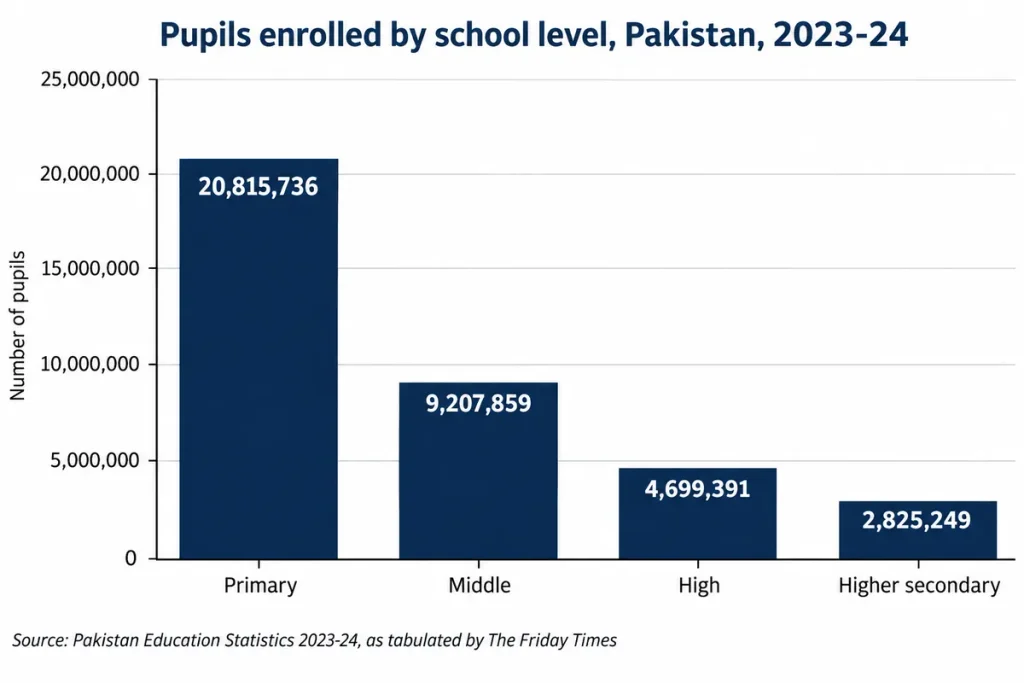
Sample question: In one tehsil, how does the distance from a primary school to the nearest girls’ middle school relate to whether primary graduates enrol?
Approach: Combine school locations with a household survey, and obtain consent from guardians. Distance is only one reason, so a single measure is not enough. Therefore add cost, safety and family views, so that one factor does not carry the whole answer.
Narrow a broad idea in five steps
Take the broad idea of school outsourcing in Punjab. It is an area of study, not yet a thesis.
- Name the document or dataset first. Here it is the appointment letters of teachers in outsourced schools.
- Next, fix the unit. One tehsil is enough.
- Then fix the dates. Use contracts issued in a single year.
- Match the method to the evidence. Letters and pay slips suit a small survey, because both are short and checkable.
- Check access before writing the proposal. Ask for the permission letter early.
The result is topic 2. Next, the guide to choosing a thesis topic and the research methodology guide help with steps one and four. Then the research proposal guide covers what follows.
Four mistakes that weaken an education thesis
Treating a news figure as data
An opinion article can point you to a question, but its numbers are not evidence unless they trace back to a dataset.
Mixing nominal and real rupees
Spending in 2019-20 and 2023-24 cannot be compared without adjusting for inflation, because prices changed. For example, the PIE report itself notes that real gains were largely eroded.
Writing that no research exists
The UKFIET authors say high quality studies are very few, not absent. So claim a gap only after a proper literature search.
Starting fieldwork without permission
Surveys of teachers, observation forms and school records all need approval. So ask your department which letters it requires before you collect anything.
Frequently asked questions
Can a B.Ed student write a thesis, or only a project?
It depends on the programme, so check yours. The UMT scheme gives the capstone project or thesis 3 credit hours, and the University of the Punjab BS Education course gives 3 credit hours over 16 weeks. In comparison, an MS thesis carries at least 6 credit hours under the HEC policy. At B.Ed level, one clear question and one source of evidence is normal.
Do I need permission to study a school?
Yes, for surveys, observation and school records. So ask your department which letters it needs. Topics 1, 4, 7, 9 and 10 use judgments, published tables, syllabi, theses or policy drafts, so they avoid this step.
What if official figures conflict?
Name the report, the table and the year, and use one version throughout. The non-formal education report gives the out-of-school total as more than 25 million in one place and 25.3 million in another. Dawn also noted 25.37 million and 26.2 million from the same agency. A short note on the difference also shows careful work.
Choosing your next step
Pick the topic where you can already name the document you will open first. Other subjects, meanwhile, are listed on the thesis topics hub. Once a topic is chosen and the proposal is next, help with structure, methodology and supervisor feedback is available through Order Now. Support is available 24/7, every day of the year, on WhatsApp, email and live chat. Any work received is for reference and learning, and should be used according to your institution’s policy.