
Architecture Thesis Topics for Pakistani Students: Buildings, Heritage Laws and Housing You Can Study on Site
Five questions decide whether an architecture thesis topic will survive your first jury.
- Is my thesis a design project, a research study, or a design with a research chapter in front of it?
- Which building, street or site can I visit, measure and photograph before my synopsis is due?
- Which authority holds the records I need: a building control authority, a heritage authority, a housing company or a university department?
- Will that office give me a permission letter in time, and what will it want to see?
- What will my jury count as evidence: drawings, logger readings, interviews, legal text, or all four?
Architecture is a wide subject. The twelve topics below sit mostly in housing, heritage and building performance, because those fields leave public records a student can check. Questions about structures and materials fit better in the engineering thesis topics list.
A design thesis and a research thesis need different evidence
The B.Arch scheme at UET Lahore places Thesis Design-I in the ninth semester at 10 credit hours and Thesis Design-II in the tenth at 11 credit hours, according to the department’s programme page. The same page says graduates meet the licensing requirements of the Pakistan Council of Architects and Town Planners. A design thesis therefore ends in drawings and a jury. A research thesis ends in a written argument tested against evidence.
Many departments ask for both. A 2024 NED thesis on purdah and apartment design in Karachi puts literature, survey findings and case studies first. Only then does it move to site analysis, plans, sections and jury remarks. Copy that order: evidence first, design second.
Pick your route before your topic
| Route | What you hand in | Evidence that fits | Topics below |
|---|---|---|---|
| B.Arch design thesis with a research chapter | Brief, site analysis, drawings, jury | Site survey, case buildings, user interviews | 5, 7, 9, 12 |
| B.Arch research-led thesis | Written study plus one design test | Measurements, audits, archive records | 3, 8, 10, 11 |
| M.Arch or MS research thesis | Full thesis with methods and limits | Logger data, simulation, legal and archive text | 1, 2, 4, 6 |
| PhD | Original contribution | Several sites or a longer record | Extend 1, 4, 6 or 10 |
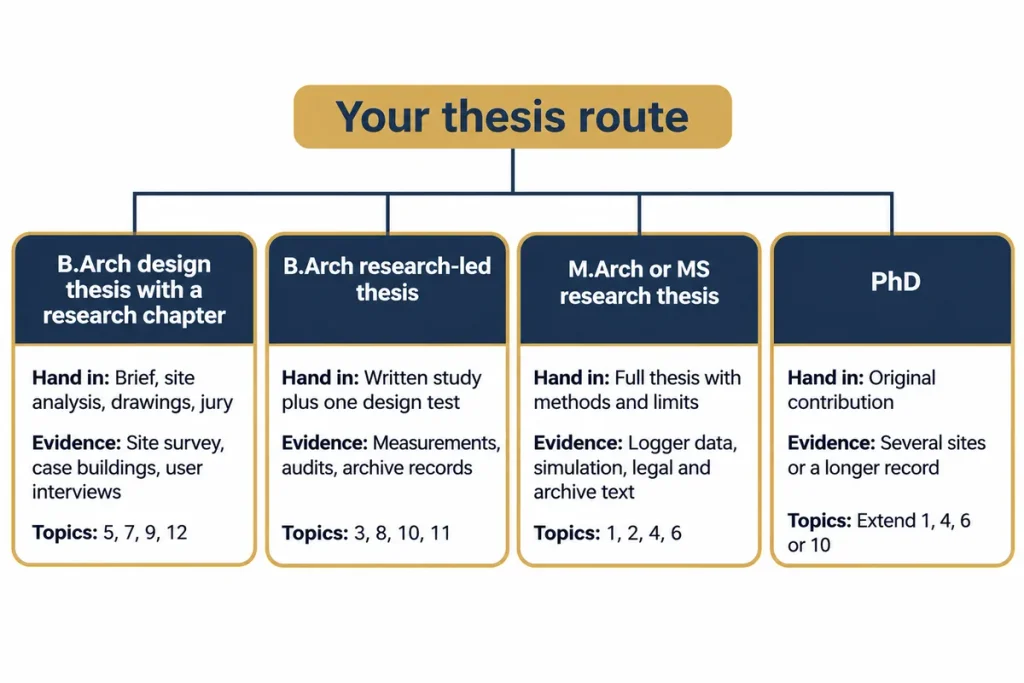
These matches are a guide, not a rule. Your department sets the format, so confirm it with your supervisor before you commit.
Architecture Thesis Topics You Can Test on Site
Climate, energy and the building code
1. Does the energy code’s single envelope zone hold outside Karachi?
ENERCON, now NEECA, developed the Building Code of Pakistan Energy Provisions in 2011, and it was promulgated in 2013. A 2018 paper in the Journal of Art, Architecture and Built Environment says the code defines one envelope zone based on Karachi. The authors add that it has no compliance mechanism of its own and that its scope aims at larger non-residential buildings.
Take one office or hospital design from your studio. Run its envelope through the code’s clauses, then through an energy simulation for Karachi and for a second city such as Quetta. Report where the single-zone assumption changes the result. A house is the wrong test object, because the code points elsewhere.
Level: M.Arch or MS, or a BS thesis limited to one building. Position correct as of November 2026; check whether a provincial energy code now applies in your city.
2. A longer indoor climate record for one house type in Quetta
In a 2018 conference paper, Mahar, Amer and Attia logged temperature and humidity in ten concrete houses in Quetta. They monitored for two weeks in summer 2017 and two weeks in winter 2017 to 2018. Summer living-room readings ran from 29.5 to 34.4 °C, and winter readings from 8.1 to 26.3 °C. The paper admits a small sample, short periods and bedroom data left out of the results.
A thesis can fill that gap. Ask how bedroom conditions differ from living rooms across a full month in each season, in one house type only. Pair the loggers with a resident questionnaire. Name your comfort model, because the paper does not say which one it applied.
Level: M.Arch, MS, or a strong BS thesis. You need written consent from each household.
3. Two classrooms in one Lahore school: top floor against ground floor
A 2024 review in Sustainability on indoor comfort in hot Pakistani cities used weather files for Lahore and took no measurements inside Lahore buildings. It reports daytime dry bulb temperatures there between 1 and 45 °C. Measurement is the missing piece.
Log two comparable classrooms in one school during a hot spell, one on the top floor and one on the ground floor. Then compare the readings with an adaptive comfort limit and test one cheap fix, such as shading the roof or opening a high vent. Keep the claim small: one school, one spell, one fix.
Level: BS or M.Arch. You need written permission from the school and a supervisor who can lend loggers.
Buildings that fail and homes that must be rebuilt
4. Repair or vacate: one Old City block in Karachi
After the Lyari collapse of 4 July 2025, the Sindh Building Control Authority said 588 buildings in Karachi were dangerous, 107 of them in Lyari. The Sindh local government minister later accepted that some listings may have been wrong. A new province-wide survey followed, with district committees that include PCATP, PEC and builder representatives. The committee was to judge whether buildings needing minor or moderate repair could stay habitable, and to recommend help for tenants with pagri rights.
A thesis can study that decision for one block. Record structural condition, tenure and what residents do after a notice. Then ask what evidence would justify repair instead of evacuation in a five-storey block of the same age.
Level: M.Arch. Plan ethics and permission first, because tenants are vulnerable participants. Position correct as of November 2026; ask the authority for the current list.
5. What households do with a 200 square foot core house
Sindh’s flood housing programme pays up to Rs300,000 in four instalments for a single-room unit of 200 square feet, built on a plinth at least three feet high. Owners build it themselves and pass inspections, as The Friday Times reported in 2024. The World Bank’s project factsheet says it supports about 350,000 such units. The article does not say whether owners may extend them.
That silence is your question. After one monsoon, how do households alter the unit: a veranda, a kitchen corner, a second room, shade? Draw measured sketch plans of a small sample in one union council. Then redraw the unit with the changes owners actually make.
Level: BS or M.Arch. Ask the programme company and the district office for access early, and check the current programme rules before you fix your sample.
6. Dhajji dewari after two decades
The World Housing Encyclopedia report on dhajji dewari in Pakistan and India says well-maintained houses performed reasonably well in the October 2005 earthquake. It also lists weaknesses: rotting timber at the base, weak anchorage to the foundation, poorly fixed floors and roofs, and poor post-2005 workmanship. ERRA first limited timber houses to one storey and allowed multi-storey timber in April 2008, the report notes. Arup’s research project argues the system suits seismic areas when built well.
Survey the reconstructed dhajji houses of one valley and score each against those listed weaknesses. Photograph the base, the plinth and the roof fixing. Then ask which weaknesses appear most often and why.
Level: M.Arch in conservation or seismic design, or a BS thesis on one village. Check road access and security conditions before you promise a site.
Old cities, heritage law and ruins
7. Walking the Shahi Guzargah: one 300 metre stretch
The 1.6 km trail from Delhi Gate to Lahore Fort was the first pilot of the Walled City rehabilitation. A Geo feature reports over 850 restored façades. It also quotes a planning consultant who says the physical work succeeded while walkability stayed hard, because these are living neighbourhoods.
Choose one stretch of about 300 metres. Count pedestrians, motorbikes and carts at morning, midday and evening. Map where shop displays spill onto the street. Then propose a street section that keeps trade alive and frees a walking line. Do not read one visit as typical; three time slots make the case.
Level: BS or B.Arch, with a design response. Interview shopkeepers with a short consent script.
8. What declaration changed for one haveli
In July 2023 the Walled City of Lahore Authority declared 15 more sites and havelis as heritage properties, which took the total under the 2012 Act to 52. Nisar Haveli, Haveli Wajid Ali Shah and Khalifa Manzil were among those named. Dawn does not explain what protection means for owners, so the thesis must read the Act’s own text, including its chapter on conservation planning and building regulations.
The law has also moved. The News reported on 1 July 2026 that an amendment renamed the body the Punjab Walled Cities and Heritage Areas Authority and widened its reach beyond Lahore. Compare two declared havelis: their condition, use and permitted changes before and after declaration.
Level: B.Arch research route or M.Arch. Position correct as of November 2026; check the authority for the notified status of each property.
9. Façade-only protection on one Karachi street
Dawn reported in 2023 that Sindh has over 3,500 protected buildings and sites, including 1,750 in Karachi. Only ten staff in Karachi watched for illegal work, and most buildings stand in Saddar and Civil Lines, where plots are expensive. The Express Tribune adds that the 1994 Act protects the outer frame and allows changes inside.
Pick one street in Saddar. Record every listed building’s condition, use and any change visible from the pavement. Ask the heritage department for each register entry. Then design an adaptive reuse scheme for one building that keeps the outer frame and justifies each internal change.
Level: B.Arch design thesis or M.Arch. Do not confuse listed buildings with old but undeclared ones.
10. Mapping flood damage in one quarter of Moenjodaro
UNESCO’s state of conservation page records 25 to 30 wall collapses after the August 2022 floods, along with cavities, eroded slopes and standing water. The World Heritage Committee asked for overall condition assessments with maps by quarter, damage and risk.
Take one quarter of the site. Build a damage and drainage map from the state party’s reports and a field visit. Then propose a drainage-led repair order: which walls first, and why. If the site is closed to students, an archive-only version still works.
Level: M.Arch in conservation, or a PhD extension. You need permission from the Sindh antiquities directorate. The page I read lists no committee decision after 2023, so check for newer ones.
People, access and everyday use
11. Audit one city’s hospitals against the Accessibility Code of Pakistan 2006
The Coalition for Inclusive Pakistan assessed 316 government buildings in 19 districts. Only 48 per cent had a ramp where stairs required one, 23 per cent had handrails on both sides of the ramp, and none had tactile paving or visual alarms. Only the disability laws of Sindh and Punjab require compliance with the Code. The ICT Act of 2020 speaks only of appropriate standards and Council guidelines in section 7.
Audit every public hospital in one district with a checklist built from the Code’s own items. Compare your percentages with the Coalition’s. For Islamabad, note that the CDA told owners in 2019 that ramps from the footpath are mandatory for non-dwelling buildings under its 2005 zoning regulations.
Level: BS or M.Arch. Use the same thresholds as the Code, or your numbers will not compare.
12. Purdah and layout: testing one apartment model after occupancy
The NED thesis mentioned earlier proposed an urban apartment model for middle-income Karachi. It drew on case studies of Saima Villas and Sunny View Apartments and on resident surveys, yet its document lists no research questions. A research thesis can test the layout idea in finished buildings.
Choose two existing apartment blocks. Ask residents to sketch which rooms they can see from the door and from the window. Interview women residents with a female interviewer and written consent. Then compare how layout, not household income, shapes the privacy they report.
Level: B.Arch with a research chapter, or M.Arch. Treat purdah as a range of practices, because households differ.
Match the topic to your level
A B.Arch thesis is the last stage of a professional degree, so a jury will expect a design. An MS or MPhil follows the HEC Graduate Education Policy 2023, which allows 30 credit hours of coursework or 24 credit hours plus at least 6 credit hours of thesis. The same policy expects PhD students to complete coursework, the comprehensive exam and the synopsis defence within the first six semesters. Position correct as of October 2026. Your university may add its own rules, so read the MPhil thesis guide and your department handbook together.
Before you settle, search earlier work on your site. The HEC repository guide shows how to find theses already written on it.
Narrow a broad idea in five steps
“Housing after floods” is a field, not a topic. Topic 5 shows how to cut it down.
- Name the object: the 200 square foot core unit, not housing in general.
- Name the place: one union council in one district.
- Name the evidence: measured sketch plans and short owner interviews.
- Name the authority: the programme company and the district office that must allow access.
- Name the output: a table of alterations and a redrawn unit.
If a step stays vague, your topic is still too broad. The guide on choosing a thesis topic adds a feasibility check, and the notes on choosing a research methodology help you match the evidence to the method.
Four mistakes in architecture thesis topics
- Starting from a building type. A museum or a hotel is a brief, not a question. Add what you will test about it.
- Picking a site you cannot enter. A closed hospital ward or a protected monument can stall your fieldwork for months.
- Skipping the permission letter. Ask the owner or authority in writing before you measure, record or interview anyone.
- Treating news reports as the record. Use them for context. Then read the register, the Act or the official report behind them.
Frequently asked questions about architecture thesis topics
Can I write a research thesis in architecture without designing a building?
Often yes at M.Arch or MS level, but it depends on your department. The final year of the five-year B.Arch is a design thesis, as the UET scheme shows. Ask your supervisor which route your degree allows before you plan the work.
Do I need permission to measure or photograph a building?
Measuring inside a school, hospital, private building or protected site needs written permission. Ask the owner or the authority first. Then ask your supervisor which ethics form your department requires.
Which number should I cite when news reports disagree?
Cite the official source and give its date. In July 2025 the chief minister spoke of over 480 dangerous buildings in Karachi, the authority said 588, and The Friday Times counted 740 across Sindh. Each figure answered a different question, so state which one you use.
Take the next step
Once a topic fits your site and your jury, the synopsis comes next. The guide to writing a research proposal walks through it. If you want help shaping the synopsis, structure or formatting, you can place an order for academic support, and the work is meant for reference and learning under your institution’s policy. For other subjects, browse the full list of thesis topics.