
Developmental Psychology Research Topics: From Early Years to Old Age in Pakistan
Questions to settle before you choose
A developmental thesis needs one age window, one measure and one place. Before you commit, ask yourself:
- Which age band can I reach with permission, and can I finish data collection in one semester?
- Do I want to compare ages, follow the same people over time, or reuse a survey that already exists?
- Which instrument has an Urdu version, and who owns its licence?
- Will my ethical review committee accept children, mothers or older adults without extra safeguards?
- Is my question about change, or am I really describing the scores of one age group?
Developmental psychology covers the whole lifespan. The topics below lean on childhood and emerging adulthood, because Pakistani studies and datasets are easiest to find there. School learning sits with the educational psychology topics. Disorders sit with the clinical psychology topics, and peer or group behaviour sits with the social psychology topics. The wider psychology research topics list shows how the subfields connect.
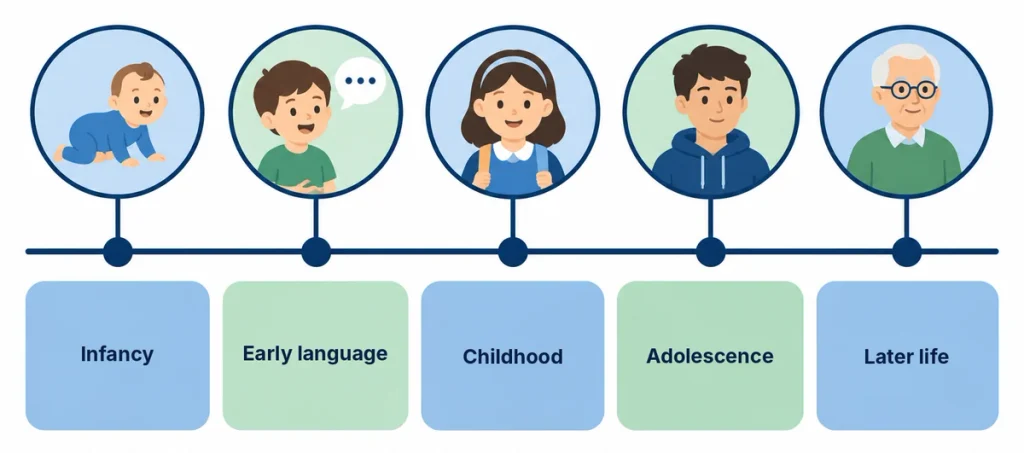
Infancy and the first five years
The earliest years have the strongest Pakistani evidence base, because trials and national surveys already exist. Each topic below starts from one of them.
1. Caregiver responsiveness during a Lady Health Worker home visit
Starting point. A cluster trial in rural Sindh trained Lady Health Workers to teach responsive stimulation. It enrolled 1,489 mother and infant pairs. At 24 months, the stimulation groups scored higher on Bayley cognitive, language and motor scales, with effect sizes of 0.6, 0.7 and 0.5 in the 2014 Lancet trial in Sindh.
Research question. How do mothers respond to infant cues during a routine home visit? Which responses does the health worker model? Code 30 observed visits in one union council for turn-taking, naming and warmth.
Level and approach. In practice, this suits a BS final-year project or an MS thesis. Use a structured observation sheet. Train two coders, then report how closely they agree.
Pitfall. However, mothers behave differently when watched. Build in a settling period and state the limit plainly. You will also need permission from the district health office before any visit.
2. Does treating maternal depression change child development? A systematic review
Starting point. The Thinking Healthy Programme trial treated perinatal depression in rural Pakistan. A follow-up reached 584 of 705 mother and child pairs when the children were about seven. Cognitive, socioemotional and physical outcomes did not differ between the intervention and control groups. However, children of mothers who had prenatal depression showed more difficulties and anxiety than a reference group of 300, according to the seven-year follow-up in Lancet Psychiatry.
Research question. What do randomised trials in South Asia show about treating maternal depression and later child development? Limit the review to trials that report a child outcome.
Level and approach. In practice, this suits MS, MPhil or PhD. Register a protocol before searching. Two reviewers should screen records independently. A review needs no fieldwork, so it helps students who cannot reach participants.
Pitfall. Also, do not mix trials that treat the mother with trials that teach parenting. They test different pathways, so one review should answer one question.
3. Early learning programmes and development in the poorest Sindh households
Starting point. In the Sindh MICS 2018-19 early childhood snapshot, 48% of children aged 3 to 4 were developmentally on track. Only 24% were on track for literacy and numeracy, and only 10% attended an early childhood programme. Attenders were nearly twice as likely to be on track. A four-province MICS analysis found the same direction. Its authors still warn that families who choose a programme may differ in other ways.
Research question. Does the link between attendance and being on track hold inside the poorest wealth quintile, after adjusting for the mother’s education?
Level and approach. This is an MS-level secondary analysis. Request the survey data through UNICEF’s MICS site. Then fit a survey-weighted regression in SPSS, Stata or R.
Pitfall. The data are cross-sectional. Therefore, never write that attendance improves development. Also, forgetting the survey weights will distort every estimate.
4. Does the south Punjab gap show up in every developmental domain?
Starting point. A study of Punjab MICS round 6 found that children in southern Punjab were 11.35% less likely to be on track than children elsewhere in the province. Wealth explained 52.8% of the gap and the mother’s education explained 21%, in the decomposition of the south Punjab gap. Across four provinces, literacy and numeracy was the least attained domain, at 14.6% to 27.2%. The physical domain passed 90% everywhere, as the domain results across four provinces show.
Research question. Does the south Punjab gap appear in the social-emotional domain, or only in literacy and numeracy?
Level and approach. In practice, this suits an MS thesis with strong statistics, or a PhD chapter. Repeat the decomposition one domain at a time.
Pitfall. The physical domain barely varies, so it has little to explain. Report it briefly and spend your effort on the domains that do vary.
Language and mind before school
Between ages two and six, children learn to talk, to read other minds and to hear the sounds of words. Three topics follow that arc.
5. Mental-state talk and false belief in four-year-olds
Starting point. Two studies with 72 and 77 preschoolers found a lag in false-belief understanding compared with Western children, as the two preschool studies in Pakistan report. A later mother and child talk study found words about thoughts and feelings in only 2% of maternal and 1% of child utterances. Even so, a child’s own use of such words tracked social understanding.
Research question. Do eight weeks of picture-book sharing that names feelings and wishes raise four-year-olds’ use of mental-state words? Does false-belief performance follow?
Level and approach. In practice, this suits MS or MPhil. Run a small quasi-experiment in two preschools, with parental consent. Test children before and after with the same task set.
Pitfall. Word-for-word translations can confuse young children, so pilot the tasks with five of them first. Also avoid claiming a national lag from a small convenience sample.
6. Who watches along? Screen time and toddler language
Starting point. In a Lahore study of 318 preschoolers, only 27% of children with more than nine hours of daily screen time met language milestones at 33 months. A pilot trial in the Journal of the Pakistan Medical Association randomised 160 children with speech delay. Screen time fell below 30 minutes a day for three months, and vocabulary gains were far larger than in the control group.
Research question. Does the screen and language link change when an adult watches along, or when the content is in Urdu instead of English? Both abstracts report device type and daily hours, so who watches and in which language adds something new.
Level and approach. In practice, this suits BS or MS. Collect a three-day parent diary. Pair it with the communication domain of a screening questionnaire. Check the licence and the available Urdu version first.
Pitfall. Children who talk late may be given more screens, so the direction of cause is unclear. State that limit, and remember that parents estimate hours roughly.
7. Urdu sound screening in government school classrooms
Starting point. The U-PASS tool has ten subtests. It was tested on 115 Urdu-English bilingual children in Grades 1 and 2, across Canada and Pakistan, and Urdu sound scores were linked to word reading. The authors note that online testing mostly reached middle and higher income homes. They also state that in-person use is not yet validated, in the U-PASS validation paper.
Research question. Do U-PASS scores predict Urdu word reading in Grade 1 and 2 children in government schools, tested one to one in person?
Level and approach. In practice, this suits MS or MPhil. The authors describe the tool as open access, so start with their supplementary files. Pair it with a short Urdu word-reading list.
Pitfall. Many children speak Punjabi, Sindhi or Pashto at home, so Urdu may be a second language for them. Record each child’s home language instead of assuming Urdu.
Childhood under discipline and disaster
Law and disaster shape childhood in ways that textbooks rarely cover. These two topics need extra ethical care.
8. School discipline and behaviour in Islamabad
Starting point. The Islamabad Capital Territory Prohibition of Corporal Punishment Act 2021 bans physical punishment, and cruel or degrading treatment, of anyone under 18. It covers schools, workplaces, care institutions and juvenile justice. It extends only to Islamabad, and its list of settings does not name the home, according to the text of the Act. Rules to enforce it were formally launched in 2023, as the launch of the Rules report explains. Position correct as of November 2026; check the Islamabad administration or the federal education ministry for the current Rules.
Research question. How do Grade 7 and 8 students in Islamabad describe discipline in their school? Does it relate to teacher-reported behaviour difficulty?
Level and approach. In practice, this suits MS or PhD. Use a short anonymous questionnaire plus teacher ratings, after ethical approval. A legal reading of how the Act is enforced fits better in the law thesis topics.
Pitfall. Pupils may fear reprisals, so honest answers may be rare. Decide in advance what you will do if a child reports serious harm.
9. How children of different ages describe the 2022 floods
Starting point. A World Bank phone survey note drew on 4,044 completed interviews with parents of children aged 3 to 17. Parents reported sadness in 37% of children and more aggression in 19%. The note warns that phone surveys miss the poorest families. It also records what parents saw, not what children said.
Research question. How do children aged 6 to 7 and 10 to 11 in one flood-affected district describe what happened and what they miss?
Level and approach. In practice, this suits MS, MPhil or PhD. Use drawing plus a short talk, then compare the two age groups through thematic coding by two coders. Prepare a distress protocol and a local referral contact before any fieldwork.
Pitfall. Drawing skill grows with age. As a result, an older child’s richer picture is not proof of more trauma. Never treat drawings as a diagnosis.
Adolescence and emerging adulthood
Pakistani youth often study, work and live with parents at the same time. That makes this stage rich for qualitative and survey work.
10. Marriage-age expectations recalled by young women where the law differs
Starting point. Sindh set 18 as the marriage age for both sexes in 2013. The president signed the Islamabad law at 18 in May 2025. The Punjab Assembly passed a 2026 bill with the same age. The same report describes Khyber Pakhtunkhwa and Balochistan as still using an older framework with 16 for girls. Position correct as of November 2026; check the notified texts and each province’s law department.
Research question. How do women aged 18 to 24 recall their families’ marriage-age expectations? How do they link those expectations to schooling? Compare one Sindh district with one Khyber Pakhtunkhwa district.
Level and approach. In practice, this suits MS, MPhil or PhD. Use semi-structured interviews in the participants’ own language, then reflexive thematic analysis. Interview adults only.
Pitfall. Still, law is not the only difference between districts. Income, language and local custom also differ, so avoid causal claims. A sociology reader will find more angles in the social sciences thesis topics.
11. Which markers of adulthood do final-year students rate as essential?
Starting point. A 2026 narrative review of adulthood markers separates objective markers from subjective ones. Education, employment, financial autonomy and marriage are objective. Identity, responsibility and perceived independence are subjective. The review links delayed transitions to more stress and lower life satisfaction in lower-middle-income settings.
Research question. Which markers do final-year students in one city rate as essential for adulthood? Does feeling like an adult relate to stress?
Level and approach. In practice, this suits BS or MS. Adapt an established inventory, such as the Inventory of the Dimensions of Emerging Adulthood, with the authors’ permission. Back-translate it, then pilot it with 20 students.
Pitfall. Items on marriage and independence can read differently for sons and daughters, so test that in pilot interviews, and use one stress measure only.
12. Family expectations and identity: university students and young workers
Starting point. Interviews with 12 Pakistani emerging adults found that parental, religious and cultural expectations were reconciled with personal interests. Norms played a flexible and often positive role. A 2026 interview study of Lahore students reported pressure from uncertainty and parental expectations among ten university students. A Lahore analysis of emerging adulthood summarises Arnett’s view that the stage is mainly an urban, better-off experience.
Research question. Do young apprentices and university students in one city describe identity choices in the same way?
Level and approach. In practice, this suits MS, MPhil or PhD. Interview 10 to 12 people per group with one shared guide. Compare themes across the groups.
Pitfall. Recruiting apprentices through an employer can bias what they say. Meet them in a private place, and do not assume they have fewer choices.
Later life
Pakistan has a growing older population but few developmental theses on it. Two topics start from published studies.
13. Prayer and memory loss: how families adapt religious routines
Starting point. Interviews with 20 people with dementia in Karachi and Lahore found that symptoms disrupted daily prayers. The authors report that participants did not know dementia can bring exemptions from some religious duties. Focus groups in Karachi and Lahore with 40 adults explored beliefs about dementia.
Research question. How do families in one city outside Karachi and Lahore adapt prayer and fasting when an older relative has memory problems?
Level and approach. In practice, this suits MS or MPhil. Interview the older adult and one family member, in the local language. Ask a local scholar how to phrase questions, but do not give religious rulings yourself.
Pitfall. Recruiting only through hospital clinics shows treated cases. Say so in the limitations. Also confirm each person’s capacity to consent before you begin.
14. Why do households with more children report more impairments in old age?
Starting point. The Karachi geriatric survey covered 1,200 adults aged 60 and over from every sub-district in 2013 and 2014. Psychological and cognitive impairments were the most common. Women were 2.45 times more likely to have three or more impairments. Living with more children also went with more impairments.
Research question. What do older adults in one Karachi sub-district say about space, caregiving and money in households with many children?
Level and approach. In practice, this suits MS or MPhil. Use a sequential mixed design: a brief screening interview first, then 12 to 15 in-depth interviews.
Pitfall. The published result is a correlation. Never write that children cause impairments. Instead, treat the pattern as a question about household strain.
Matching a topic to your degree
The same area can be a BS project or a PhD chapter. Scope and method decide the level.
| Degree | Topics that fit | Why |
|---|---|---|
| BS final year | 1, 6, 11 | Short observation, diary or survey with a small sample |
| MS or MPhil | 3, 5, 7, 8, 9, 12, 13, 14 | One clear design, one setting, one comparison |
| PhD | 2, 4, 10, or a longer version of any topic | Review protocols, multi-wave data or sensitive fieldwork |
MPhil students can see how examiners read a thesis in the MPhil thesis guide. PhD candidates who want a second reader for a long proposal can look at PhD thesis support.
Ethics and permissions with children and older adults
Ethical review committees treat children and people with memory loss as vulnerable groups. Expect more paperwork, and start early.
For children, plan three layers. First, get permission from the institution, such as the school head or the district health office. Second, obtain parental consent. Third, ask for the child’s own assent in simple words in the home language. The Islamabad Act defines a child as anyone under 18, so treat every adolescent in school as a child for consent.
For older adults with memory problems, assess capacity to consent. Record a family member’s agreement as an addition, not a replacement. Keep every name off drawings, diaries and recordings. Finally, write a distress plan: who you call, and which local service you refer to, if a participant becomes upset.
Narrowing a broad idea in five steps
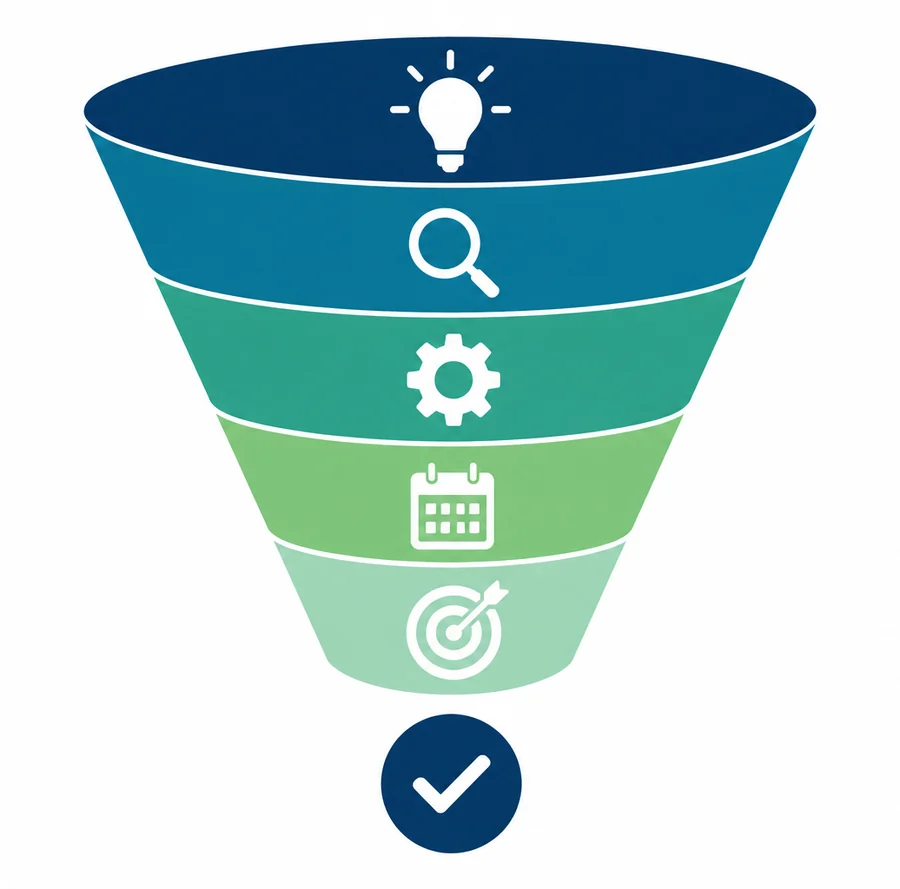
- Pick one age window and one setting, such as 3 to 4 years in rural Sindh.
- Find one Pakistani study and one dataset for that window. Read their limitations first. Past theses are easy to check in the HEC repository guide.
- Choose the question type: compare ages, compare groups, test a short programme, or reuse a survey. Then match it to a design using the research methodology guide.
- Check the instrument for language version, licence and norms.
- Test feasibility: time, permission and sample size. After that, shape the idea into a proposal with the research proposal guide, and plan your method chapter using the methodology chapter guide.
Mistakes that weaken developmental theses
- Choosing “child development” with no age band, which gives no sample frame.
- Claiming change from a one-time survey of one age group.
- Planning a longitudinal study in a one-year degree. The seven-year Thinking Healthy follow-up shows how long such work takes.
- Translating a test without piloting it with children.
- Forgetting that a general-population survey cannot show what happens inside one family.
- Describing a correlation as a cause.
Frequently asked questions
What is the difference between developmental psychology and child psychology?
Developmental psychology studies change across the whole lifespan, from infancy to old age. Child psychology is one part of it, focused on birth to adolescence. Family psychology overlaps when your question is about parents, siblings or households.
Can I finish a longitudinal study in an MS or MPhil degree?
Usually not. Most programmes give one year for data collection. Instead, compare age groups at one time, or reuse a longitudinal dataset someone else collected.
Can a BS student use MICS or other national survey data?
Often yes, because the files are built for secondary analysis. You still need to register for access, learn the survey weights and keep the question small. A supervisor who knows survey analysis helps a great deal.
If you want a second reader for your proposal or help shaping a method, you can start from the order form, and real student feedback is on the reviews page. Use any support as reference and for learning, and follow your institution’s policy.