
How to Write a Research Paper: Step by Step, From Question to Final Draft

Most students lose time on the same four worries:
- Is my paper meant to argue a position, report my own data or review other studies?
- Do I write the introduction first, or leave it until the body is done?
- How do I know my outline matches what my department expects?
- If my supervisor wants a journal paper, what must I check before I pick the journal?
The steps below show how to write a research paper in an order that avoids rewrites. They cover course papers and journal articles. A thesis chapter works differently, so read how a full thesis is organised if that is what you owe.
The Short Answer: Write in This Order
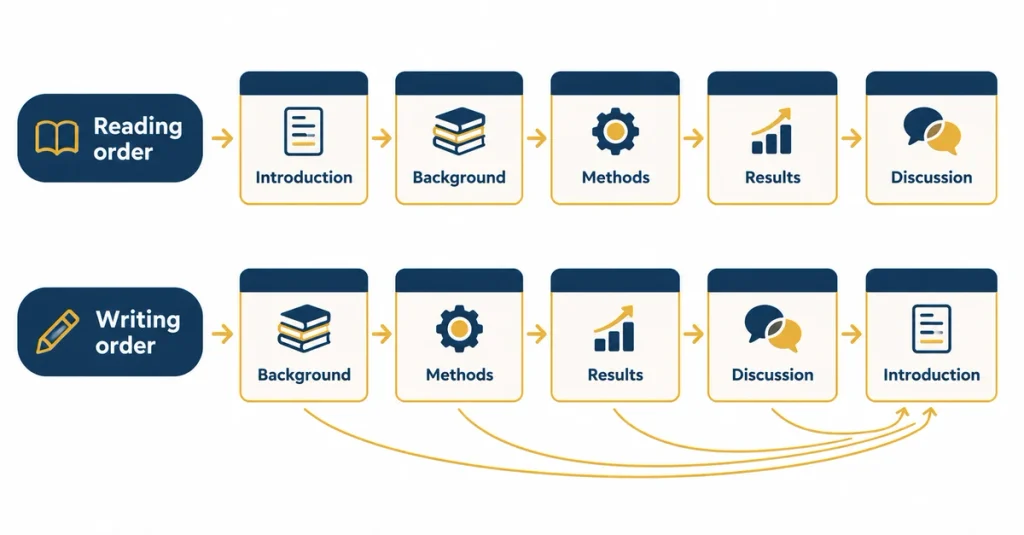
A research paper comes together in a fixed order. You settle the paper type, narrow the question, take notes that keep their sources, outline, draft the body, and only then write the introduction. After that, you revise and check the details. Reading order and writing order differ, and that gap causes most rewrites.
- Find out which kind of paper you owe and read the brief or the journal guidelines.
- Narrow the question until the pages you have can answer it.
- Read, and label every note with its source.
- Outline to match the paper type.
- Draft the body first, then the introduction, conclusion, abstract and title.
- Revise with a reverse outline.
- Check references, similarity and format.
Step 1: Decide Which Kind of Research Paper You Owe
Your instructor’s brief or the journal’s guidelines decide the structure, not a template found online. Purdue’s writing lab explains that the IMRAD pattern (introduction, methods, results, discussion) is common in the sciences and often used for empirical work in the humanities. However, it does not suit every purpose, such as a proposal or exploratory writing. Its advice is to check what is expected by asking the instructor, reading journal guidelines and studying published examples, as set out in Purdue OWL’s guide to organisation and structure.
Most course papers fall into one of three types.
| Paper type | Typical shape | What the reader checks first |
|---|---|---|
| Argument or analysis (common in humanities and many social science courses) | A clear claim, then sections built around themes or reasons | Is the claim clear, and does every section support it? |
| Empirical study (your own survey, experiment or dataset) | Introduction, methods, results, discussion | Could another researcher repeat the study from your methods? |
| Review paper (evaluating existing studies) | Question, how sources were chosen, themes, gaps | Were sources chosen fairly and compared, not just listed? |
If the brief does not say which type applies, ask. A short email asking whether the paper should report data or argue from sources saves days later. Some departments also issue their own template, so ask for it before you format anything.
Step 2: Narrow the Question Until the Pages Can Answer It
A course-length paper cannot answer “Does social media affect students?” Narrow it by population, setting and variable instead. For example, “How do WhatsApp study groups change the way final-year BS students in one university plan assignments?” is a question a short paper can actually answer.
Then run two checks. First, can you find enough credible sources on it? Second, for empirical work, can you collect or access the data in the time you have? The guide to narrowing a broad idea into a researchable one walks through the same test at thesis scale, and it works for papers too.
Some departments ask for a proposal before the paper. A proposal asks for approval to do the study, while the paper reports it. What a research proposal contains shows the difference.
Step 3: Read So That Every Note Keeps Its Source
Notes cause more accidental plagiarism than copying does. Troy University’s writing center advises labelling each note as quoted, paraphrased or summarised the moment you take it, as in its step-by-step research paper checklist. The same checklist suggests separating primary material from secondary material while you read. Also save full citation details with every source, because rebuilding them at midnight before the deadline is where errors creep in.
For local context, past PhD theses from Pakistani universities can show how similar questions were framed with local data. The guide to the HEC repository of past theses explains how to search them.
Step 4: Outline to Match the Paper Type
Purdue’s outlining questions work for any type. What are the main points? What background does the reader need for each one? In what order should they come: most important first, simple to complex, or by category?
For an empirical paper, Purdue also lists what each IMRAD section must answer:
- Introduction: what the purpose and research questions are, and what background the reader needs.
- Methods: what methods were used, how the study was run and, if people took part, who they were.
- Results: what the data show and how the questions were answered.
- Discussion: what the results might mean, whether they agree with the literature, and what future researchers should do.
Write one or two sentences under each heading saying what that section must achieve. For an argument paper, do the same for each theme or reason. As a result, the outline becomes a test: any section that cannot state its job in two sentences is not ready to draft.
Step 5: Draft the Body First, the Introduction Last
The introduction promises what the paper delivers, so it is easiest to write once you know what the paper delivers. Edanz’s author infographic, How to Write a Research Paper: Use the IMRaD Formula, suggests this order for original research. Prepare the tables and figures first, then draft methods, results and discussion, then the introduction. Finalise the title and abstract at the end. An argument paper follows the same logic: draft the sections that carry the argument, then introduce them.
Background and literature
Use the literature to show what is known and where your question fits. Do not list every source you read. Instead, group sources by idea, compare them, and end with the gap your paper addresses. The guide to writing a literature review shows how to group and compare sources without turning the section into a list.
Methods
Write enough that another researcher could repeat your study. Edanz frames methods as the section that describes materials, procedures and analysis for each result. Cover the design, the sample and how you chose it, the tools, the procedure, the analysis and any ethics steps. If you collected data from people, ask your department whether ethics approval is needed before collection starts.
In a review paper, methods means how you found and chose sources: the databases, the search terms and your inclusion rules. Choosing the method itself is a separate decision, covered in how to choose a research methodology.
Results and findings
Report what you found without interpreting it yet. Put numbers in tables or figures, and state the main point of each one in the text. Answer your research questions in the order you asked them. Keep opinions and explanations for the discussion.
Discussion and conclusion
The discussion says what your findings mean. Purdue and Edanz both place the results against the published literature. Edanz adds the strengths and weaknesses of your study, its implications and directions for future work. Include limitations here, because a reader trusts a paper more when it names them.
The conclusion is shorter. It answers the original question in a few sentences and states the main implication. Do not introduce new evidence there. In short, the discussion argues, and the conclusion closes.
Introduction, abstract and title
Once the body is done, write the introduction: the purpose, the background the reader needs, the research questions and the gap. Then write the abstract, which summarises the whole paper and so needs the finished body. Finalise the title last, so it names the feature of your research that matters most.
Step 6: Revise With a Reverse Outline
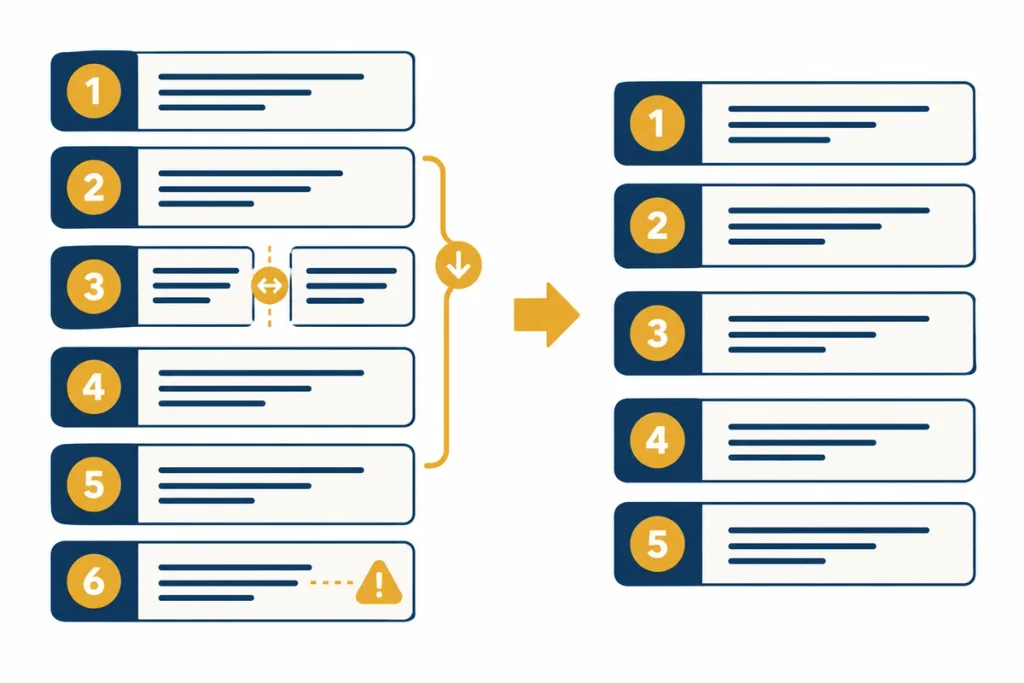
A reverse outline is an outline made after the draft. The University of Oklahoma Writing Center’s reverse outline handout gives the method. Number each paragraph, then write one sentence on its main point, focusing on the argument rather than the evidence. Keep the outline separate from the draft so you can compare them.
Then ask four questions. Does every paragraph support the main idea? Where might a reader get lost? Are you repeating yourself? Does any paragraph try to do too much?
Here is an illustrative example. Imagine a BS Sociology paper on mobile wallet use among small shopkeepers in Rawalpindi. Its reverse outline reads:
- Introduces the cash habits of small shopkeepers.
- Explains what a mobile wallet is.
- Covers fees and trust together.
- Reports interview findings on fees.
- Explains what a mobile wallet is again.
- Concludes that trust matters more than fees.
Three problems appear at once. Item 3 holds two ideas, so it should split. Items 2 and 5 repeat each other, so they should merge. Item 6 claims that trust matters more than fees, yet no paragraph reports findings on trust. The writer must either add that evidence or soften the claim.
Step 7: Check References, Similarity and Format
First, match every in-text citation to an entry in the reference list, and every entry back to a citation. Use the style your instructor or journal names, and apply it consistently. Next, check the format against the brief: margins, headings, title page and any word limit.
Your university may also run the paper through similarity software. Matches from properly quoted and cited material are expected, but unmarked copying is not. How HEC treats similarity figures in theses, and how to read a report, is explained in the guide to the HEC similarity index. For a course paper, ask your department which limits it applies.
If the Paper Is Headed for a Journal
Choose the journal before you finish the draft. Edanz advises doing this early because the journal fixes the word count, section names, number and style of references, and formatting. Journals also vary the IMRaD pattern: some combine results with discussion, and some place methods at the end.
In Pakistan, HEC groups recognised journals into W, X and Y categories. According to HEC’s journal FAQs, W means indexed in Web of Science (SCIE, SSCI or AHCI). X means indexed in ESCI or Scopus with extra quality conditions. Y covers journals that meet HEC’s basic criteria or are indexed in Scopus, MEDLINE/PubMed, CNKI or DOAJ. Browse the current recognised journals through HEC’s research publications section, which also points to the HJRS journal search.
PhD scholars face a further rule. The Graduate Education Policy 2023 sets a publication requirement for the degree. It asks that the student is first author, that the article relates to the PhD work, and that the journal category counted is the one at the time of acceptance. The number of articles needed depends on your field.
Before you submit, run four checks:
- Confirm the journal’s category in the HEC list for the year you submit.
- Look for a clear statement of submission process, peer review, funding and any publication fees. HEC’s FAQs say recognised Pakistani journals must disclose these.
- Look for an ethics policy covering plagiarism, authorship and conflict of interest.
- Ask your university’s Quality Enhancement Cell how it verifies student publications, since HEC’s FAQs say these cells do that work.
Position correct as of October 2026; check HEC’s journals section for the current policy and recognised lists.
Quick Answers
How long should a research paper be?
The brief or the journal’s guidelines set the length, and no single figure applies to every paper. If the brief gives no limit, ask the instructor, then size each section from your outline.
Where do author names go in a research paper?
Names and affiliations usually sit under the title on the first page. The order, the corresponding author and the exact format depend on your department’s template or the journal’s author guidelines, so follow those.
What is the difference between a research paper and a thesis?
A paper answers one focused question in a few thousand words and is usually written for a course or a journal. A thesis is a longer degree requirement with chapters, and the awarding university sets its format and defence rules within HEC policy.
When a Section Will Not Come Together
Sometimes the body is drafted, but the discussion stays flat or a supervisor’s comments are hard to turn into a plan. In that case, support with structure, feedback on a draft, editing, referencing and proofreading is available, and you can request a quote with your stage, word count and deadline. Work from us is for reference and learning, and it should be used according to your institution’s policy. You can also read what students have said about the support before you decide.