
Medical-Surgical Nursing Research Topics: Theatres, Wards and Discharge Teaching in Pakistan

Before I commit to a medical-surgical thesis, I need to settle a few things.
- Can I observe one ward process for several weeks, or will I only see a single shift’s records?
- Is my outcome something a nurse controls, such as a dressing, a teaching session or a checklist step, or something a surgeon decides?
- Do I need a licensed scale, and who gives permission for an Urdu version?
- Will the ethical review committee treat a chart review as minimal risk, or will it ask for patient consent?
- Has a Pakistani study already answered my question, and what is still left to measure?
Medical-surgical nursing means adult patients on general medical and surgical wards, in theatres and in dialysis, cardiac and chest units. These topics stay inside that space. Intensive care, maternal and newborn care, children and mental health sit elsewhere, and wider staffing and safety ideas such as missed care, falls and hand hygiene are in nursing thesis topics. Laboratory-side questions belong with medical laboratory technology research topics.
The topics suit MSN and MS Nursing students most, and they work as research proposal topics for nursing students who need a narrow ward idea. BSN students can shrink any of them to one unit and a smaller sample, while PhD candidates will need a stronger theoretical frame.
What makes a ward topic researchable
A good medical-surgical topic has a paper or digital trail. For example, theatre registers show start times, drug charts show analgesic doses, and dialysis records show access care. If the trail does not exist, you must observe the process yourself, which takes longer and needs written permission.
Next, check who owns the step. A nurse owns the pre-discharge teaching session, but a surgeon owns the decision to operate. A topic that measures a nursing step is easier to defend than one that measures a doctor’s decision.
Finally, check the unit. One ward, one theatre or one dialysis shift gives a sample you can finish. A whole hospital rarely does.
Medical-surgical nursing research topics by stage of care
Twelve topics follow the patient from the ward before surgery to the home after discharge. Each one names a gap that the Pakistani studies cited here leave open.
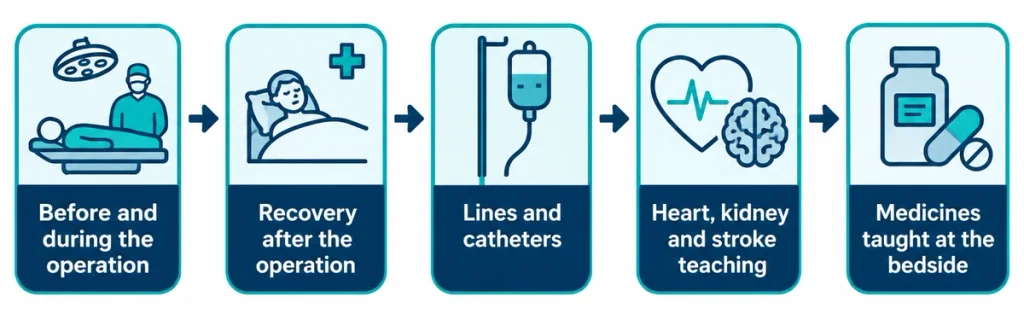
Before and during the operation
1. Actual fasting hours for elective surgery against what the ward instructs
A tertiary hospital study in Sukkur followed 434 scheduled cases. Of these, 270 started at least 60 minutes late, and the mean nil-by-mouth time was 770 minutes. An earlier case running long caused 59.25% of the delays. The study looked at theatre flow, however, not at what ward nurses told patients.
Research question: how long do adult elective patients actually fast, and how many receive an instruction tied to their theatre slot instead of to midnight? Record the instruction, the last intake, the anaesthesia start and a 0 to 10 thirst score. That study reported no notable complications, so do not make complications your outcome. Ask your anaesthesia department which fasting guideline edition it follows.
2. The circulating nurse and sign-out on the surgical safety checklist
Audit data show where the checklist breaks. In a Rawalpindi surgical unit audit, sign-out was performed in 34.8% of 23 observed operations and in 87.5% of 16 operations after teaching. In that audit, 81.1% of staff said no one starts the process, and 62.5% felt it was unnecessary because a nurse already confirms the details.
A Rawalpindi orthopaedic theatre audit reported full sign-out compliance rising from 20% to 65% across 30 operations per cycle. Meanwhile, a four-year Karachi ward series saw checklist marking climb from 20.4% to 89.9%, with infection falling from 7.50% to 2.12%. Those figures show an association, not proof of cause.
Research question: does naming one nurse to start sign-out change completion in one theatre complex? Use two audit cycles with unannounced observers.
3. Wound teaching at discharge and symptoms in the first two weeks at home
A registered Karachi trial of written Urdu wound-care guidance measures patient knowledge and satisfaction at discharge. It enrolled 180 patients against a target of 300. It also required patients to read Urdu, so patients who cannot read fall outside it.
That leaves a clear opening. Test nurse teach-back with a picture sheet, then phone each patient on day 7 and day 14 with a wound-symptom checklist. Report patient-reported symptoms, not “infection”, because a surgeon’s criteria define infection. Position correct as of November 2026; check the registry entry before you design around it.
Recovery after the operation
4. Pain reassessment after analgesia on two surgical wards
In one hospital survey, 99 surgical-ward nurses named time pressure (48.5%), staffing (46.5%) and missing pain tools (42.4%) as the main barriers. Nurses with under five years of experience more often reported limited drug knowledge (57.8% against 31.4%).
Those are perceptions, though, not observed practice. Audit whether a pain score is recorded within one hour of each analgesic dose, then interview eight to ten nurses about workload. A missing entry does not prove untreated pain, so state that limit plainly.
5. Teaching a new stoma patient to change the pouch before discharge
At a Karachi surgical clinic, 136 patients with stomas were interviewed. Only 25.7% had received counselling before surgery, 52.9% had emergency surgery, and 88.2% said meeting a stoma nurse earlier would have helped. An older Islamabad ward study of 30 patients found that only six could manage the stoma alone at discharge. Its data date from 2007.
Research question: after a structured teaching series, what share of patients change the pouch independently before discharge? Observe with a checklist and compare with a ward that teaches as usual. Separate emergency from elective stomas, since emergency patients are often too unwell to learn early.
Lines and catheters
6. Peripheral cannula phlebitis: dwell time and the quality of day-one care
A cohort of 258 adults at a Karachi university hospital found phlebitis in 39.1%. Dwell time before the first assessment, IV fluids, tuberculosis and unsatisfactory nursing care on day one were all linked to it. The data come from 2019 and from one hospital.
Replicate it in another public hospital with one validated phlebitis scale, a daily site check and a care checklist written before data collection. If you decide how to score care after seeing the outcome, you bias the result. Avoid saying that nursing care caused phlebitis.
7. Urinary catheter days and documented indication on a medical ward
Many Pakistani studies already ask nurses what they know. In three Rawalpindi and Islamabad hospitals, 60% of 150 nurses had poor knowledge and 40% poor practice. A nine-hospital survey reached 127 nurses and 358 doctors, and its authors noted that infection incidence was not measured. A Lahore survey of 114 nurses still found misperceptions about catheter removal.
So skip another knowledge survey. Instead, review every catheterised patient daily for four weeks on one ward, and record whether an indication and a removal plan are written. Report catheter days per 100 patient days.
Heart, kidney and stroke teaching
8. Heart failure self-care for patients who cannot read
In Karachi, 115 educated and 115 uneducated heart failure patients were compared, and self-care was higher among the educated (p=0.005). A wider survey of 230 patients linked self-care to education, income and years since diagnosis. Meanwhile, a cardiac institute trial of 80 patients used nurse instructions plus written material and phone guidance, and a second Karachi trial of 80 patients measured self-care at one and two months.
Written material helps readers, so test picture-based teach-back for patients who cannot read. Use a self-care scale at 30 days, read to the patient. Check the licence and any Urdu validation first.
9. Observed fistula care compared with what patients say they do
A Lahore General Hospital survey of 141 dialysis patients shows the gap. Some 97.9% knew about manual compression exercises, yet only 51.8% did them. Limb elevation for swelling was practised by 36.9%, and washing the arm before dialysis by 64.5%.
Self-report may flatter practice, so have a nurse record observed care at the start of each session for one month: skin cleanliness, thrill check and arm position. Then compare with each patient’s own answers. A Shifa College of Nursing trial of skill-building education, registered for 274 participants, already tests teaching, so keep yours observational and check the registry before you start. Position correct as of November 2026.
10. Nurse-applied swallow screening after stroke
Screening matters because dysphagia is common. In three Lahore hospitals, 53% of 150 stroke patients failed a bedside swallow screen applied by a speech and language pathologist. At the same time, 80 nurses in four hospitals showed limited knowledge of dysphagia and its screening in an older survey.
Research question: after a short training session, do ward nurses and a pathologist agree on the same patients? Use independent paired screens on one neurology ward and report agreement with kappa. A failed screen means the patient stays nil by mouth, and the pathologist must not be delayed, so write that rule into your protocol.
Medicines taught at the bedside
11. Inhaler technique taught by nurses before COPD discharge
In 765 patients admitted to a Quetta chest hospital, only 6.3% completed all seven steps correctly. Pharmacy salesmen had taught 38.4% of them, while staff nurses had taught 12.2%. Most errors fell on breathing out first, breathing in fully and holding the breath.
Test a nurse demonstration with teach-back at discharge, then recheck the seven steps at the first follow-up visit. Keep the assessor the same person. Patients often behave better when watched, so say so in your limitations.
12. Insulin injection technique and lipohypertrophy on a medical ward
Nurse technique has been measured before, but long ago. A 2006 Lahore study found that only 40 of 272 nurses followed all eight steps. More recently, a Services Hospital Lahore study of 363 patients found lipohypertrophy in 22.86%, linked to needle reuse more than ten times, more than two injections a day and a long gap since instructions were reviewed.
Observe the injection technique of insulin-treated inpatients, palpate injection sites by one fixed method, then re-teach and review before discharge. Use the 2006 data only as a historical contrast, because they are twenty years old.
Match the design to the data you can reach
Choose the design from the data trail, then size the sample. The table shows the usual fit for the twelve topics. For a fuller comparison, read how to choose a research methodology.
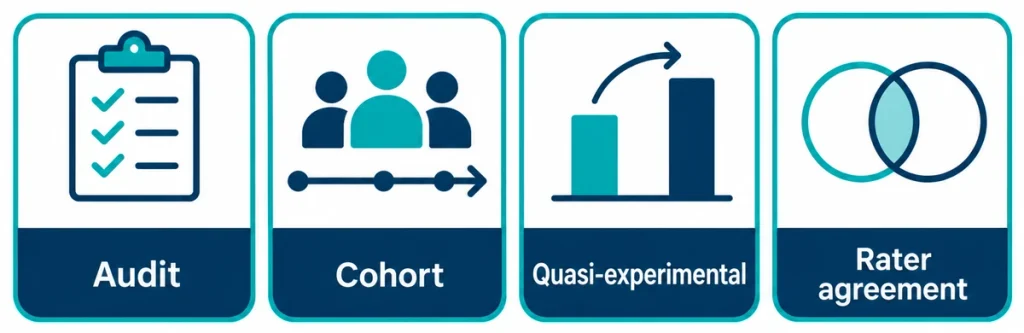
| Design | Fits topics | Main data source | What to report |
|---|---|---|---|
| Observational audit, one or two cycles | 1, 2, 4, 7, 9 | Checklists, charts and theatre registers | Proportions with confidence intervals |
| Prospective cohort | 6 | Daily site checks | Incidence and risk ratios |
| Quasi-experimental, before and after | 3, 5, 8, 11, 12 | Teaching session plus follow-up | Change in score or skill steps |
| Agreement between raters | 10 | Paired independent screens | Kappa and percent agreement |
Permissions and ethics on a ward
Every study with patients or staff needs approval from your university or hospital ethical review committee. Chart reviews may qualify for a waiver, but the committee decides, not you. Ask your supervisor which route applies before you write the proposal.
Observation also needs written permission from the nursing office and the ward in-charge. For teaching studies, patients need consent, and a patient who is too unwell to learn should not be recruited. Finally, anonymise names and record numbers before analysis. The chapter on how to write the methodology chapter shows where these steps belong.
Narrowing a ward idea in four steps
- Name one unit, such as a surgical ward, a dialysis shift or a neurology ward.
- Name one nursing step in that unit, such as a teaching session or a daily check.
- Choose one outcome you can count without a laboratory, such as completed steps or documented scores.
- Search earlier theses before you commit; the HEC repository guide explains how, and choosing a thesis topic helps with the final decision.
Common mistakes with medical-surgical topics
The first mistake is another knowledge survey. Many exist, so add an observed practice or a measured outcome instead.
Second, students claim cause from a single-ward audit. An association is the most you can show.
Third, they copy a licensed scale without permission. Check who holds the licence, and whether an Urdu version has been validated.
Finally, they ignore the clock. Ethical review can take weeks, and ward permission can take longer, so start both as soon as your proposal is accepted.
Frequently asked questions
How many patients or nurses do I need?
It depends on the design, so ask your supervisor before you fix a number. For an audit, a published proportion from a similar ward gives a starting point for the calculation. For before-and-after teaching, base the number on the change you expect in a score. A small stored sample may suit an MSN thesis if you state the limits.
Can I run a randomised trial as a nursing student?
Sometimes, but it is hard. You need two comparable groups, a way to stop them sharing information and enough time. A quasi-experimental design with a comparison ward is more realistic for most MSN theses, and examiners accept it when you describe the limits.
Is a chart review safe from an ethics point of view?
It carries less risk than patient contact, but the committee must still approve it. Remove names and record numbers, keep the data on a protected device and ask for a waiver of consent in writing if you need one.
Where to go next
If your idea also touches surgery, medicine or public health, more focused ideas sit in medical research topics. Other subjects are grouped in the thesis topics hub.
Once a topic is chosen, writing the research proposal is the next step. If you want structured help with the proposal, chapters or analysis, you can send your details through the order form for a quote. It is academic support for reference and learning, so use it according to your institution’s policy. You can also read what students say on the reviews page.