
How to Remove Plagiarism From a Thesis the Right Way

Your supervisor sends back Chapter 2 with a similarity report and one line in the margin: fix before submission. Say the overall figure reads 31%, one journal article accounts for 9% of it, and a paragraph you were sure you had paraphrased is highlighted from start to finish.
The shortcuts are easy to find: a paraphrasing tool, a plagiarism remover, a handful of swapped synonyms. None of them does what it promises. To remove plagiarism from a thesis, find each matched passage, work out why it matches, and then rewrite it from your own understanding, quote it with marks, or credit the source. That takes longer than pressing a button, but it is the only fix that survives a re-check and an examiner’s questions.
What You Are Actually Removing
A similarity score and plagiarism are different things. Turnitin explains that its percentage shows how much of your text matches the databases your institution selected. Its guidance for instructors adds that deciding whether plagiarism occurred takes more than the score. The HEC guidelines on reading the Turnitin report say the same: a high index is not a verdict, and the supervisor has to check each match.
So highlighted text falls into three groups. Properly quoted or cited material is legitimate, even though it matches. Common phrases, proper nouns and very short matches are usually harmless. The third group is the real problem: wording or ideas taken without credit, including close rewording of someone else’s sentences. That is what you remove, and no percentage can tell you it has gone.
A low figure can hide the third group, too. Turnitin’s own guidance notes that content spinners can produce a low score even when the work is not original.
The numerical limits are explained in how HEC reads the 19% and 5% limits. What follows is the repair work.
Step 1: Get a Report You Can Work With
Before you rewrite anything, find out which version of the report your department reads. The same chapter can show quite different figures depending on the exclusions applied.
Turnitin offers several filters, including exclusion of the bibliography, quoted text, cited text and small matches. The small-match filter starts at eight words, and eight is the lowest value allowed. The cited-text filter exists only in the newer version of the report.
HEC adds its own instructions. The Graduate Education Policy 2023 asks for the references and the table of contents to be removed before the file goes to Turnitin, because both push the index up. HEC’s guidelines also let evaluators set aside bibliography and quoted material after verifying them, and they warn that too much quoted material is not wanted. So follow the instruction on references and contents, but do not delete quotations or sections to lower the figure. The evaluator decides what to exclude.
Then ask for a chapter-wise report instead of one file for the whole thesis. A long document spreads a problem thin, whereas a single chapter shows it clearly. It also helps to ask which office runs the check, how many attempts you get and whether your earlier drafts are stored.
Position correct as of October 2026; check HEC’s current policy and your university’s instructions for the latest status.
Step 2: Sort Every Highlight Before You Touch the Text
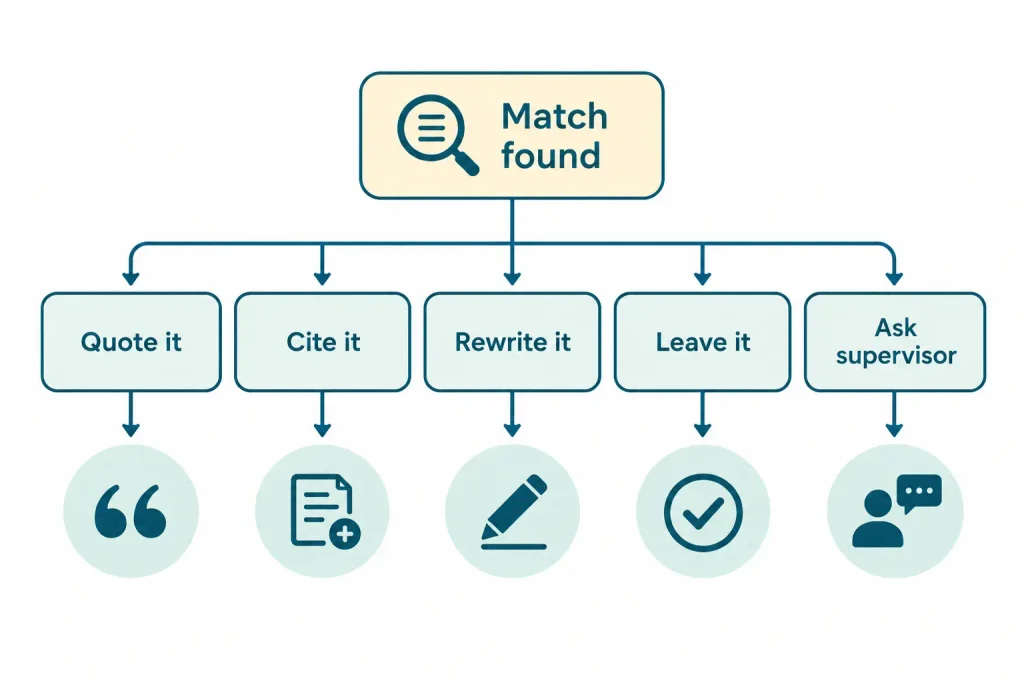
Open the report and start with the largest single source. HEC asks evaluators to look closely at any single source at 5% or more, so that source usually carries your biggest repair. Then decide which of five types each highlighted passage belongs to.
| What the match is | Where it usually sits | What to do |
|---|---|---|
| Quoted or cited text with correct marks | Literature review, definitions | Keep it. Shorten it if a chapter leans on long quotations. |
| Common phrases, standard terms, proper names, formulae | Anywhere | Leave short matches alone. Rewrite long stock sentences in your own words. |
| Standard procedure or adapted instrument | Methodology | Cite the source, name your changes, and describe your own steps in your own words. |
| Your own earlier work | Chapters built on a proposal, assignment or published paper | Cite or disclose it, then follow your university’s rule on reuse. |
| Close paraphrase or uncited copying | Literature review, background | Rewrite from notes, then cite. |
Most of the effort goes into the last row. The first three rows need small fixes, such as a citation or a shorter quotation. The fourth needs honesty about reuse. Only the last needs a real rewrite.
Step 3: Rewrite From Your Notes, Not From the Source Sentence
Swapping words inside someone’s sentence is not paraphrasing. The order of ideas, the evidence and the structure still belong to the author, and HEC’s Anti-Plagiarism Policy lists paraphrase plagiarism as a type of its own. A close rewrite can therefore pass a text-matching check and still fail a supervisor’s reading.
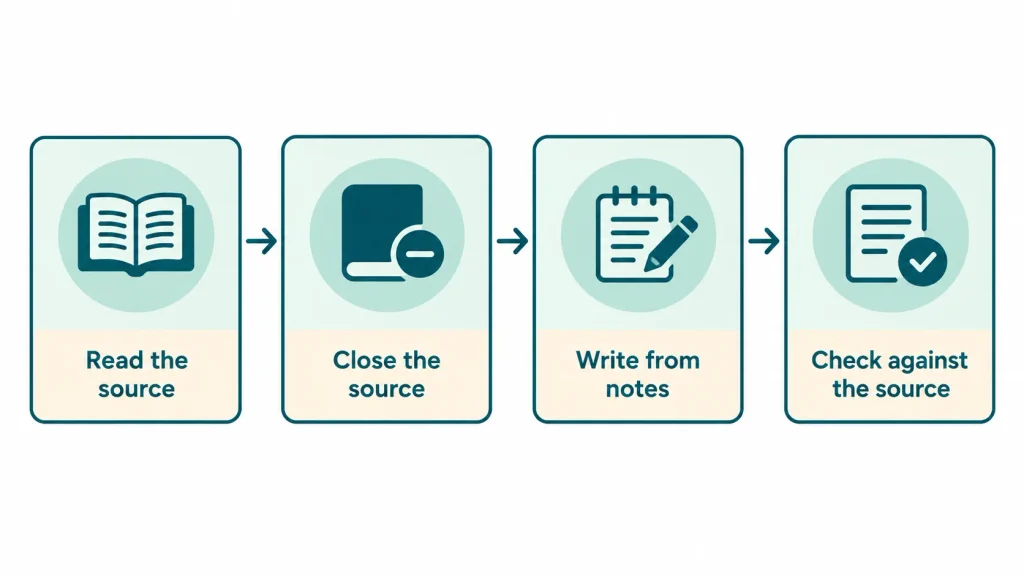
Use the close-the-source method instead.
- Read the passage until you can explain it aloud without looking.
- Close the source. Write one line of notes: the claim, the evidence and the page number.
- Write your sentence from the note, shaped by your own research question, not by the order the author used.
- Reopen the source and check facts only. Correct any error, then add the citation.
- Run the chapter through the check again.
A before-and-after illustration
The example below uses an invented source sentence, so no real author is quoted.
- Source sentence: Employees who can predict their weekly workload report higher job satisfaction than employees whose workload changes without notice.
- Swapped words (still a problem): Staff who can foresee their weekly work demands report greater job contentment than staff whose demands shift without warning.
- Rewritten from a note: Satisfaction seems to follow predictability: staff who know their week in advance report more of it (Author, Year). That is why Chapter 3 measures schedule notice as well as hours.
The second version keeps the source’s structure and its ideas in the same order. The third starts from what your own argument needs, and it credits the idea.
Quote only when the exact wording is the evidence
Some wording cannot change: a statutory definition, a scale item, a term an author coined. Put it inside quotation marks, add the page number and keep it short. Turnitin’s quoted-text filter ignores text inside quotation marks when it is switched on, which is why the marks matter. HEC still prefers not to see long stretches of quotation, so build the paragraph around your own sentences and let the quotation support them.
Where Thesis Similarity Usually Hides
Similarity clusters in a few places. Fixing them one by one is quicker than rereading the whole thesis.
The literature review
Chapter 2 is where retelling happens: one paragraph per article, in the article’s order. Instead, build a grid with one row per source and one column per theme, then write from the grid. Each paragraph then compares sources on a theme, so no single source drives the wording. The full method is in the guide to writing a literature review for a thesis.
Methodology and adapted instruments
Standard procedures read the same in every thesis, so they match easily. Describe what you actually did, in the past tense and in your own words. Cite every scale you adapted and say what you changed. The methodology chapter walkthrough shows how to justify each choice instead of copying a textbook description.
Your own earlier writing
Self-plagiarism is on HEC’s list of plagiarism types. Even so, HEC’s guidelines say matches with your own previous work may be ignored if it is the same work, and the same holds for matches from the student repository. So a proposal or seminar paper that reappears in your thesis is a question of disclosure, not of deletion.
Keep a record of what you submitted earlier, and tell your supervisor before the report is run. For doctoral scholars, HEC’s policy asks for publications from the research, so some overlap with your own articles is expected. The rule is outlined in how HEC’s publication requirement fits PhD thesis format. Cite the article where the text appears, then confirm with your university how published material may be reused.
Definitions and background
Stock definitions match across hundreds of documents. Cite the definition, then add what only you can: how you use the term, where it came from and how it differs from a neighbouring term in your study. A short quoted definition with a page number is fine when the exact words matter.
Findings and conclusion
HEC’s policy expects similarity in the findings and conclusion to stay at or below 9%. Those sections report your own data, so a match there usually means borrowed discussion language. Rewrite the discussion around your results first and the literature second. The policy also allows results, conclusion and recommendations to be uploaded separately, so ask your department whether it uses that option.
Position correct as of October 2026; check HEC’s Anti-Plagiarism Policy for the current status.
Why Paraphrasing Tools and Plagiarism Removers Do Not Work
No software removes plagiarism, because plagiarism is a question of credit, not of score. A spinner can lower the overlap a checker reports. As CASRAI’s guide to AI paraphrasing and plagiarism risk points out, that happens without making the reused text original. The ideas and their order stay the same, and only the wording changes.
Detection has also moved on. Turnitin added AI paraphrasing detection in July 2024. It later announced AI bypasser detection for English submissions at institutions that have its AI writing detection switched on. These checks give reviewers a flag to examine, not a verdict, and false positives are a documented risk. If your own honest writing is ever flagged, your notes, drafts and version history are the evidence that matters.
HEC’s policy also covers this ground. It lists text modification by software, such as spinners and translation tools, among the forms of plagiarism. Penalties scale with how deliberate the act was and how much text is involved, from a mandatory research ethics course up to suspension or expulsion. Position correct as of October 2026; check the policy for the current text.
Language help is a different matter. Correcting grammar in your own sentences is not the same as rewording someone else’s. Check your university’s rule on AI tools, and disclose any use it requires.
Step 4: Recheck, Then Stop When Every Highlight Has a Reason
After you rewrite a chapter, run it again. Expect the figure to move, because databases grow and your earlier draft may now be stored as a source. Judge the result by the highlights, not by the number alone.
Never delete a matched sentence just to remove a highlight. A missing citation is still missing. A chapter is ready when each of these is true:
- Every highlighted passage of more than a few words is quoted, cited, common wording or your own credited work.
- The largest single source is under 5%, or your supervisor has agreed it is justified.
- The findings and conclusion are checked on their own and sit at or below 9%.
- You can explain each rewritten passage aloud, without the source open.
- You have kept your notes and drafts.
If Your Supervisor Has Already Raised Serious Concerns
Show the report early. HEC’s guidelines say a supervisor may guide the scholar when similarities are significant, or report the case on that evidence. Showing the report before final submission keeps the conversation on rewriting. Bring your notes, the largest sources and a short plan for the three worst chapters.
Quick Answers
How much plagiarism is allowed in a PhD thesis?
HEC’s own FAQ says plagiarism is not allowed at all. The 19% overall figure, the 5% single-source figure and the 9% findings figure are screening points for evaluators, not amounts you may use. A PhD dissertation must also pass the similarity test before it goes to external experts, under the Graduate Education Policy. Position correct as of October 2026.
How do I remove self-plagiarism from a thesis?
You rarely delete it. Cite your earlier proposal, assignment or article where the text appears, and rewrite any passage that is not the same work. Then ask your supervisor how your university treats reused published material. Evaluators may ignore matches with your own same work, but they must be able to see that it is yours.
Why did the figure rise after I rewrote the chapter?
Three causes are common. Your new wording may now match a different source. Your earlier draft may be stored in your institution’s repository and match your final text. Or the report may have been run with different settings, such as the references left in. Open the largest source in the new report to see which one applies.
Getting a Second Reader Before You Resubmit
Rewriting a flagged chapter takes judgment, and a second reader catches what you have stopped seeing. If a supervisor has returned a report, you can send the report and your deadline and say what is flagged. We will tell you what help makes sense: feedback on rewriting, editing, proofreading and referencing. Written by subject writers, not generated by AI tools.
Doctoral candidates with several flagged chapters can start with PhD thesis help. Students who want to hear from others can read real reviews from students. Support is for reference and learning, so use it according to your institution’s policy.