
How to Write a Literature Review for a Thesis: From Search to Synthesis
It is week six of the semester. You have forty PDFs open, a supervisor who says Chapter 2 “reads like a list”, and a draft that is four pages of “[Author A] found this, [Author B] found that”. Before you write another paragraph, a few questions need honest answers.
- Where do I look, and how do I know a source is good enough to use?
- Should I organise the chapter by theme, by date or by method?
- How do I stop summarising and start building an argument?
- How do I show a research gap without claiming that nobody has ever studied my topic?
- Will my similarity report cause trouble if I paraphrase a lot?
A literature review in a thesis is a structured argument. It shows what existing research says, where studies agree or conflict, where the evidence is weak, and why your own question follows from all of that. Summaries of individual sources are only the raw material.
This guide covers the literature review chapter of a BS, MS, MPhil, MBA or PhD thesis, usually Chapter 2. A stand-alone systematic review follows a stricter protocol, so it is covered only briefly below.
What a Thesis Literature Review Does
Its purpose in your thesis
The chapter proves that you understand your field. It also justifies your research question, explains why you chose your theory and method, and shows what your study adds. Examiners read it to check whether your question is necessary, not just interesting.
Where it sits
Chapter 1 introduces the problem, aims and questions. The literature review usually follows as Chapter 2, and the methodology comes next. Some universities place the theoretical or conceptual framework inside Chapter 2, while others give it a separate chapter. Formats differ, so follow your department’s handbook and ask your supervisor for a recently approved thesis as a model.
What Chapter 2 usually contains
Most chapters include a short introduction, a body organised around themes or debates, a framework section, a statement of the gap, and a conclusion that leads to your research questions or hypotheses. A review is not an annotated bibliography. An annotated bibliography describes sources one by one, whereas a review arranges them around ideas.
How to Write a Literature Review Step by Step
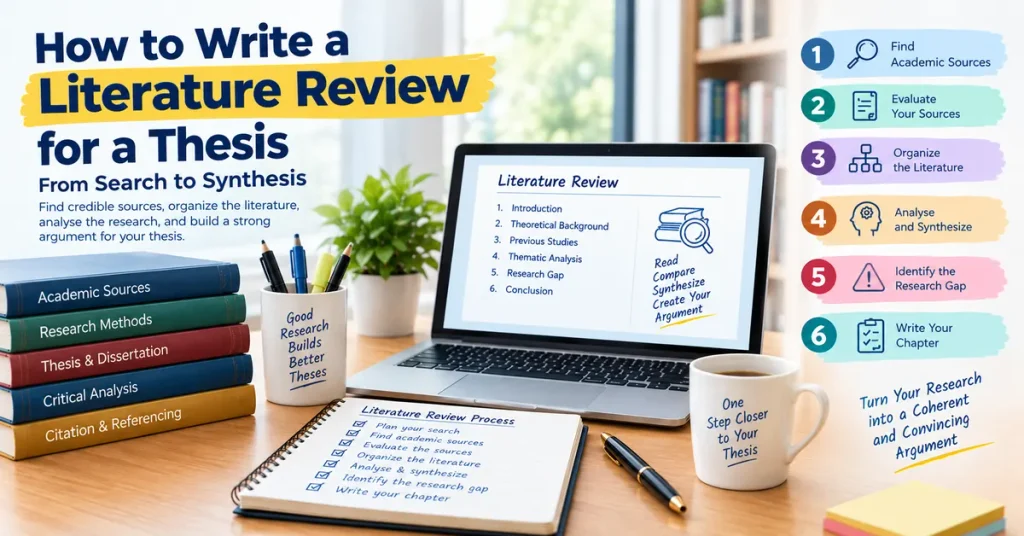
The work moves in a clear order. Each step is explained in the sections that follow.
- Narrow your focus and turn your question into search terms.
- Search scholarly databases and record every search.
- Screen sources for relevance and credibility.
- Read critically and fill in a literature matrix.
- Group the studies into themes or debates.
- Synthesise, then identify the gap.
- Write the introduction, body and conclusion.
- Paraphrase, cite and check the draft against a checklist.
Define Your Focus and Search Terms
Start with a narrow question
A review is much easier when the topic is narrow. “Employee motivation” produces thousands of studies. “Work engagement among bank employees” produces a manageable field. Students still shaping a topic can look at the narrow ideas in business administration thesis topics, nursing thesis topics or computer science thesis topics.
Use keywords and synonyms
List the main concepts in your question, then add alternative words for each. For example, “employee engagement” may also appear as “work engagement”. Combine them with AND and OR so the database finds both. A search might look like this: (“employee engagement” OR “work engagement”) AND (bank* OR “banking sector”) AND Pakistan.
Set inclusion and exclusion criteria
Decide in advance what counts. For instance, you might include peer-reviewed studies in English from a stated period that study working adults. Then you might exclude opinion pieces and studies with no described method. Writing these rules down keeps your selection consistent, and you can reuse them in your methodology section.
Keep a search log
Record the database, date, search string and number of results each time. This takes five minutes and saves hours later, because you can repeat a search or explain it to your supervisor.
How to Find Academic Sources for a Literature Review
Use your university library first
The Higher Education Commission runs the National Digital Library, which gives member universities access to journals, databases and e-books. Some resources are basic and others are premium, so access varies by university. Log in through your library portal or its VPN, and ask the librarian which databases cover your subject.
Match the database to your field
- Health and nursing: PubMed.
- Education: ERIC.
- Computing and engineering: IEEE Xplore and the ACM Digital Library.
- Management and social sciences: ScienceDirect, JSTOR, Emerald, Taylor & Francis and Wiley, depending on what your university subscribes to.
Scopus and Web of Science are citation indexes rather than full-text libraries. They help you map a field and see who cites whom, and you then open the paper through a resource your library provides.
Follow the citations
Google Scholar is useful for a first sweep. Its “Cited by” feature shows newer work built on a key paper. In addition, the reference list of a recent review article is a ready-made reading list. Also check your supervisor’s papers and past theses from your own department.
Be careful with open sources
Open-access journals can be excellent, and the Directory of Open Access Journals is a helpful check. However, some journals promise very fast publication with little real peer review. If a journal gives no clear editorial board or review process, treat its articles with caution.
How to Evaluate Literature Review Sources
Ask the same questions of every source, whether it comes from Pakistan or abroad.
Relevance
Does the study address your concept, population or context? A strong paper on a different topic still does not belong in your review. Check the abstract and the method before you read further.
Credibility
Look at who published it, whether it was peer-reviewed, and whether the method is described clearly enough to judge. Check whether the paper has been corrected or retracted. Prefer primary studies over blogs, and use textbooks mainly for definitions and background.
Currency and classics
Recent work shows the current state of evidence. However, a foundational paper that defined your concept still deserves a place. Cite it, then show how later studies developed it.
A note on HEC journal categories
HEC’s Journal Recognition System sorts journals into W, X and Y categories. It mainly serves publication requirements for faculty and doctoral scholars. For reading, it is one signal among several. A journal’s category does not prove an individual article is sound, so read the method yourself.
Build a Literature Matrix
A matrix turns forty PDFs into something you can compare. Create one row per source and fill in the same columns every time. The example below uses placeholders.
| Source | Aim | Sample and context | Method | Key findings | Limitations | Use in my review |
|---|---|---|---|---|---|---|
| [Author A, Year] | [What it tested] | [Who, where, how many] | [Survey, interviews, experiment] | [Main result] | [What it cannot show] | [Theme 1, definition] |
| [Author B, Year] | [What it tested] | [Who, where, how many] | [Method] | [Main result] | [Weakness] | [Theme 1, contrasts with A] |
The last column matters most. Once every row says where the source belongs, your themes appear on their own. Free tools such as Zotero or Mendeley can store the PDFs and generate your reference list at the same time.
How to Organise the Literature
Choose the structure that fits your question, not the one that is easiest to write.
| Approach | Best when | Risk |
|---|---|---|
| Thematic | You are comparing ideas, factors or findings across many studies | Themes can overlap if you define them loosely |
| Chronological | The history of a concept, policy or technology matters | It can turn into a timeline with no argument |
| Methodological | Your question depends on how studies were conducted | It can hide what the studies actually found |
| Theoretical | Competing theories explain the same problem | Students sometimes describe theories without testing them against evidence |
Most strong chapters mix approaches. For example, you can use themes as your main sections and place studies in date order inside each theme. In short, if your sections are named after authors, you are probably summarising instead of organising.
Literature Review Structure for a Thesis
An illustrative Chapter 2 outline
This outline is only a model. Your headings should come from your own themes.
- 2.1 Introduction
- 2.2 Work engagement: definitions and measurement
- 2.3 Drivers of engagement among bank employees
- 2.4 Engagement and job performance
- 2.5 Evidence from Pakistan
- 2.6 Theoretical framework
- 2.7 Research gap
- 2.8 Summary and research questions
How to write the introduction
Keep it short. Name the topic, explain the scope, say how the chapter is organised, and briefly state how you searched. Do not repeat Chapter 1.
How to write the body
Each section should open with a claim, support it with several sources, compare them, and close by connecting back to your question. A reader should be able to read only your topic sentences and follow your argument.
How to write the conclusion
Summarise what is well established, what is contested and what is missing. Then state your research questions or hypotheses, so the next chapter feels like a natural step. Add no new sources here.
Critical Analysis vs Summary
A summary reports what a study says. Critical analysis judges how far the evidence can be trusted and how it fits with other studies. Examiners want the second.
Questions that turn a summary into analysis
- How was the sample chosen, and who is missing from it?
- Were the measures valid for this population?
- Does the design allow the conclusion, or does it only show an association?
- Does the context match mine?
- What do the authors themselves admit as limitations?
Be fair and specific. “The study used one organisation, so findings may not generalise” is a useful point. “This study is weak” is not.
A weak and a strong paragraph
Weak: “[Author A, Year] studied engagement in banks and found that supervisor support mattered. [Author B, Year] studied engagement in telecom firms and found that pay mattered.”
Stronger: “Studies broadly agree that supervisor support shapes engagement ([Author A, Year]; [Author B, Year]). However, [Author C, Year] found no effect, which may reflect a different sector and a shorter measurement scale. Most of these studies rely on one-time surveys, so causal claims remain limited.”
The second version compares, explains a disagreement and states a limitation. Replace the bracketed placeholders with your own real sources.
How to Synthesize Sources in a Literature Review
Synthesis means combining sources to say something none of them says alone. A reliable paragraph pattern has five parts.
- State the claim or theme.
- Present evidence from two or three sources.
- Show where they agree or differ.
- Explain why, using sample, method or context.
- Connect the point to your research problem.
Transition words do real work here. Words such as “similarly”, “in contrast”, “as a result” and “however” show the reader how your sources relate. Use them naturally, not in every sentence.
How to Identify Research Gaps
A gap is a specific, evidenced shortfall in what is known. Look for these types:
- Evidence gap: findings conflict or are thin.
- Population or context gap: studies cover a different group or setting.
- Method gap: studies use only one design or measure.
- Theory gap: a framework has not been applied to your setting.
- Time gap: the evidence is old and conditions have changed.
The best evidence for a gap sits in the limitations and “future research” sections of recent papers. If several authors point to the same missing piece, you have a defensible gap.
A missing local study is a weak gap on its own. Instead, explain why the context would change the result, such as a different regulation, market or population. Then show how your research question answers the shortfall.
Literature Review Methodology: Explain Your Search and Selection
Even a narrative review benefits from a short statement of how you found your sources. It tells examiners the review was not selective by accident. A simple version reads: “Sources were searched in [databases] between [dates] using the terms [search terms]. Studies were included if [criteria].”
A systematic or scoping review needs more. It follows a written protocol and usually reports the selection process in a PRISMA flow diagram. Ask your supervisor early which type your department expects.
Paraphrasing, Citations and Similarity
The HEC Anti-Plagiarism Policy (Version 2.0) applies to students at all HEC-recognised universities. It counts rephrasing a source’s ideas without credit as plagiarism. It also names mosaic plagiarism, where phrases from several sources are woven together, and the use of text-spinning software to avoid detection.
The policy treats a similarity index of 19% or less as acceptable, with less than 5% from any single source. It also says the index is a guideline and an alert, not proof of plagiarism, so your supervisor interprets the report. A bibliography lists sources you consulted, so it does not excuse copied text. For machine-generated text, the policy’s FAQ says copying it without attribution is plagiarism, and warns against relying on AI for insights and conclusions.
Position correct as of October 2026. Check HEC and your university for the current rules.
A safer way to paraphrase
Read the passage, close the source, and write the idea from your notes. Then compare your version with the original, change any shared phrasing, and add the citation. This builds your own sentences instead of editing someone else’s. Use direct quotes rarely, and only when the exact wording matters.
Reference consistently
Follow the style your department requires, usually APA or Harvard. A citation manager keeps in-text citations and the reference list matched. Check that every source you cite appears in your list, and that every item in the list is cited.
Common Literature Review Mistakes and How to Fix Them
| Mistake | Why supervisors flag it | Fix |
|---|---|---|
| Describing sources one by one | It reads as a list with no argument | Reorganise around themes and compare sources inside each section |
| Weak or irrelevant sources | It lowers the credibility of the whole chapter | Re-screen with your inclusion criteria and replace blogs with primary studies |
| Too many direct quotes | It hides your voice and raises similarity | Paraphrase and keep quotes for essential wording |
| A gap with no evidence | Examiners ask how you know | Support it with limitations, conflicts or context differences from named studies |
| Review does not match the research questions | The chapter feels disconnected from the study | Check that each theme leads toward a question or hypothesis |
| No record of the search | You cannot explain or repeat it | Keep a simple search log from the start |
| Citation and reference mismatches | It signals carelessness | Use a citation manager and check both lists before submission |
Literature Review Checklist for a Thesis
- Is my topic narrow enough to review in one chapter?
- Did I record my search terms, databases and dates?
- Are my sources peer-reviewed, relevant and clearly described?
- Does each section make an argument instead of listing studies?
- Have I compared studies and explained disagreements?
- Have I stated limitations of the evidence fairly?
- Is my research gap supported by named evidence?
- Does the chapter end by leading to my research questions?
- Is every idea paraphrased in my own words and cited?
- Do my in-text citations and reference list match exactly?
Where to Go Next
Start with the matrix, because it makes every later step easier. Then draft one theme at a time and send each section to your supervisor, instead of waiting for a complete chapter.
For several years, students have come to us with a stalled chapter, a supervisor’s red pen and a deadline that will not move. If you would like feedback on a Chapter 2 draft, help with structure, or editing of your reference list, you can send your details through the order form for a quote. The support is meant for reference and learning, so use it according to your institution’s policy. You can also read what students say about working with us.