
Medical Laboratory Technology Research Topics: Bench Studies, Blood Banks and Lab Quality in Pakistan
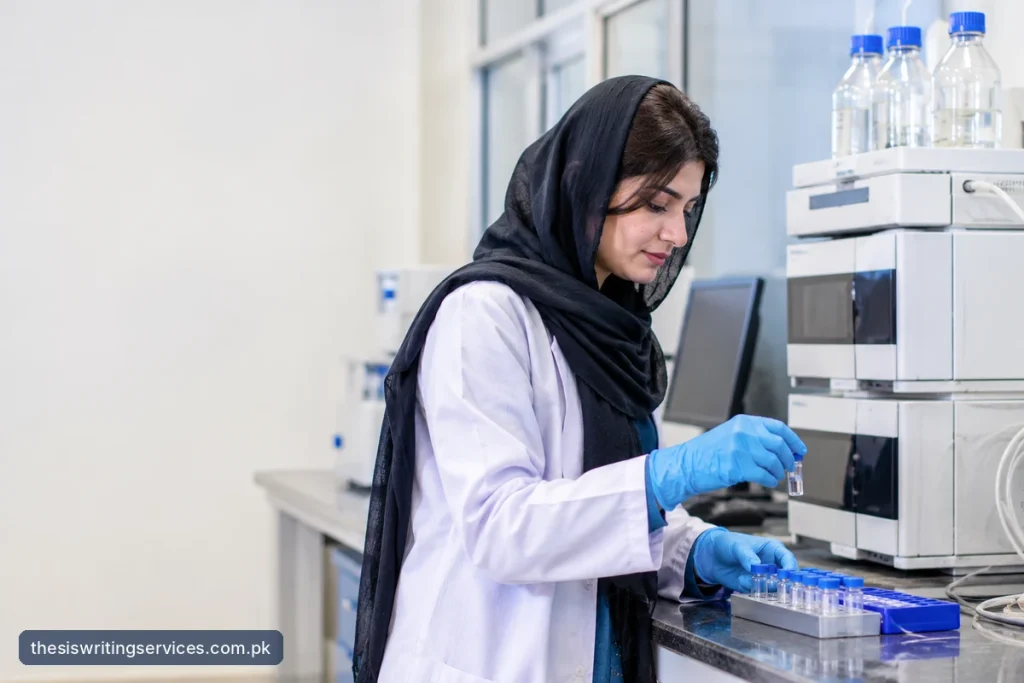
Before you commit to a lab thesis, a few questions usually decide whether it will finish. Do I have a reference method I can actually test against? Can I collect enough samples from one hospital in one semester? Will my ethics committee accept leftover blood, or will it want consent for every tube? Does my department own the HPLC, the PCR machine or the HEp-2 slides this idea needs?
Medical laboratory technology is wider than one thesis can cover, so the twelve topics below stay on the bench side. They cover haemoglobin disorders, blood banking, clinical chemistry, cytology, autoimmune serology and laboratory quality. Culture, resistance and infection work sits in the medical microbiology research topics list, and clinical-medicine ideas fit better in the wider medical research topics overview. If your department is nursing rather than laboratory science, the nursing thesis topics will suit you better.
What makes a lab thesis hold up
A strong lab thesis has three things: a named reference method, a defined sample and one honest statistic. The statistic is usually sensitivity and specificity, agreement, prevalence or a difference between groups. Without a reference method, a new cut-off or a cheaper test cannot be judged, so examiners tend to push back on that first.
Most of the Pakistani studies cited below come from a single hospital. That is normal for a student project, but it shapes your claim. A result from one analyser in one city tells you whether the idea works there, not everywhere. State that limit in your own conclusion instead of waiting for the examiner to point it out.
Haemoglobin disorders and red cell screening
Beta thalassaemia trait is common in Pakistan, and the laboratory decides who is told they are a carrier. That makes three narrow, bench-level questions possible.
1. Is the HPLC HbA2 cut-off right for my laboratory?
A 2025 validation study at the Armed Forces Institute of Pathology tested 243 patients with microcytic indices and compared HPLC with PCR. At a cut-off of 4.0%, the Rawalpindi HbA2 validation study reported 96.2% sensitivity and 93.8% specificity. Its ROC curve placed the best lower limit at 3.95%.
One referral population and one platform produced that figure. A thesis can ask whether the same cut-off holds on your analyser and your patient mix, using ARMS-PCR or sequencing as the reference. That study excluded transfused patients and those with abnormal iron studies, so write your own exclusion rules down before you start.
Level: MS or MPhil in haematology. A BS project works if the host laboratory already runs the PCR.
2. Which borderline HbA2 cases need molecular testing?
Values between 3.0% and 3.9% can hide a carrier. In a borderline HbA2 study from Rawalpindi, 123 people in that range were tested by ARMS-PCR. Of them, 58 (47.1%) carried a mutation, and IVS1-5 and Fr8-9 accounted for 19 each. Mutations were commoner at 3.5% to 3.9% than at 3.0% to 3.4%, and carriers had lower MCV and MCH.
A practical thesis question follows. Which mix of MCV, MCH and ferritin most reliably picks out the borderline cases worth sending for DNA testing? Remember that the panel covered common mutations only. A negative result on that panel does not prove someone is a non-carrier, so word your conclusions carefully.
Level: MS or MPhil.
3. Can a low-cost screening cascade replace HPLC for first-pass testing?
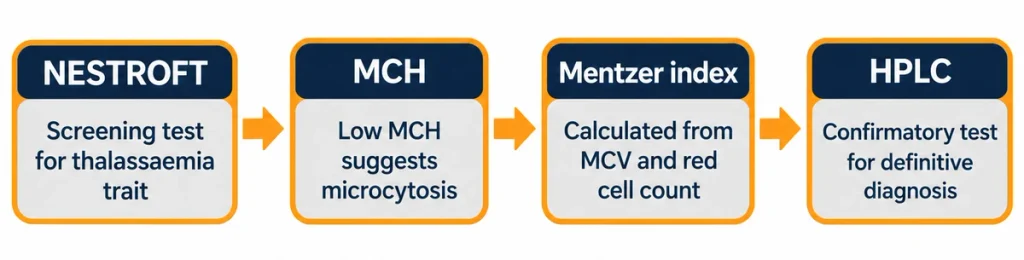
Many district laboratories cannot run HPLC on every sample. A Dow-led screening of 915 medical students used NESTROFT first. Of 390 positives, the Dow student screening study found that 282 had a blood count pattern of iron deficiency, and the rest went to HPLC. Only 2.4% were carriers, and the overall prevalence was 4.1%.
Red cell indices offer another cheap filter. In a Peshawar red cell indices study of 203 patients with the trait, MCH below 26 gave 99% sensitivity and the Mentzer index was below 15 in 97%. That design enrolled only people who already had the trait, so it cannot measure specificity. A new thesis could test NESTROFT, MCH and the Mentzer index against HPLC in the same group and report the cost per carrier found.
Level: BS final year, with HPLC done by a partner laboratory.
Blood bank and transfusion safety
Blood bank theses work best when they use records the blood bank already keeps. They also carry real public health weight.
4. How common are red cell alloantibodies in transfusion-dependent thalassaemia?
Two Pakistani series report very different frequencies. In an Abbottabad series of 302 patients, 12 (4.0%) were alloimmunised, and anti-Cw was the commonest antibody. Those patients received non-leukodepleted blood, and the authors stated that no thalassaemia centre in Pakistan gave phenotype-matched blood for Kell, Kidd or Duffy at the time. A five-year paediatric series found 22 alloimmunised children (26.19%), mostly Rhesus (77.3%) followed by Kell (22.7%), linked to family history and splenectomy.
Such a wide gap is a reason to compare methods before comparing numbers. Panel type, transfusion count, leukodepletion and age all differ. A thesis can screen a thalassaemia centre’s patients, record those variables, and report which of them tracks with antibody formation. Note that the Abbottabad study excluded DAT-positive patients, so define your own exclusions.
Level: MS or MPhil. BS only with direct blood bank access.
5. Do replacement donors carry more infections than voluntary donors?
At the Peshawar Regional Blood Centre, 41,817 donors were screened between June 2016 and May 2020. The overall rate was 4.61%, which was 3.90% in voluntary donors and 5.42% in replacement donors. The rates for HBV, HCV, HIV and malaria were 1.95%, 1.38%, 0.23% and 0.14%, according to the Peshawar donor seroprevalence paper. Only 0.78% of donors were women.
The same record-based design can run at another centre or compare year by year. Donor records in that study were anonymised by code, which is a good model for your own ethics application. The paper also said eight centres were using nucleic acid testing, though it was not mandatory. That describes 2021, so check the current position with the provincial blood transfusion authority before you present it as today’s fact.
Level: BS or MS, because the data already exist.
Clinical chemistry and point-of-care testing
Chemistry theses are strongest when they challenge a number that clinicians use every day.
6. Does iron deficiency change HbA1c in people without diabetes?
Three Pakistani studies approach this from different sides. A Karachi Civil Hospital study compared 230 non-diabetic patients, with and without iron deficiency, and correlated HbA1c with serum iron and transferrin saturation. A Baqai Institute study of 139 people with normal glucose tolerance found HbA1c higher in anaemic men with MCV below 76 fl, but similar in women. An Islamabad study of 140 women split them into four groups by diabetes and anaemia.
All three compare groups at one point in time. A study that follows the same people before and after iron replacement would answer a different question. Searches for this topic did not turn up a Pakistani before-and-after design, so check the literature again before you commit. Also decide early how you will define iron deficiency, because ferritin and transferrin saturation do not always agree.
Level: MS in chemical pathology.
7. Where do bedside glucometers disagree with the laboratory?
An Aga Khan University study of 110 patients found good agreement between a glucometer and the laboratory analyser from 3.3 to 16.7 mmol/L. Outside that range the difference was significant. In the Aga Khan glucometer comparison, mean turnaround was 0.08 hours at the bedside against 2.49 hours in the laboratory, and bedside testing cost 48.8% less.
Interference is the second angle. A Karachi test of four meters against a hexokinase method showed that haematocrit and ascorbic acid shifted readings. The Ziauddin interference study reported that two devices met ISO 15197:2013 and two did not. Both papers are old and the devices have changed, so a current thesis should name the exact model and strip lot. A ward-level comparison in anaemic or dialysis patients would add something new.
Level: BS or MS.
8. Do published haematology reference intervals suit my laboratory?
Reference intervals decide what is flagged as abnormal. Aga Khan University Hospital measured 21 haematology analytes in adults aged 18 to 60, kept 297 participants after removing 26 outliers, and used the nonparametric CLSI EP28-A3C method. The authors report in the Aga Khan reference interval paper that these values differ from Caucasian ranges.
Two student angles exist. First, check whether those intervals hold on your analyser and in your city. Second, look at a group the study did not cover, such as people over 60. Recruiting healthy volunteers is slow and needs ethics approval, so plan the screening questionnaire and sample numbers early.
Level: MS or PhD.
Cytology and autoimmune serology
These two areas depend on pattern reading, so agreement and ordering behaviour make good research questions.
9. How reliable is the Bethesda system for thyroid aspirates?
At Liaquat National Hospital, 528 patients had thyroid FNAC and 61 went on to surgery. The Liaquat National Bethesda study reported accuracy of 80.3%, sensitivity of 64.3% and specificity of 85.1%, with a high malignancy rate in category 3. A smaller Shaukat Khanum series of 36 cases reported 63.9% accuracy, and its thyroid correlation paper noted five non-diagnostic smears.
Agreement is a separate question. In an Islamabad interobserver study of 200 aspirates, three histopathologists reached kappa values from 0.735 to 0.841. A thesis could test agreement on the indeterminate categories using a fixed slide set. Be aware of verification bias: only the surgical cases have a histology answer, which was 61 of 528 at Liaquat National.
Level: MS in histopathology or cytology.
10. Are antinuclear antibody requests ordered and read sensibly?
At the Indus Hospital in Karachi, 1,000 patients were tested for ANA by immunofluorescence, and 260 (26%) were positive. Homogenous and speckled patterns made up 41.9% and 39.6% of positives. The authors of the Indus Hospital ANA audit called the ordering of follow-up antibody tests unjustified and asked for cost-effective protocols.
Titre thresholds matter too. A Lahore series of 1,966 samples treated 1:80 as positive and found 55% positive in the Shaukat Khanum ANA study. Since ANA also appear in healthy people, a thesis could compare titre and pattern with the final clinical diagnosis. A laboratory-side alternative is validating in-house slides, as the Rawalpindi HEp-2 validation did against commercial slides on 305 sera.
Level: MS in immunology or pathology.
Laboratory quality, turnaround and regulation
Quality theses suit students who cannot easily get patient samples. They also give a laboratory something it can act on.
11. Where do pre-analytical errors actually start?
The Armed Forces Institute of Pathology tracked five pre-analytical indicators across 272,731 chemistry samples. Haemolysis affected 2,306 (0.84%) and 604 samples never arrived. Night shifts had significantly higher rates for the first three indicators, according to the AFIP pre-analytical audit.
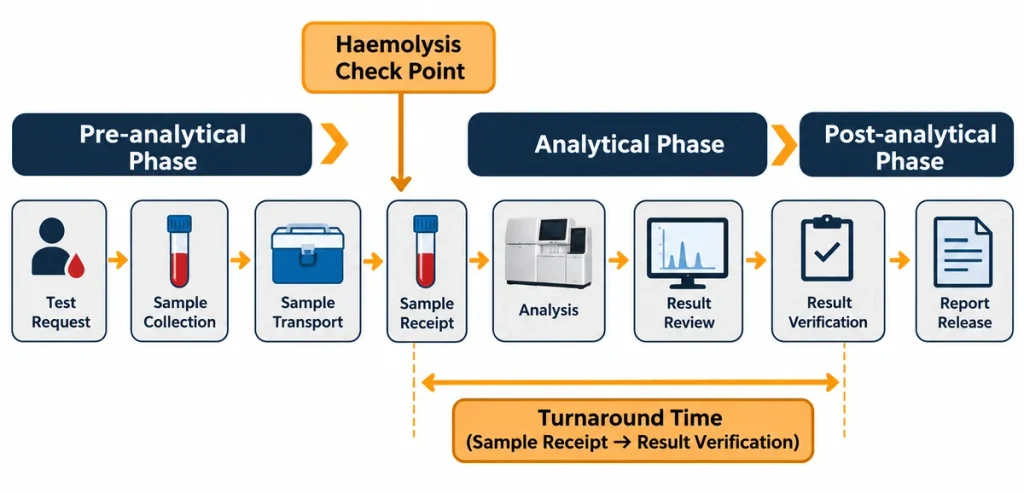
The study compared shifts but could not say which collection point or collector was responsible. A thesis can split haemolysis by emergency, ward and outpatient collection, then measure again after phlebotomy retraining. Record the collector, the tube type and the time, because otherwise you cannot attribute a cause.
Level: BS or MS. This is one of the safest topics for a short project.
12. Does my laboratory meet turnaround and licensing standards?
Turnaround time is easy to define and hard to improve. In an Aga Khan stat test audit, 408 of 20,079 samples (2.03%) were reported after the acceptable time. Those samples came from 2001, so a current replication is itself a defensible aim. Use the same definition, from receipt to result verification.
You can then map findings against the Punjab Healthcare Commission’s clinical laboratory standards. The commission’s laboratory standards list a manual with 37 standards and 118 indicators for clinical laboratories. In 2023, Dawn’s report on the revised laboratory standards quoted a speaker saying that about 900 of more than 1,800 laboratories in Punjab were registered. For accreditation, one Lahore laboratory’s accreditation document shows a scope under ISO 15189:2022. A gap analysis against that standard is a realistic MS project. Position correct as of November 2026; check the Punjab Healthcare Commission and the Pakistan National Accreditation Council for the current requirements.
Level: MS in laboratory quality or management. Get written permission before naming a laboratory.
Matching the question to a design and a statistic
Your question decides the design, and the design decides the statistic. The table below shows the usual pairings for the twelve topics. If you are unsure about the wording of your methods chapter, the guide on how to write the methodology chapter covers the structure, and the guide to choosing a research methodology helps with the quantitative choices.
| Your question | Design | Usual statistic | Topics |
|---|---|---|---|
| Does a cut-off or test work? | Diagnostic accuracy study | Sensitivity, specificity, ROC with confidence intervals | 1, 2, 7, 9, 10 |
| How common is it? | Cross-sectional or record review | Prevalence with confidence interval | 3, 4, 5 |
| Do two groups differ? | Comparative cross-sectional | t-test, Mann-Whitney, correlation | 4, 6 |
| Do raters or methods agree? | Agreement study | Cohen’s kappa, Bland-Altman | 7, 9 |
| Did a change help? | Audit or before-and-after | Proportions, run charts, Six Sigma | 11, 12 |
| What is normal here? | Reference interval study | Nonparametric percentile intervals | 8 |
Ethics and samples before you start
Leftover samples and stored records still need ethics review in most institutions. Ask your supervisor which committee applies and whether anonymised records qualify for a waiver. Blood donors, thalassaemia patients and children are vulnerable groups, so de-identify data at the point of collection, as the Peshawar blood centre team did.
Before you commit, search for earlier work. The HEC research repository of theses shows what other universities have already submitted, which stops you repeating a finished project. If the sample size or design section is where your proposal stalls, one-to-one thesis and proposal support can help you plan it with a supervisor-ready structure.
Where lab theses lose marks
- There is no reference method, so accuracy cannot be calculated.
- Exclusion rules change halfway through, which makes the sample hard to defend.
- Numbers from studies with different cut-offs are compared as if they were equal.
- The sample size is a convenience figure with no reasoning behind it.
- Device or kit details are missing, so nobody can repeat the work.
Narrowing a lab idea in practice
Pick the bench you can reach, not the topic you like most. Start from the instrument and records your department already has. Then write the one comparison you can finish in a semester, such as one cut-off against one reference method in one group. The guide on choosing a thesis topic walks through that narrowing, and writing a research proposal shows how to present it. Other subjects sit in the full thesis topics directory.
Frequently asked questions
Can a BS student use a molecular result in a laboratory thesis?
Yes, if the host laboratory runs the test as part of routine work. Agree in writing which results you may use, who ran them and how they will be credited. Then your study can treat the PCR as the reference without needing your own molecular bench.
Is a retrospective record review acceptable for an MS thesis?
Many published Pakistani laboratory studies are record reviews, including the Peshawar donor study and the Indus Hospital ANA audit. Acceptance depends on your university and supervisor, so ask before you build the plan. Ethics approval is still needed.
Which topic is safest for a short BS project?
Topics based on existing records or routine results carry the least risk, such as 5, 10 or 11. They need no new patients, so delays come mainly from ethics and permissions. Whichever you choose, this list is for reference and learning, and you should follow your institution’s policy on how it is used.
Student feedback from past projects is available in the student reviews if you want to see how others found the process.