
MPhil Thesis in Pakistan: Structure, Format and Length

Your supervisor says “around 80 pages.” A classmate at another university finished with far fewer. The HEC policy you found online says nothing about chapters at all. Before you plan the next six months, a few questions need straight answers:
- How many words does my MPhil thesis need, and who decides that?
- Does HEC set the format, or does my university?
- Which chapters will my examiner expect to see?
- Who reads the thesis, and what happens if they ask for changes?
- What does the viva actually mark?
Here is the short answer. HEC fixes only the floor for an MPhil: credit hours and duration. Length, chapters, referencing, binding, examiners and the viva all come from your university’s own regulations, and they differ a lot. The examples below come from Pakistani universities and institutes, each with its source, so you can compare them with your department’s current rules. The same HEC floor covers MS and MBA theses, though each university words its own rules for them.
What HEC fixes and what your university decides
HEC’s Graduate Education Policy 2023 applies from Fall 2023. For an MS or MPhil, it asks for 30 credit hours of coursework. The other route is 24 credit hours of coursework plus at least 6 credit hours of research or thesis. Where a degree includes research, the policy tells each university to frame its own rules on thesis defence and evaluation through its statutory bodies.
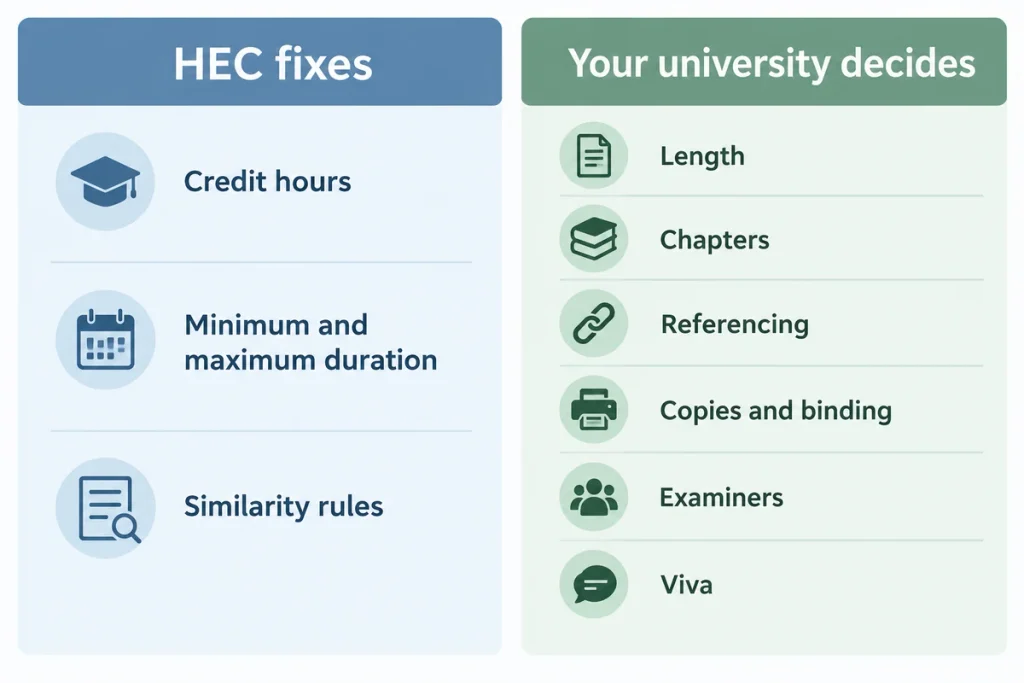
The policy also sets the clock. A degree cannot be awarded before 1.5 years, which is three regular semesters, or after four years, which is eight regular semesters. A university may allow an extension when the delay comes from circumstances beyond the student’s control. HEC generally judges compliance by the policy in force on the date a student enrolled, so check which rules your batch falls under.
Everything else is local. In practice, your university decides the length, the chapter plan, the referencing style, the number of copies, the binding, the examiner panel and the viva rules.
One caution: some regulation documents online are older than the 2023 policy. The Islamia University of Bahawalpur’s MPhil regulations, for example, carry amendments dated October 2010. The University of the Punjab’s thesis examination rules show a 2017 copyright date. They still show how such rules are usually built, but your department may have replaced them. Ask for the version that applies to your batch.
Position correct as of October 2026; check HEC’s policy and your university’s current regulations for the latest status.
How long an MPhil thesis should be
No national word count exists, so the range is wide. PIDE’s thesis guidelines require at least 12,000 words for an MPhil, excluding references and appendices (notification dated 17 September 2021). The SZABMU thesis guidelines give 25,000 to 30,000 words, about 80 to 120 A4 pages, also excluding references and appendices. The Sardar Bahadur Khan Women’s University guidelines say MPhil and MS work should normally fall between 20,000 and 40,000 words. Departments may vary this once their research committees approve a different count.
Some universities count pages, not words. UAF, for instance, sets a minimum of 75 pages for MS and MPhil, as UAF’s postgraduate thesis format explains. Others set floors by chapter: the Dow University of Health Sciences template asks for at least 1,000 words in the introduction.
So the same degree title can mean a 12,000-word policy paper or a 30,000-word medical thesis. PIDE, for example, accepts only policy-oriented topics. Instead of aiming for a number you heard, ask your supervisor for a recently passed MPhil thesis from your department and compare its length with your regulations.
Chapter structure: what your discipline expects
HEC does not prescribe chapters. Most departments still land on a five-chapter pattern: introduction, literature review, methodology, results and discussion. The SBKWU guidelines list exactly these, followed by a conclusion and recommendations. The UMT guidelines and the Dow template below use the same skeleton. What changes is what each chapter must contain. For a wider walk-through, see the chapter-by-chapter thesis structure.
Objectives are a good example. SBKWU allows no more than three objectives for an MPhil, each starting with “To” and an action verb. Whatever your cap is, each objective should be something your results chapter can answer directly.
Social sciences and psychology
UMT’s thesis organisation guidelines show the pattern. The literature review includes research conducted in Pakistan, then the rationale, objectives and hypotheses. Methodology covers design, sample, operational definitions, measures, procedure and ethical considerations. Results move from descriptive to inferential analysis, one hypothesis at a time. The discussion opens with a brief summary of findings, then relates each finding to theory and earlier research in the cultural context.
If methodology is your weak point, start with choosing a research methodology. For the second chapter, writing the literature review covers the common traps.
Medical and health sciences
Health universities are more prescriptive. The Dow template fixes the order of methodology headings. It starts with study design, setting and sampling technique, then moves through sample size, duration, inclusion and exclusion criteria, study parameters, ethical considerations, data collection and data analysis. It asks for Vancouver references. It also expects approval documents in the appendices, including scientific committee, BASR and IRB approvals, a plagiarism undertaking and a Turnitin receipt.
Both Dow and SZABMU expect a review of local literature, meaning work done in Pakistan. SZABMU also prefers at least 70% of references from the last five years.
Literary studies
Humanities departments shape chapters around the argument. UMT’s MPhil English Literature format, revised in May 2022, asks for an introduction, a review of literature and a methodology and theoretical framework chapter. The analysis then runs across as many chapters as the argument needs: by theme, by section of a text, or by period. The document itself notes that how chapters are divided will differ from thesis to thesis. The conclusion carries limitations and guidance for future researchers, and citations follow MLA.
Format: where universities differ
Margins, fonts and page order are covered in the general thesis format guide. For an MPhil, the sharper differences lie in spacing, referencing style and abstract limits. Four documents show the spread:
| University | Spacing | Referencing | Abstract |
|---|---|---|---|
| SBKWU Quetta | Double (1.5 minimum in one clause) | APA 7th edition | Up to 300 words, one paragraph |
| SZABMU Islamabad | 1.5 to double | Vancouver | Up to 250 words, structured |
| UMT, MPhil English Literature | Double | MLA 8th edition | One page, single paragraph, five to eight keywords |
| University of Karachi | 1.5 | APA or Chicago | Up to 350 words |
The Karachi row follows its MPhil, MS and PhD guidelines, which are also covered in AIOU, Karachi, UHS and other university formats.
Binding shows how local the rules are. The SBKWU guidelines call for black hard binding for MPhil after the defence. The UHS MPhil regulations ask for black with golden lettering and four copies. UHS’s separate thesis format guidelines, however, prescribe olive green for MPhil and six copies. When two documents from one university disagree, ask the examination office, not a senior student.
Similarity checks before submission
Most universities ask for a similarity report with the thesis. HEC’s policy gives the reading rule. A similarity index of 19% or less may get the benefit of the doubt, while any single source at 5% or more without citation needs revision. References and the table of contents should be removed before the check, otherwise the index rises. Dow asks for the Turnitin receipt and a similarity summary, with overall similarity at 19% or less and any single source under 5%. UMT’s English Literature format wants the anti-plagiarism report signed by the Chief Library Officer and bound into the final copy.
The number alone does not decide anything, so how HEC reads similarity reports is worth reading before you submit.
Stages from coursework to degree
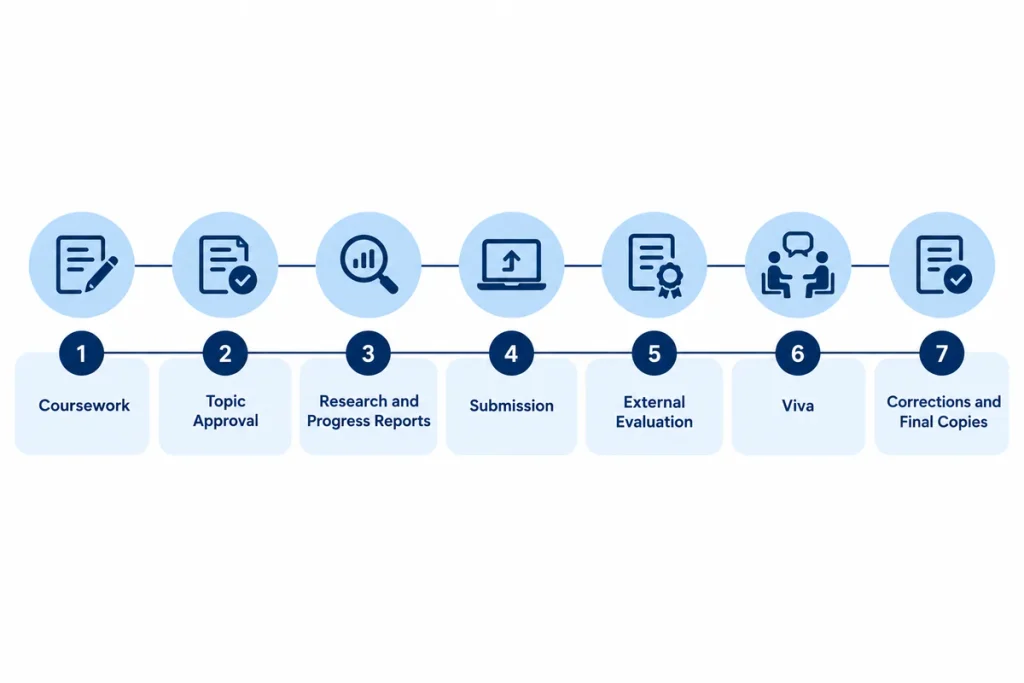
Most MPhil regulations follow the same arc: coursework, approved topic, supervised research, submission, external evaluation and viva. The dates and committees differ.
Topic, supervisor and approval
At UHS Lahore, the supervisor recommends the thesis topic by the end of the first academic year, and the Advanced Studies and Research Board approves it. At Bahawalpur, the research problem is assigned within 30 days of finishing coursework, and the supervisor must hold a doctorate unless the Vice-Chancellor permits otherwise. PIDE adds more steps: a concept note, then a proposal with internal review and an internal defence, then endorsement by its research council. An MPhil concept note or proposal cannot be submitted after the fifth semester without the Dean’s approval.
The approval document goes by different names, so it helps to know how a synopsis differs from a research proposal. For the writing itself, see writing the research proposal. If the topic is still open, how to choose a thesis topic comes first.
Research period and time limits
Supervisors report on progress, and universities enforce it. At Bahawalpur, the supervisor submits two progress reports in the second year, at the end of the third and sixth month. If both are unsatisfactory, the student ceases to be on the rolls. PIDE asks MPhil students at the thesis stage for a quarterly report in the first week of May, August, November and February. Next semester’s registration depends on it.
Time limits vary too. HEC’s outer limit is four years. UHS allows one extension of up to 12 months, and none beyond that. Bahawalpur expects submission within three years of admission, extendable by one year, with nothing beyond four years. Punjab expects submission within the registration period or up to six weeks after the final examination of the fourth semester. Its Vice-Chancellor may extend the date by up to six months in total.
Submission
Copies and binding depend on the university. UHS asks for the thesis ring-bound with a CD first and hard-bound after approval. Bahawalpur asks for four typed copies with the supervisor’s approval letter. SBKWU asks for three spiral-bound copies before the defence, one each for the external examiner, the supervisor and any co-supervisor, and six after it.
Some universities also add conditions. PIDE allows submission only after a working paper goes to the department. This is waived if a PIDE working paper or an HEC-recognised journal article from the thesis is already published. It also checks the minimum word count, the new thesis format and fee clearance.
External evaluation and revisions
Evaluation works differently in each place. At UHS, external examiners, including one from abroad, evaluate the thesis before the viva, and the viva happens only after they approve it. At Bahawalpur, two external examiners are chosen from a panel of at least six, and a Board of Examiners accepts the thesis, defers it for resubmission or rejects it. At Punjab, the Board has the department head, one external examiner and the supervisors, with the same three outcomes. At both, a thesis of sufficient merit may be resubmitted in revised form within six months.
PIDE shows what an examiner’s report triggers. The external evaluator’s comments go to the Controller of Examinations, then to the supervisory team. The student must incorporate every comment within 15 days and submit the final copy within 15 days of the defence. Marks are split: 20% for the supervisor, 60% for the external evaluator and 20% for the viva committee.
The viva: what examiners actually score
A marking sheet is the clearest guide to preparation. The University of Veterinary and Animal Sciences, Lahore uses a 120-mark viva sheet for MPhil students admitted in 2023 and later. Knowledge of the candidate carries 30 marks, split between technical knowledge of the topic and general knowledge of the subject. Quality of research carries 60: originality and justification, quality of data, interpretation of conclusions, and achievement of the objective, 15 each. Presentation of the thesis carries 30, covering consistency, illustrations, references, grammar and typing. Four scores, from the external examiner, the supervisor and two committee members, are averaged.
Other universities score differently. Bahawalpur requires at least 50% in the thesis and viva, and places candidates in the first class at 65% or more. Still, the UVAS sheet shows what a viva can test: whether the topic is justified, whether the data are sound and whether the objectives were met.
For the defence presentation, build slides around your objectives. Give each objective one result and one sentence on how you know the data are sound. Prepare a plain answer to “what is original here, and why was it worth studying?” Then rehearse the limitations, so you state them before an examiner does.
Where MPhil students lose time
- Writing to a template from another university, then reformatting everything at the end. Fix: get your own department’s manual first.
- Counting words the wrong way. PIDE and SZABMU exclude references and appendices, but another university may count differently. Fix: ask what the count includes.
- Skipping local literature in a health or social science thesis, where Dow, SZABMU and UMT all expect it. Fix: search Pakistani journals early.
- Running the similarity check on the full file, with references included, then misreading the number. Fix: follow your university’s instructions for what to remove.
Quick answers
Can an MPhil be completed without a thesis?
HEC’s minimum allows either route: 30 credit hours of coursework, or 24 credit hours of coursework plus at least 6 credit hours of research. Your university decides which routes it offers. The UHS and Bahawalpur regulations quoted above require a thesis based on research.
Is an MPhil thesis the same as an MS thesis?
HEC treats MS, MPhil and equivalent degrees as one level 7 group with the same minimum credit rules. Any difference comes from the university. PIDE, for instance, uses one grading scheme for MS, MBA and MPhil theses.
Can I finish an MPhil before the minimum duration?
No. HEC’s policy says the degree cannot be awarded before 1.5 years, or three regular semesters, so an early draft does not shorten the programme.
Before you plan the next chapter
Ask your department for four things. These are the regulations that apply to your batch, the current thesis format manual, one recently passed MPhil thesis and the rules for the similarity check. Then build your outline around those documents instead of a general template. If you are still deciding how to begin, writing a thesis step by step gives the overall sequence.
We have spent several years on the problems you are facing now: an unclear topic, a weak literature review, results that will not add up. If you want a second pair of eyes on a chapter against your department’s format, you can send your university’s format and deadline, and you can read real student reviews first. Any support is for reference and learning, so use it according to your institution’s policy.