
How to Write an Introduction for a Research Paper: Context, Gap and Aim
The results are in, your supervisor wants a journal draft, and the Introduction heading has sat above a blank document for two days. Where does the first sentence begin? How much background is enough before a reviewer calls it a literature review? Which sentence must name the gap, and where does the aim go?
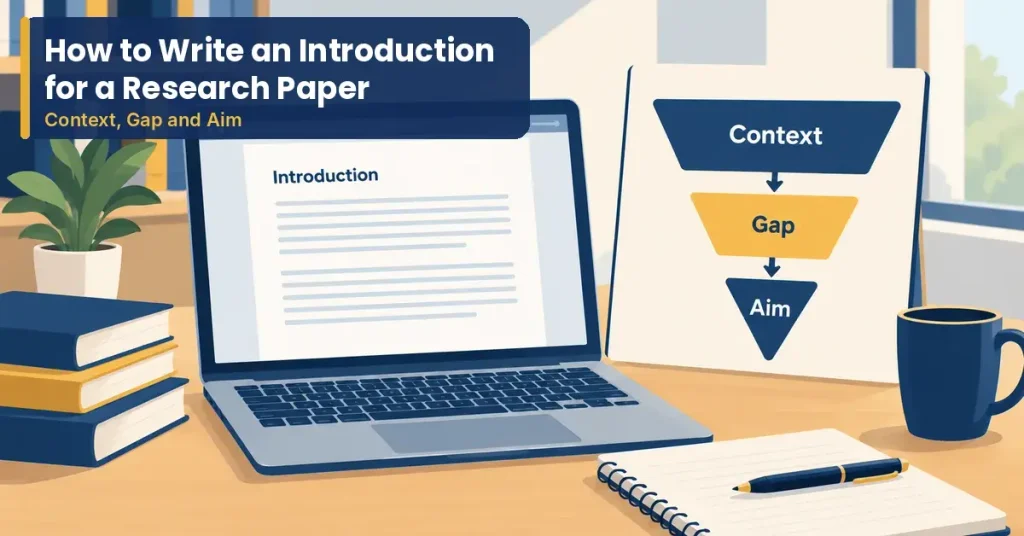
Here is the short answer to how to write an introduction for a research paper. First, start from a topic your reader already accepts. Then narrow to one thing that is still unsettled. Finally, state the exact question your study answers. Those are three jobs, in that order: context, gap and aim.
This guide covers the introduction of a journal-style paper, the kind a Pakistani MS, MPhil or PhD student writes from thesis work. A thesis Chapter 1 follows the same logic but runs longer, so a later section shows where the two differ.
What a research paper introduction has to do
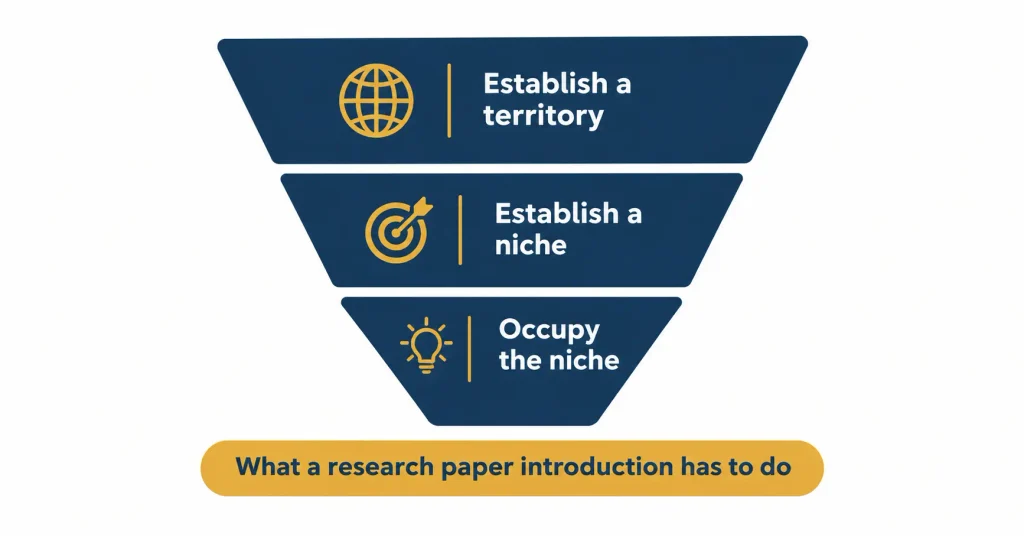
Writing scholars describe the usual pattern as the CARS model, short for Create a Research Space. John Swales built it from articles across many disciplines, and Purdue University’s writing lab summarises it as three moves. You establish a territory, then a niche, then you occupy that niche. In plain words, you show the topic matters, you show something is missing, and you show how your study fills the space.
| Move | The reader’s question | Your job |
|---|---|---|
| Establish a territory | Why does this topic matter? | Open with a specific, true statement, then summarise the key earlier work. |
| Establish a niche | What is still missing? | Name the gap, the conflict or the untested context. |
| Occupy the niche | What did you do about it? | State your aim, question or hypothesis. |
The shape is a funnel. It starts wide enough for an outsider to follow and ends on one precise question. As a result, every sentence in between must move the reader a step further down.
The introduction section of a research paper, part by part
Open with context, not history
Start with the narrowest true statement that still orients an outsider. Openers about all of human history waste the first impression, because they could top a paper in any field. A better first sentence already belongs to your subfield.
For example, a paper on groundwater use in Punjab should open on groundwater use. A paper on bank lending should open on lending. If a sentence could open a paper in another field without a single edit, cut it.
Also show why the topic matters instead of announcing it. Say what breaks, or what costs more, if the problem stays unsolved.
How to write the background in a research paper
Background answers a question every reader has: what is already known? It is a short, selective summary of the earlier work your gap depends on. It narrows from the field, to the subfield, to the one line of research your study extends.
Citations should carry weight, so do not simply pile them up. When a field is large, a review article can stand in for a crowd of single studies. When one claim needs several sources, split it into smaller claims. Then give each its own citations. A row of seven references behind “many studies show” tells the reviewer nothing about what any study found.
The full survey of earlier work belongs in its own section or chapter. A guide to writing a literature review shows how to build that part, and the introduction only needs the highlights.
How to write the rationale: name the gap
The gap is the hinge of the whole introduction. It explains why your study needs to exist, and that reason is your rationale. Editage’s guide to introductions calls the gap statement the hardest sentence to write and the most important one to get right. Reviewers read it closely to judge novelty and significance.
Swales’ niche moves include challenging an earlier claim, pointing to a gap, raising a question and continuing a tradition. In practice, student papers usually rest on one of these gaps:
- An untested context, such as a sector, region or sample that earlier work skipped.
- A conflict, where earlier studies disagree and yours tests why.
- An open question that earlier authors raised but did not answer.
- A known limitation, such as a missing variable, that your design handles.
Then write the gap in one or two plain sentences. For example: studies of X are plentiful, but few test Y among Z. Or: earlier results disagree on whether A changes B, and the reason is unclear.
Be careful with novelty claims. A sentence such as “no study has examined this” is only safe after a thorough search. If you have not searched widely, write “few studies” or “limited evidence” instead. For a Pakistani context, past PhD theses can show what has already been studied locally, and a guide to the HEC thesis repository explains how to search it. That repository holds PhD theses only, so search journals as well.
End on the aim, question or hypothesis
The last move states what you did about the gap. A purpose statement says what the study aims to do. A research question turns that aim into something answerable. A hypothesis goes one step further and predicts the answer. Many papers pair a purpose statement with either a question or a hypothesis, not all three.
Then check that this sentence matches the rest of the paper. The aim should mirror the design in the methods and the headings in the results. If they drift apart, revise the aim rather than bending the results. A guide to choosing a research methodology helps you tie the aim to a design.
Add a roadmap only if your field expects one
A roadmap is one sentence per major section. It is common in economics and engineering, but it is rare in medicine, psychology and the life sciences, where readers assume the standard order. Include it where your field expects it, and skip it elsewhere.
Draft it last, but sketch it first
Many writers finish the introduction last, because the gap and contribution are easier to state once the results and discussion exist. However, a rough outline first keeps your reading focused. Treat the early draft as a placeholder, then rewrite it when the findings are fixed.
How long the introduction should be
The introduction is usually the shortest section of a paper. A text-mining study of 61,518 papers on PubMed Central, published between 2016 and 2021, found a median length of 553 words, or about four paragraphs. Nine in ten introductions fell between 245 and 1,245 words, and the section made up roughly 14.6% of the paper.
Those papers are mostly biomedical, so treat the figures as a guide for science papers and not as a rule for every field. Your target journal’s author guidelines override every average. Some journals set word caps, and others ask for a separate background section. Read them before you draft, then match them.
Journal introduction, literature review and thesis Chapter 1
Students often blur these three, so a quick comparison helps.
| Part | Size | Main job |
|---|---|---|
| Journal paper introduction | A few paragraphs | Orient the reader, name the gap, state the aim. |
| Literature review | A full section or chapter | Survey and compare earlier work in depth. |
| Thesis Chapter 1 | Often several thousand words | Frame the whole thesis, usually with a chapter roadmap. |
Each university’s thesis manual decides what Chapter 1 contains, so check yours before copying a format. The guides on thesis structure and on university thesis formats in Pakistan show how the chapters fit and how manuals differ.
If the paper grows out of your thesis, do not paste Chapter 1 into it. Instead, rewrite the background for a general reader, shorten it, and cite the thesis where it is relevant. HEC’s Anti-Plagiarism Policy lists self-plagiarism among the types it covers, and a guide to the HEC similarity index explains how its limits are read.
Writing for HEC-recognised journals
For many Pakistani PhD students, the paper is not optional. HEC’s Graduate Education Policy 2023 sets a publication requirement for PhD students that is tied to HEC journal categories W, X and Y. The student must be first author, and the article must relate to the PhD work. As a result, the first outside reader of your introduction is often a journal editor, not only your supervisor.
Journals in those categories differ in structure and word limits. So read the author guidelines first, then study the introductions in three or four recent papers from that journal. Notice how long they run, whether they carry a roadmap, and how they phrase the gap. Check your university’s rules and the current HEC journal category too.
Position correct as of October 2026; check the HEC Graduate Education Policy and your university’s Quality Enhancement Cell for the current requirement.
Mistakes that weaken an introduction
| Mistake | What the reader sees | Fix |
|---|---|---|
| Starting too wide | An opener that fits any field. | Open with the narrowest true statement from your subfield. |
| Turning background into a full review | Pages of summary before the aim. | Summarise trends, cite reviews and move detail to the literature section. |
| Stacking citations | A long bracket after a vague claim. | Split the claim and give each part its own sources. |
| Announcing importance | A line saying the topic is very important. | Say what breaks or costs more if the problem stays. |
| Leaking results | Numbers before the methods. | Keep figures for the results section. |
| No pivot sentence | No clear point where background ends. | Add one plain sentence that turns from known to unknown. |
| Pasting thesis text | Familiar paragraphs from your own thesis or synopsis. | Rewrite for a general reader and cite the thesis. |
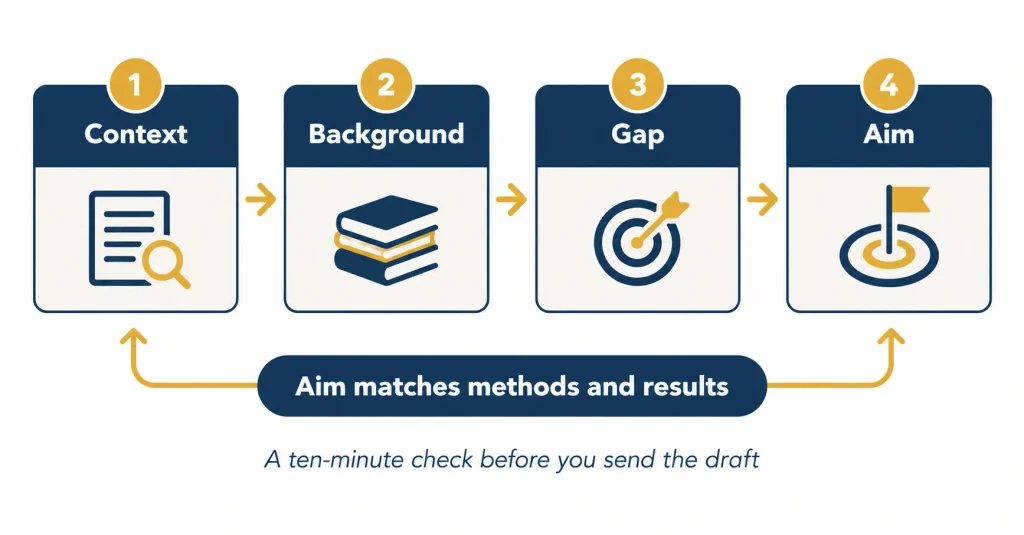
A ten-minute check before you send the draft
Purdue’s writing lab suggests a topic outline: note each paragraph’s main point in a short phrase, then see whether the moves appear in order. You can run a version of that check on your own draft.
- Write one short phrase for each paragraph that names its job.
- Check that the phrases run from context, to background, to gap, to aim.
- Underline the gap sentence. If you cannot find it in three seconds, rewrite it.
- Read only the first and last sentence of each paragraph. Together they should tell the story.
- Match the aim to your methods and to the headings in your results.
- Check that every citation supports exactly what its sentence claims.
- Compare the length and style with your target journal’s guidelines.
Questions students ask about research paper introductions
Should the introduction mention results?
It depends on the field. Swales’ third move includes an optional step for announcing principal findings. However, many biomedical journals keep results for the results section, and clinical papers usually skip the preview. Look at recent papers in your target journal and follow what they do.
Can I reuse the introduction from my thesis or synopsis?
Not word for word. A synopsis introduction is written to win approval, while a paper introduction must persuade a reviewer who has never met your supervisor. Rewrite it, shorten it and cite your thesis. The comparison of a synopsis and a research proposal shows how these approval documents differ in purpose.
My supervisor says the introduction is too long. What goes first?
Trim the background before the opening or the aim. First, cut citation clusters that repeat one point. Then remove sentences that restate the abstract. Finally, move any specific numbers to the results section.
Getting feedback on your draft introduction
A second reader often spots a missing pivot sentence or a mismatched aim within minutes. If you want structured feedback, editing and referencing help on a draft, you can send your draft with its journal guidelines and ask for a review. PhD students working toward a publication can also look at support for PhD research and thesis work.
Any support work is for reference and learning, so use it according to your institution’s policy. You can also read what other students have said before you decide.