
Artificial Intelligence Thesis Topics for Pakistan: Policy, Courts, Tax, Health and Work You Can Study With Public Evidence

Before I commit to an AI thesis, I want a few things settled:
- Will I build a model, or study how a Pakistani institution uses and governs one?
- Can I read the policy, order or dataset itself, or only a news story about it?
- When an agency reports a result, can I find the definition and the baseline behind it?
- Do a tool’s terms allow me to run other people’s writing through it?
- Will my supervisor accept the data route before I start?
Artificial intelligence is too wide for one list, so this guide covers one part of it: AI as Pakistani institutions adopt and govern it. The topics reach national policy, courts, tax, banking, TB screening, policing, universities, journals, jobs and news. Model-building projects such as Urdu speech recognition, OCR and flood mapping sit in the computer science thesis topics collection, which states the data and compute each one needs.
Choose the Evidence Before You Choose the Algorithm
An institutional AI thesis stands or falls on its source. A policy text, a court order and a published cost model can be read line by line. A press statement usually cannot, because it rarely shows its definitions. Decide which kind of source you will hold before you write a research question.
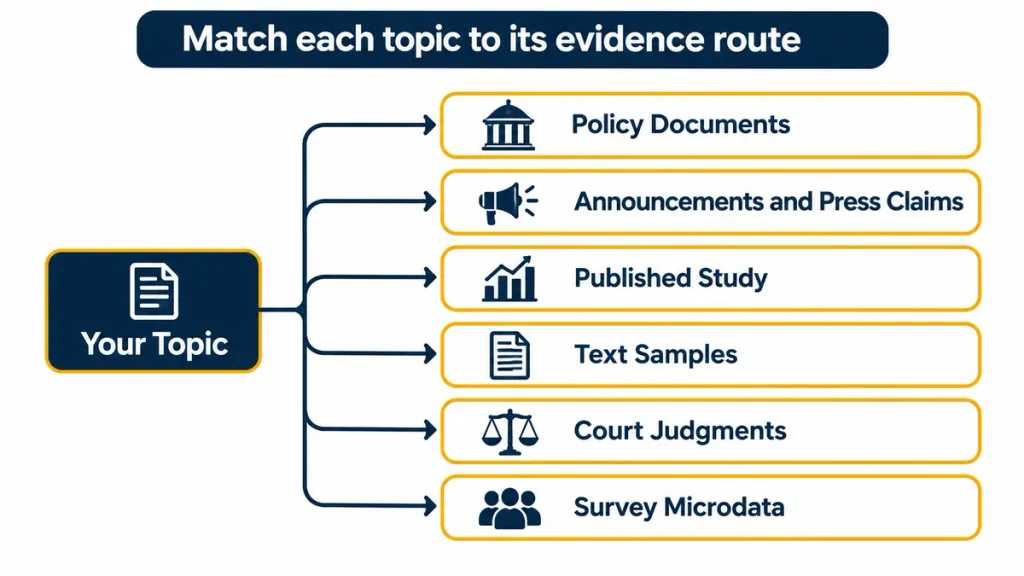
Match each topic to its evidence route
| Evidence route | Topics | Confirm first |
|---|---|---|
| Policy and rule documents | 1, 2, 3, 5 | You hold the full text, its version and its date |
| Official announcements and press claims | 4, 7, 12 | Each claim has a date, a speaker and a stated definition |
| Published study with open inputs | 6 | You can obtain the paper’s cost inputs and rerun them |
| Text samples and guideline pages | 9, 10 | The tool’s terms allow your use and your sample is large enough |
| Court judgments | 8 | You can get the reported judgment, not only a summary |
| Survey microdata | 11 | You know which survey year PBS will release, and on what terms |
Policy and Rule Topics: Read the Document, Not the Headline
Position correct as of November 2026. Several documents in this section are drafts or recent guidelines, so check the Ministry of IT and Telecommunication, HEC and the Supreme Court website for their current status before you cite them.
1. What Has Been Delivered Under One Target of the National AI Policy 2025?
Can one numeric target be tracked from public records, and what would count as proof of delivery?
The federal cabinet approved the policy in July 2025. The ministry’s announcement lists six pillars. Under awareness and readiness it sets yearly figures of 200,000 people trained, 3,000 scholarships and 20,000 paid internships. Under innovation it names a National AI Fund and Centres of Excellence in seven major cities. Press reports add a national target of one million trained professionals by 2030, which is a different baseline, so state which one you use.
First, pick a single target. Build a dated tracker from ministry releases, HEC and provincial announcements, and a formal request under the federal access-to-information law. Define “delivered” before you count, because an announced scholarship is not an awarded one. Report what you could verify and what you could not, instead of declaring the policy a success or a failure.
Suits: BS final year, MS. Evidence: documents and written requests. Sources: the ministry’s policy announcement and a Tribune report on the cabinet decision.
2. Do University AI Policies Cover What HEC’s Draft Asks For?
Which of the draft’s requirements already appear in the published policies of ten universities?
A news report from August 2026 describes HEC’s first draft policy on AI in higher education. It asks each university to write its own AI policy, set up an AI committee and report to HEC every year. It also asks students and researchers to name the tool they used and explain how, and it says nobody should be penalised only because of an AI detector score.
Turn those requirements into a coding sheet. Collect ten universities’ published policies, have two coders score each item, and report how often the coders agree. Say plainly whether you read the draft itself or a report of it, because the draft text is the stronger source. Check too whether HEC has since issued a final version.
Suits: MS. Evidence: documents. Source: the TechJuice report on the draft.
3. Where Do the 2026 Judicial AI Guidelines Go Beyond the Supreme Court’s 2025 Judgment?
Which duties does the guideline text actually state, and which gaps remain?
In a judgment dated 11 April 2025, Justice Mansoor Ali Shah wrote that AI must never become a substitute for judicial decision-making. He asked the National Judicial (Policy Making) Committee, working with the Law and Justice Commission of Pakistan, to prepare guidelines. A commentary describes national guidelines issued on 29 April 2026 and argues that they leave liability, data handling and verification duties open.
Treat that argument as a hypothesis, not a finding, because it is one author’s view. Instead, obtain the guideline text, list every operative duty, and test each alleged gap against it and against the judgment’s limits. For the doctrine behind the topic, see the law thesis topics collection.
Suits: MS in law or public policy. Evidence: documents. Sources: Dawn’s report on the Supreme Court judgment and a Minute Mirror commentary on the guidelines.
Tax and Banking Topics: Audit the Claim and Its Definition
Government and regulator statements about AI often give a result without a method. These two topics treat the statement itself as the thing to measure.
4. What Counts as “AI” in the FBR’s Announced Tax Checks?
Do public statements use one definition of AI, and what do the reported results measure?
Reports since late 2025 put different things under one label. One described a review of more than seven million income tax returns in which spreadsheet filters did the first screening and AI tools assisted later. In July 2026 the finance minister was reported saying an AI risk engine had flagged 840 high-risk audit cases worth an estimated Rs34 billion in potential revenue. In October 2026 FBR extended AI checks to returns for tax year 2026, comparing them with property, bank, vehicle and travel records.
Build a table by date, speaker, method, number and stated safeguard. Potential revenue is not assessed or collected revenue, so look for what later FBR reports show. The reports also say a flag is not proof of evasion, so examine how that rule is described. A wider list of public finance questions sits in the economics thesis topics collection.
Suits: MS in economics or public finance. Evidence: press claims and FBR reports. Sources: Arab News on the 840 cases, ProPakistani on the October 2026 expansion and ProPakistani’s earlier report on the audit plan.
5. Which Risks in the SBP’s AI Discussion Match a Peer Regulator’s Principles?
Does Box 3.2 of the SBP’s Financial Stability Review 2024 cover each principle that another central bank published in June 2026?
The box reports that about half of 55 regulated entities had deployed AI or were developing it. It lists risks such as dependence on a few suppliers, algorithmic bias, cyber-attacks and AI’s energy use, and it says the SBP’s guidelines were at an advanced stage of finalisation. The Bangko Sentral ng Pilipinas issued voluntary governance principles on 24 June 2026 under five headings: sustainability, transparency, accountability, responsibility and security.
Code each SBP risk against those headings, and note which headings the box leaves out. Then check whether the SBP has issued its guidelines. No final text turned up in the searches behind this guide as of November 2026. A comparison of two regulators makes a sharper thesis than a general essay on AI in banking.
Suits: MS. Evidence: documents. Sources: the SBP’s Financial Stability Review 2024 chapter and a SunStar report on the Philippine principles and a Baker McKenzie note on the memorandum.
Health and Policing Topics: Test the Evidence Behind the Headline
Both fields have published numbers that students can rebuild or question. Neither topic asks you to touch patient or suspect data.
6. Update the Cost Model for AI Chest X-Ray Screening in the TB Programme
Which input moves the cost per screen most, and does the conclusion hold at current prices?
A 2022 PLOS ONE analysis compared four chest X-ray software products with radiologist reading for Pakistan’s national TB scale-up plan. A summary of its results reports per-screen costs of about 0.19 to 2.78 US dollars for the two cheapest products, while two others matched radiologist costs only at high throughput. Next, rebuild the model in a spreadsheet, replace the inputs with current quotes and your own throughput scenarios, and run a one-way sensitivity analysis.
Software prices are commercial and change, so date every quote. This is a costing study, not an accuracy study, so make no claim about sensitivity or specificity. For clinical questions around the same disease, see the medical research topics collection.
Suits: MS in public health or health economics. Evidence: a published study with open inputs. Source: the 2022 PLOS ONE paper.
7. Check the Police-Reported Results of Islamabad’s SkyEye Against the Records Behind Them
What does “AI-linked arrest” mean in the reported figure, and what is the baseline for the dispatch-time gain?
An Oxford overview of AI in Pakistan’s criminal justice reports that police credit SkyEye, in use in Islamabad since 2023, with roughly 2,700 AI-linked arrests and nearly 45% faster dispatch. The overview itself labels these as police-reported figures.
Draft formal information requests for the definition, the period and the baseline. Next, compare the answers with published crime and call statistics, and record what you could not obtain. Do not collect camera footage or try to identify anyone. Get ethics approval before you contact officials.
Suits: MS in criminology or public policy. Evidence: written requests and official statistics. Source: the Oxford overview of AI in Pakistan’s criminal justice system.
8. How Do Courts Treat Video Evidence That Has Not Been Tested for AI Manipulation?
After Mir Hassan v The State, what do courts require before they rely on video?
The same overview reports that in Mir Hassan v The State (2025 YLR 645) the Balochistan High Court declined to rely on prosecution video that had not been forensically tested for AI manipulation. It also notes that the Qanun-e-Shahadat Order 1984 has no explicit AI provisions. The overview is a secondary source, so find the reported judgment before you cite it.
Then collect later High Court judgments on video and audio evidence, and code what proof of authenticity each one demanded. Ask your supervisor how your university wants unreported judgments cited.
Suits: MS or PhD in law. Evidence: case law.
Students, Journals, Jobs and News: Data You Can Collect Yourself
These four topics rest on text and survey data that a student can gather in a semester. Each one asks a measurable question about a claim that people repeat without checking.
9. How Often Do AI Detectors Flag Pakistani Theses Written Before ChatGPT?
What is the false-positive rate of one detector on human-written Pakistani MS and PhD text from before late 2022?
A 2023 Stanford study found that detectors misread non-native English writing. In a Times Higher Education account of it, seven detectors labelled essays by non-native writers as AI-generated 61.3% of the time on average, while American eighth-grade essays were classified accurately. Theses submitted before ChatGPT’s release in November 2022 are human-written by construction.
Draw a random sample from the HEC repository, using what the guide to the HEC research repository explains about access. Take a fixed section such as the abstract and introduction, and run one detector whose terms permit your use. Then report false positives with a confidence interval and by discipline. Publish no result tied to a named thesis or author. This pairs well with topic 2, because HEC’s draft says a detector score alone should not trigger a penalty.
Suits: MS. Evidence: text samples. Sources: the Liang and colleagues’ study and the Times Higher Education report on its figures.
10. What Do HEC-Recognised Journals Tell Authors About AI Use?
How many journals in each HEC category require disclosure, ban AI authorship or address AI in peer review?
The Committee on Publication Ethics said in February 2023 that AI tools cannot be authors. It added that authors must disclose which tool they used and how, in the methods section or a similar place. HEC recognises journals in W, X and Y categories.
Draw a stratified sample from each category, copy each journal’s author-guideline text with the date you read it, and code four items: authorship ban, disclosure rule and its location, image and data rules, and reviewer use. Many journals will say nothing, so that silence is itself a finding. Re-read each page on the day you finish, because journal policies change.
Suits: BS final year, MS. Evidence: guideline text. Source: the COPE position statement on authorship and AI tools.
11. Which Pakistani Occupations Are Most Exposed to Generative AI, by Province and Sex?
What share of employed Pakistanis work in occupations in each ILO exposure gradient?
ILO Working Paper 140, published in May 2025, updates the 2023 index of occupational exposure to generative AI. It scores tasks for ISCO-08 occupations and groups them into four gradients, with clerical work among the most exposed. The Pakistan Bureau of Statistics classifies occupations in its Labour Force Survey with PSCO 2015, which follows ISCO-2008.
Map PSCO codes to ISCO-08 four-digit codes, attach the ILO scores, and weight the results with the survey weights to get shares by province and sex. Exposure is not job loss, because the ILO built its task scores from Poland’s occupation classification with expert input, so explain what that means for informal work in Pakistan. Find out which survey year PBS will release as microdata, and whether that file carries the occupation code.
Suits: MS in economics or statistics, PhD. Evidence: survey microdata. Sources: the ILO working paper and the PBS Labour Force Survey page.
12. Was the 2023 “ChatGPT Decides a Court Case” Story Accurate? A Framing Study of Pakistani Reports
How did outlets describe the Phalia bail order, and how many repeated the wrong version?
Soch Fact Check examined a viral post of 11 April 2023 saying a Pakistani court used ChatGPT-4 to decide a contract dispute. Its reading of the judgment was different. The order concerned a juvenile’s pre-arrest bail petition, the judge asked ChatGPT-4 some questions, and he wrote that his decision rested on his own reasoning.
Collect every report from April 2023 that you can find, code each against four points (case type, the tool’s role, who decided, the judge’s own caveat), and report what share matched the order. Also get the order itself, and describe the juvenile only as the order does, with no identifying detail.
Suits: BS final year, MS in media studies. Evidence: news text and the order. Sources: Soch Fact Check’s review and a Dawn editorial on the order.
Fit an AI Topic to Your Degree
BS final year students should choose a topic with one document or one claim table, such as topics 1, 2, 10 or 12. Artificial intelligence master thesis topics need a comparison or a second source, so topics 3, 5, 6, 9 and 11 give an MS enough to defend. A PhD needs an original contribution, which means topics 8 and 11 work only as starting points.
The credit rule matters too. HEC’s Graduate Education Policy 2023, as read in October 2026, sets the MS or MPhil award at 30 credit hours of coursework, or 24 plus a thesis of at least 6. A short thesis track leaves room for one focused question, not three. The MPhil thesis guide explains how that credit rule shapes the work.
Narrow a Broad AI Idea in Five Steps
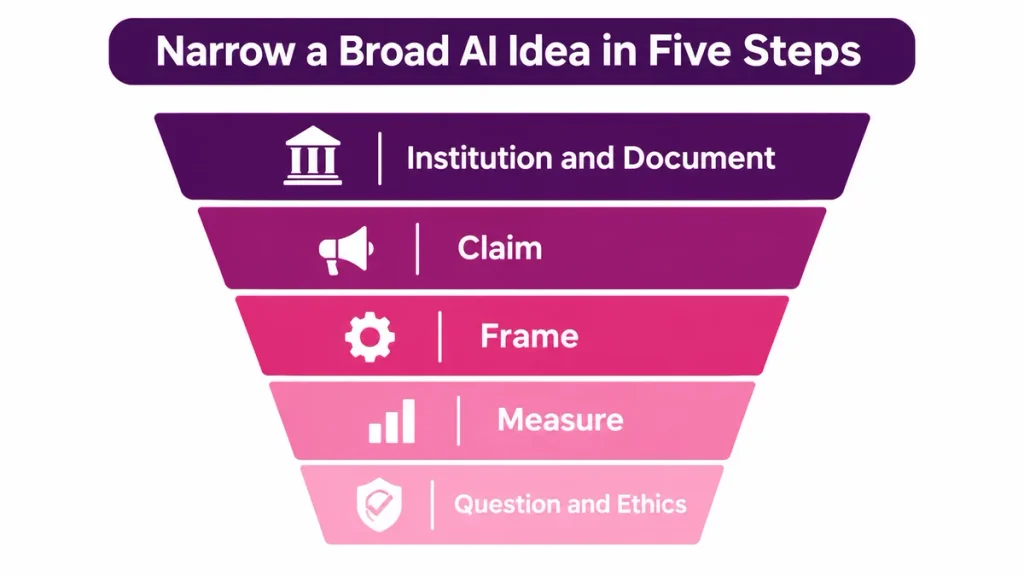
Take the broad idea “AI in Pakistani universities” and follow topic 9 to see how it shrinks.
- Name the institution and document type: theses in the HEC repository.
- Name the claim to test: detectors flag non-native writing as AI-generated.
- Fix the frame: one discipline, one date window before late 2022.
- Choose the measure: a false-positive rate with a confidence interval.
- Write the question, then check the tool’s terms and your ethics route.
A research proposal on artificial intelligence should state its data route on the first page, because examiners ask for it first. The guide to writing a research proposal shows where that fits, and the guide to choosing a research methodology helps you pick the method that matches your evidence.
Four Mistakes in AI Thesis Proposals
- Citing a news story as the source. Read the policy, order or paper behind it.
- Using “AI” without a definition. Ask what the system does, who runs it and what it replaced.
- Running other people’s writing through a tool. Read the tool’s terms and your ethics rules first.
- Claiming impact from potential numbers. Estimated revenue and job exposure are not outcomes.
Frequently Asked Questions
Can I write an AI thesis without building a model?
Yes. Examiners accept document analysis, claim audits, costing studies and measurement studies when the question, data route and method are clear. Each topic above names its evidence so you can show that early.
Which of these topics need ethics approval?
Topics that involve officials, other people’s writing or a juvenile’s case, such as 7, 9 and 12, need the closest check. Topics built only on public documents usually need less, but ask your supervisor and your ethics committee before you collect anything.
How do I stop an AI topic from going out of date?
Fix a date window, record the version and date of every document, and say whether each one is a draft, an issued text or an amended text. Re-read the key sources just before you submit.
Your Next Step
Shortlist two topics and test each with three questions. Can you hold the source document? Is the definition of “AI” clear enough to measure? Do you have the permissions you need? Other subjects are listed in the full thesis topics collection. If you want feedback on a shortlist or help shaping one topic into a proposal, send your details through the order form for a quote. Reference material is meant for learning, so use it according to your institution’s policy.