
Cyber Security Thesis Topics for Pakistan: Frameworks, Complaint Figures and Public Records You Can Check

Before I commit to a cyber security thesis, I want clear answers to a few questions.
- Which framework, circular or notice will I read in full, and who confirms that it is the current version?
- Do my figures come from one dated source, or from reports that count different things?
- Can I answer my question from public records, or would I have to probe a system I do not own?
- Does my method stay inside the law and inside the terms of every site I visit?
- Is my contribution a comparison, a count, a test of a claim or a new tool?
Cyber security is too wide for one list, so this one has a clear scope. The twelve topics below cover how Pakistani institutions write security rules, count complaints and incidents, and publish their own web and email settings. Malware analysis, intrusion detection, phishing classifiers and mobile app audits are left out, because they already sit in computer science thesis topics. Police surveillance and AI governance are covered in artificial intelligence thesis topics.
Keep Your Thesis on the Safe Side of the Law
Every topic here uses documents, parliamentary replies, press reports, archived web pages or public DNS records. None needs you to scan, log in to or break into anything. Keep it that way. The Prevention of Electronic Crimes Act 2016 covers unauthorised access. So ask your supervisor to approve your method in writing before you collect a single record. The doctrine behind the Act is a separate subject, and law thesis topics is the better place for it.
If a threat actor leaks data, do not download it. Cite the claim and the reporting around it instead. Your examiners can mark a careful reading of public evidence. They cannot mark a legal problem.
Rules and Frameworks Read Against Each Other
Pakistan’s security rules arrive as frameworks, circulars and strategies, often years apart. A thesis can test what each one actually requires and what it leaves vague. Position correct as of November 2026; check the National CERT and the regulator concerned for the current text.
1. PISF 2026: Did the Cabinet’s Call for Deadlines and Audits Reach the Framework?
Question: The cabinet asked for specific deadlines and independent audits when it approved the Pakistan Information Security Framework 2026. Do the published annexes deliver both, and for which kinds of entity?
A report dated 11 August 2026 says the cabinet approved the framework. It lists controls on data protection, identity and access, incident response, data centres, software development, supply chains and audits. Arab News reported the approval, while Minute Mirror added the cabinet’s call for specific deadlines and independent audits. National CERT’s PISF section lists a notification, two annexes, a controls sheet and thirteen control families. The second annex is titled Framework Implementation Timelines.
Read the annexes and the audit documents in full. Then tabulate the deadline for each entity category and compare it with what the cabinet asked for. So the gap, if any, is your finding.
Suits: MS, PhD. Method: document analysis.
2. Cyber Shield Against the 2017 Framework: Which Measures Are Genuinely New?
Question: How many of the State Bank’s planned cyber measures for 2025 to 2030 already existed as requirements in its 2017 technology framework?
The Cyber Shield strategy sets five priorities: strengthen, mature, enhance, develop and evolve. Its measures include a cyber-testing framework and a Zero Trust roadmap for critical banking infrastructure. They also include a standard incident reporting framework, a financial sector emergency response team and a two-hour recovery objective for financial market infrastructures. However, the document carries no date, and it sets no deadline for most measures. The 2017 circular asked institutions to comply by 30 June 2018 and told boards to review progress at least quarterly.
First, obtain the 2017 framework itself, because the circular only lists it as an enclosure. Then code each Cyber Shield measure as present, partly present or absent in the older text. Also state plainly which measures you could not classify.
Suits: MS, PhD. Method: document comparison.
3. Do Insurers’ Annual Reports Show the Cyber Controls SECP Asked For?
Question: How many listed insurers disclose a chief information security officer, cyber risk cover or board oversight of cyber risk, and has that changed over three reporting years?
Dawn reported in January 2019 that an SECP order required insurers and takaful operators to buy cyber risk insurance and appoint a senior information security officer. The order also required an annual assessment to reach the commission by 30 April. SECP’s 2020 guidelines followed in March 2020. Also confirm that each instrument is still in force before you build on it.
The 30 April assessment goes to the regulator and may never be public. So your thesis measures disclosure in annual reports, not compliance. That limit is honest, and it also keeps the study feasible.
Suits: BS final year, MS. Method: content coding of reports.
4. The Six-Month Deadline for Cybersecurity Operation Centres: Who Set It and Who Must Comply?
Question: Which notice created the deadline, which organisations does it cover, and has a start date been published?
Tribune reported in July 2026 that public and private organisations had six months to set up operation centres with SIEM, EDR, NDR and XDR tools. However, the report does not say when the six months begin. It also does not name the notice.
Trace the primary instrument: issuing body, date, scope, definition of an organisation and any penalty. If no notice can be found, then that is itself a result about how Pakistani cyber rules are announced. Either way, record what you searched and when.
Suits: BS final year, MS. Method: document tracing.
Complaints, Incidents and What Gets Counted
Official figures on cybercrime and attacks differ by source, period and unit. As a result, careful counting makes a worthwhile thesis. Figures in this section are as reported by November 2026; check each source for later releases.
5. Three Totals for One Year: Reconciling NCCIA Complaint Figures
Question: Which of the published National Cyber Crime Investigation Agency figures for 2025 measure the same thing, and which cannot be compared?
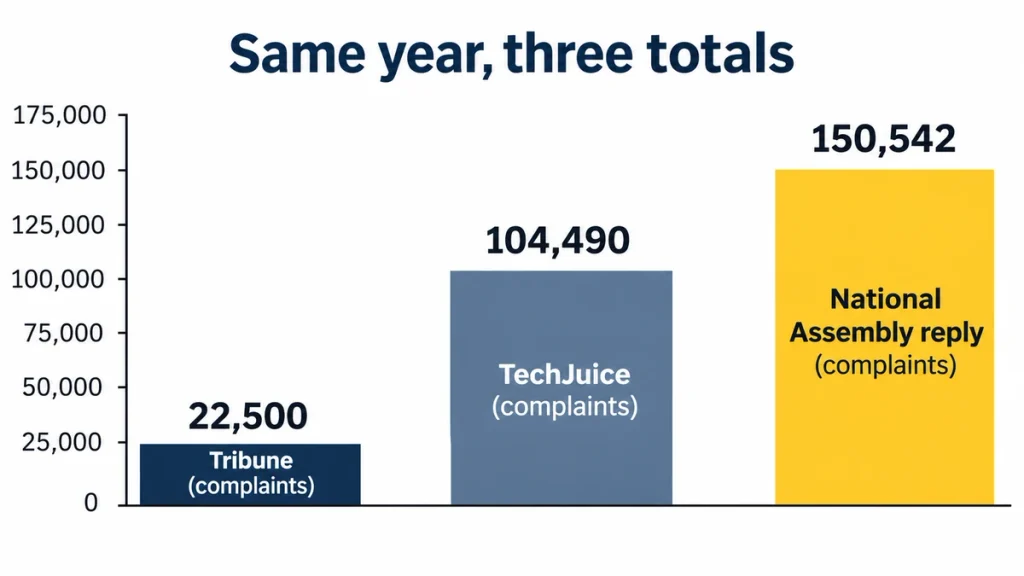
Tribune quoted the agency’s head in December 2025: 22,500 complaints, 620 registered cases and 26 convictions for 2025. A National Assembly reply reported in January 2026 gave 150,542 complaints, 81,996 of them about financial crime, 10,756 financial-crime inquiries and 851 registered cases, with 523 staff. The agency’s year-end statement reported 2,196 cases investigated, 2,902 arrests and 774 successful prosecutions. TechJuice reported 104,490 complaints for 2025, and its categories do not add up to its totals.
First, build one table with source, date, period and unit for every number: complaint, inquiry, case, conviction or prosecution. Then test which figures can sit side by side. Request the original parliamentary replies, because news reports may round or merge terms.
Suits: BS final year, MS, PhD (as a longitudinal series). Method: source reconciliation.
6. Frozen Accounts and Recovered Money: Aligning Losses, Freezes and Recoveries
Question: For one period, how much reported loss, how many frozen accounts and how much recovered money can be matched with the same currency and the same dates?
The agency’s year-end statement reported 46,056 frozen accounts and wallets and a recovery of over 461 million, with no currency stated. Minute Mirror reported a Senate briefing on 227,757 complaints and Rs8.32 billion in losses over three years. The periods differ, and one currency is missing.
Ask for same-period figures through the committee secretariat or an information request, and state the currency in your title. Also write the alignment table before any statistics. Never divide a recovery for one year by losses for three.
Suits: MS, PhD. Method: secondary data alignment.
7. A 2026 Incident Register: Who Says Pakistan’s Attacks Happened?
Question: How many publicly reported 2026 incidents rest on an actor’s claim, an aggregator listing, a regulator count or a victim statement?
The head of National CERT said Pakistan had recorded 253 attacks in 2026 so far, in the 2 July 2026 report cited under topic 4. TechJuice reported in November 2026 that PTA dark-web monitoring flagged 326 threat indicators between July 2025 and June 2026. It adds that ThreatMon confirmed seven ransomware incidents with Pakistani victims, three of them in healthcare. The same report says Pakistan has minimal breach-disclosure requirements. An aggregator record lists a teaching hospital in Islamabad as a ransomware claim on 23 August 2026, with 149 GB and a $300,000 demand, and no victim statement.
However, claims can fail. ProPakistani reported an actor’s breach claim against a disaster-management body, and an unnamed official denied it. Neither side was independently confirmed in that report.
Next, build a register with date, sector, source type and confirmation status. Then count entries by confidence level, not just by total. Do not open leaked files.
Suits: MS, PhD. Method: source-graded incident register.
Public Records You Can Check Without Touching Any System
Each check below reads information that its owner publishes on purpose. So fix your list, your dates and your method in the proposal, and get them approved first.
8. Email Spoofing Defences on Federal Ministry Domains Against National CERT’s 2025 Advice
Question: How many ministry domains publish SPF and DMARC records that meet the strength National CERT recommended?
In June 2025 National CERT warned that missing or weak SPF, DKIM and DMARC records invite spoofing and fraud. TechJuice summarised the advisory: hard-fail SPF, DMARC at quarantine or reject, DMARC at none treated as weak, and 2048-bit DKIM keys. That report names weakness codes WK-1 to WK-7 without defining them, so obtain the advisory itself.
First, take a fixed list of ministry domains from an official directory. Then, on a single day, read each domain’s published SPF and DMARC records and score them against the advisory. DKIM selectors cannot be listed from outside, so leave DKIM out or ask the domain owners. Repeat three months later to see change.
Suits: BS final year, MS. Method: passive DNS survey.
9. Where Do Government Websites Actually Run? A Hosting Census Against PISF’s Local-Hosting Direction
Question: What share of a sample of federal and provincial websites resolve to networks inside Pakistan, and does that change over time?
A report of 17 July 2026 said the draft framework required government websites and apps hosted abroad to move to local data centres, with no deadline given. Tribune stated on 21 July 2026, without naming a source, that more than 90% of Pakistan’s data is hosted overseas. It also named the State Bank and PTA as operators of local data centres.
First, sample your domains, then record the network owner and country for each address on two dates. Treat content delivery networks as their own category, because an edge server hides the true origin. Finally, check whether the approved text keeps the migration rule, since the report described a draft.
Suits: BS final year, MS. Method: passive resolution census.
10. Did Government Sites Really Go Read-Only? A Before-and-After Check in Web Archives
Question: After the 2026 National CERT direction, did sampled government sites remove search boxes, forms and login routes?
TechJuice reported on 8 May 2026 that National CERT told government sites to switch to read-only mode, disable forms and logins, and keep interactive features off. The report gives no advisory number and no duration.
First, confirm the advisory’s own date with National CERT. Then compare archived captures from before and after it for a sample of sites, coding each interactive feature as present or absent. A missing capture is not evidence of change, so record archive gaps separately.
Suits: BS final year, MS. Method: archived-page coding.
11. How Long Do Fake Government Websites Live? Domain Age and Takedown Timelines
Question: How soon after registration do fake government domains appear, and how long do they keep resolving after National CERT names them?
ProPakistani reported in October 2026 that National CERT found phishing sites using the names of PTA, FIA, the immigration and passports directorate, SECP and BISP. Take the domains from the National CERT notice itself, not from a news summary.
First, date each domain using public registration records and certificate transparency logs. Then re-check whether it still resolves at set intervals. Never enter data on these sites, and do not open them in a signed-in browser. Ask your supervisor to approve the method first.
Suits: MS. Method: registry and log timeline.
12. Does a BS Cyber Security Syllabus Teach the Pakistani Law Its Graduates Will Meet?
Question: Which Pakistani statutes, regulators and incident rules are named in cyber security course outlines?
The University of the Punjab’s outline, approved at a board of studies meeting on 23 May 2025, lists Cyber Law and Cyber Crime in semester VII. It also lists Digital Forensics, whose outline names laws, standards and ethics. In the first part of the document, no Pakistani statute appears by name, but the Cyber Law outline was not in that part.
First, read the full outline. Then compare it with four or five others. Code each for named statutes, local regulators, local case studies and the 2025 amendment. Past theses in the HEC research repository show whether anyone has audited curricula this way.
Suits: BS final year, MS. Method: curriculum content analysis.
Fit a Topic to Your Degree and Your Time
Match each topic to its evidence route
Choose by evidence first, then by interest. For example, a student with no data access should start in the first row. The design choices behind each route are explained in the guide on choosing a research methodology.
| Evidence route | Topics | Confirm first |
|---|---|---|
| Framework, circular or notice read in full | 1, 2, 3, 4 | You hold the official current text, not a news summary |
| Parliamentary replies and reported figures | 5, 6 | Each figure’s period, unit and speaker |
| Incident claims and counts | 7 | A source type for every entry, and no leaked files downloaded |
| Public DNS and hosting records | 8, 9 | A fixed domain list, a collection date and your supervisor’s sign-off |
| Archived and registry records | 10, 11 | Archive coverage, and no contact with live phishing sites |
| Public course outlines | 12 | Full outlines, not prospectus summaries |
What each level should deliver
BS final year. Shrink topic 8, 9, 10 or 12 to a sample of about twenty domains or outlines on one date. In short, a clean table and an honest limits section beat an ambitious study you cannot finish.
MS and MPhil. Under the HEC Graduate Education Policy 2023, as read in October 2026, an MS or MPhil can be 30 credit hours of coursework or 24 of coursework plus at least 6 for the thesis. So a six-credit thesis suits one table, one comparison and one clear claim. The MPhil thesis guide shows how supervisors read that scope.
PhD. Topics 5, 7 and 9 can grow into repeated measurements across several years. Also, the same policy expects the synopsis defence within the first six semesters, so fix your evidence route early. For planning chapters around committee feedback, see PhD thesis planning support.
Narrow a Broad Idea in Five Steps
Take the idea “I want to study cybercrime in Pakistan.” However, it is too broad to test. Topic 5 shows how it narrows.
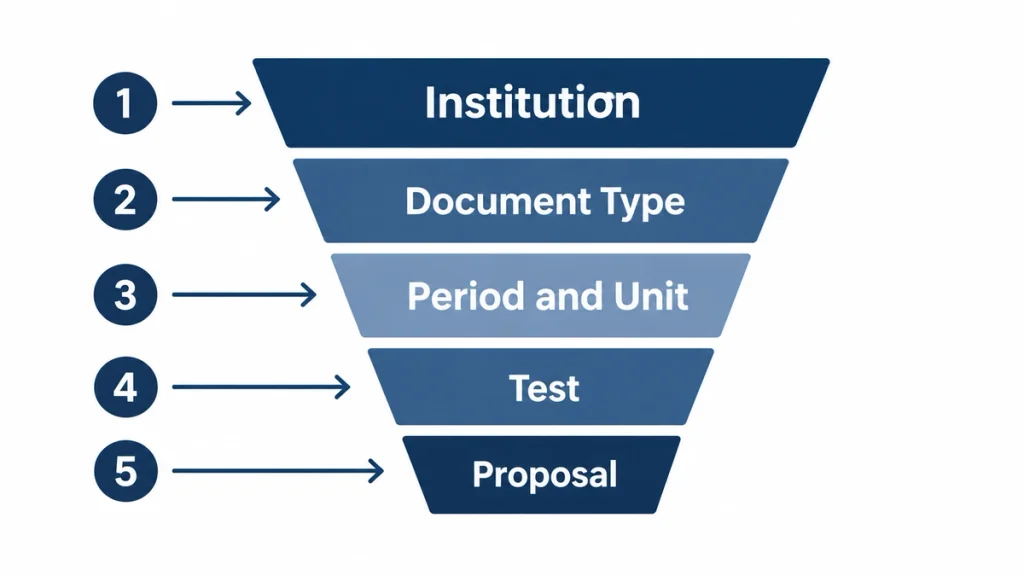
- Name the institution. Choose the National Cyber Crime Investigation Agency, not “the government.”
- Name the document type. Choose parliamentary replies and the agency’s year-end statement.
- Fix the period and the unit. Choose calendar year 2025, and separate complaints, inquiries, cases and convictions.
- State the test. Ask which figures can be compared and which cannot.
- Write the proposal around the source table. A cyber security research proposal should show the table of sources before it shows any theory.
For the proposal itself, the guide on how to write a research proposal covers the sections your department will expect.
Four Mistakes That Sink Cyber Security Theses
Treating a claim as an incident
An actor’s post or an aggregator listing is a claim. In the disaster-management case in topic 7, the claim and the denial were both unconfirmed. So record both, and say which one you can support.
Quoting a number without its period and unit
Three reported totals for one agency and one year show the risk. Therefore, always write the period, the unit and the source beside every figure.
Treating a draft as the rule
A July 2026 report described the information security framework as a draft awaiting approval, and an August report described it as approved. So date every claim about a rule. Then say whether the text is a draft, an approved document or a notified instrument.
Testing what you do not own
A scan “only for my thesis” can still amount to unauthorised access. Instead, use records that owners publish on purpose, and keep written approval from your supervisor.
Cyber Security Thesis Questions Students Ask
Do I need ethics approval if I only use public records?
Often little or none, but your department decides. For example, work that stays with documents, archived pages and public DNS records is usually simpler. Interviews with officials, surveys of fraud victims or any contact with a live system need approval first.
Can I finish a cyber security thesis without a lab?
Yes. Topics 8, 9, 10 and 12 need a laptop, a fixed list and patience. They also give you a clear method, which examiners often value more than a tool demo.
What if my sources give different numbers for the same thing?
Report each figure with its source, date, period and unit. Then explain the difference instead of averaging it away. A thesis that says why two numbers cannot be compared has done real work.
Your Next Step
Shortlist two or three topics and test each with three questions. First, can you hold the official text? Second, is every figure tied to a period and a unit? Third, can you collect the evidence without touching a system you do not own? For the wider map of subjects, browse the full list of thesis topics by subject.
If you want feedback on a shortlist or help shaping one topic into a proposal, send your details through the order form for a quote. Reference material is meant for learning, so use it according to your institution’s policy.