
Entrepreneurship Thesis Topics for Pakistan: Startup Rules, Funding Totals and Incubator Claims You Can Check

Choosing among entrepreneurship thesis topics gets easier once I settle a few questions about evidence, before I settle on a theme:
- Which Pakistani meaning of “startup” must my sample meet: the tax code’s, the SECP’s or the State Bank’s?
- Can I open the original report behind a funding or failure figure, or only a news summary of it?
- Does my idea test a policy or a scheme, or does it repeat another survey of student intention?
- Will a company registration count stand in for startups, or do I need firms that actually trade?
- Which number will my examiner ask me to defend, and where did it come from?
Entrepreneurship here means startups, young companies and the schemes built around them. Interview studies of small shops, freelancers and home-based sellers sit in business administration thesis topics. Family succession and SME strategy sit in management thesis topics, and HR, finance and marketing questions sit in MBA thesis topics. The twelve topics below stay out of those areas. Each one starts from a document you can open, for example a tax clause, a regulator’s monthly release or an incubator’s annual report.
Why Entrepreneurship Research Needs Source Discipline in Pakistan
Pakistani startup figures travel fast and lose their context on the way. For example, a funding total changes with the report that counts it. A failure rate changes with the sample, and a job count changes with the programme that claims it. So the strongest topics here compare documents instead of repeating a number.
Also, several rules and drafts below are still moving. Where a topic depends on one, it carries a dated note. Position correct as of November 2026; check the named regulator before you cite it.
Twelve Topics You Can Test Against Original Documents

Startup Definitions, Tax Clauses and Venture Capital Law
Tax and securities rules decide who counts as a startup, so these three topics work on legal text. Position correct as of November 2026; the venture capital law is still a draft.
1. Three Official Meanings of “Startup”: Income Tax, SECP and State Bank
Level: MBA or MS. Under the updated Income Tax Ordinance, as summarised for tax year 2027, a startup must be technology-driven and must have begun on or after 1 July 2012. It must also be certified by the Pakistan Software Export Board. Finally, its turnover must stay below Rs100 million in each of the last five tax years. A summary of the FBR definition also notes that the FBR can add other startups by notification.
A State Bank working paper describes a different test. Its survey of 700 firms says the SECP counts a company with up to ten years of operation, revenue below Rs500 million and an innovation-focused, scalable model, while the State Bank counts a company registered within five years. Meanwhile, the draft venture capital law repeats the ten-year idea. In June 2026 the SECP and the Board of Investment also discussed a harmonised startup definition.
Code every criterion into a table. Then test it on ten invented company profiles to show which profile passes which test. Take the bill’s wording from the published draft, not from a news summary.
2. Angel Funds Today and the Draft Venture Capital Bill: What Would Change for a Seed-Stage Group
Level: MS in finance or law. In August 2025 the SECP amended the Private Fund Regulations, 2015 to add an Angel Fund category, a closed-end sub-category of venture capital fund that invests mainly in unlisted early-stage companies. On 24 August 2026 the SECP shared a draft Venture Capital Bill with the Board of Investment for public consultation.
According to TechJuice’s reading of the draft, fund managers would need a licence and each fund would need separate registration. The reported fee is Rs200,000 for each, with a decision due within 45 working days. Unlicensed activity could draw a fine of up to Rs100 million. Both documents appear to use the same investor test: income of Rs5 million or net assets of Rs15 million, excluding the home.
First, compare the two clause by clause. Which duties does the bill add, drop or leave unchanged for a small angel group? Law students can pair this with the doctrine in law thesis topics. Position correct as of November 2026: the bill is a draft under consultation, so quote the official text if it has been released.
3. One Section, Several Descriptions: Section 65F, Clause 43F and the 0.25 Percent Export Rate
Level: BS accounting or MBA. Startup tax relief sits in more than one provision, and sources describe it differently. A government investment page calls section 65F a 100 percent tax credit for a PSEB-certified startup in the year of certification and the next two years, and PwC’s tax summary describes the same startup credit without citing the section.
However, a June 2026 TechJuice report describes a section 65F extension to June 2029 as an exemption for software exporters, freelancers and IT-enabled services. CW Pakistan calls it a technology tax credit and reports clause 43F, which exempts startups from section 153 withholding. A consultancy note puts the 0.25 percent export rate for PSEB-registered exporters under section 154A, through tax year 2029.
So the research question is whether these descriptions match the Finance Act 2026 and the Ordinance as amended. Grade each source’s claim against the statute text. Position correct as of November 2026; check the FBR for the current text.
Universities, Incubators and Support Schemes Judged on Their Own Reports
Programmes report their own results, so these three topics ask what each report actually counts.
4. What the Mandatory Entrepreneurship Course Teaches About Pakistani Startups
Level: BS or MS. A university-hosted copy of HEC’s Undergraduate Education Policy lists Entrepreneurship as a two-credit general education course. Outlines at the University of the Punjab (GENT-101 and GE-362) and at Quaid-i-Azam University (ENT-101) list the same seven topics. All three end with regulatory requirements in Pakistan, and the Punjab outlines name the SECP. However, none of the three names SMEDA, PSEB or Ignite.
So ask whether 15 to 20 public outlines add local startup tools to the model topics, such as the PSEB certificate, the startup tax rule or incubation centres. Use content analysis with two coders. A survey of 600 final-year students measured course exposure with one yes-or-no item, so an outline audit supplies the missing content measure. That study also calls the course “Entrepreneurship and Innovation” with a capstone, while the policy copy lists “Entrepreneurship” only. Check HEC’s current wording first.
An outline is not a classroom, so add instructor interviews if your supervisor agrees. HEC announced faculty training for the course in November 2026. Curriculum audits in general are covered in education thesis topics.
5. HEC’s Incubator Scorecard Against One University’s Progress Report
Level: MS. HEC’s 2026-27 call for proposals says it has set up 43 Business Incubation Centers at public universities. Its annual scorecard guidelines score six domains, from staffing and the incubation process to funding linkages and post-incubation support. Each domain asks for named evidence, for example occupancy notifications and selection committee minutes.
One public report, BIC-AUST’s first annual progress report, lists 21 activities between July 2022 and August 2024, with team counts and prize amounts. Yet it gives no count of startups incubated, no funding raised and no jobs.
Map five to eight published centre reports onto the six domains and mark each as reported, partly reported or not reported. Write “not reported”, never “not done”. A report posted online may differ from the scorecard submission that HEC receives.
6. Three Job Counts for the National Incubation Centres
Level: MS or MPhil. The Ministry of IT’s page on the centres lists eight centres and, over five years, more than 1,300 startups incubated, more than 660 graduated and more than 126,000 jobs. Ignite’s FY2023-24 annual report gives 222 startups incubated and 207 graduated for that year. Its since-inception row appears to show 882 graduated and 160,811 jobs, but the table extracts badly, so read page 41 in the PDF yourself.
Then a third count comes from an Ignite item on NIC Karachi, where the LMKT chief executive spoke of nearly 100,000 jobs and over Rs4.5 billion raised in four years. The annual report also says “secured” in its text and “committed” in its table for investment, and it defines neither word.
The thesis question is what counts as a job in each document and whether the counts reconcile by period and centre. Different totals do not make any one figure false, because scope and dates differ. Ask Ignite for its definitions in writing.
Company Registrations, Funding Totals and Survival Claims
These four topics turn counts into questions. In each, the first task is to find out what the count includes.
7. Reading SECP’s Monthly Releases: Single-Member Companies and the IT Count
Level: BS or MBA, with basic statistics. The SECP publishes a monthly incorporation release. Single-member companies were 39 percent of 2,993 registrations in March 2026. In the record month of July they were 2,117 of 5,438, or 38.9 percent. In October they were 2,079 of 5,003, or 41.6 percent. Information technology led the sector table each time.
Collect 12 to 24 releases. Does the single-member share move with the IT count? Is July high because it opens the fiscal year? Compare July 2026 with July 2025 before you answer. Sector labels also change: the March table merges IT and e-commerce, while the October table lists them apart.
However, a registration shows an intention to trade, not trading. Do not call every new company a startup.
8. Why Published Totals for Pakistani Startup Funding Differ
Level: MS or MPhil in finance. For 2024, Data Darbar’s tally was $22.5 million. The i2i capital brief, as Tribune reported it, gives $34 million across eight deals. A policy brief reported $43 million.
For 2025, Data Darbar counts $36.6 million in disclosed equity. However, i2i reported $74.23 million, made up of $8.18 million in equity and $66.04 million in hybrid finance. Third-quarter 2026 funding was $74.7 million across five deals. One fintech made up about 91 percent of it, so the rest came to only about $6.7 million.
Build a deal-level sheet and assign each deal to equity, hybrid or undisclosed under each report’s own rule. Then test how cut-off dates and the word “disclosed” move the totals. Broader investment and growth questions stay in economics thesis topics.
9. Tracing the “80 Percent Close Within Three Years” Claim
Level: MS. In September 2025 Dawn wrote that more than 80 percent of startups close within three years. It cited i2i’s 2024 ecosystem report and said Karandaaz research confirmed the trend, without giving a Karandaaz figure.
The State Bank’s working paper, Key Determinants of Startup Survival in Pakistan (April 2026), the same State Bank paper cited in topic 1, surveyed 700 firms. About one-fifth had ceased operations, giving a 79 percent survival rate. Closure ranged from 6 percent in IT to 39 percent in trade, and about 41 percent of closures came within six months. The authors warn that closed firms without contact details are harder to reach, so closure may be understated.
Trace the 80 percent figure to its first appearance. Then compare firm definition, time window and closure definition across the sources. Do not declare one number right. The samples differ, and that difference is the finding.
10. Kamyab Jawan Loan Figures: Ministers’ Statements Against an Audit Finding
Level: MS in public policy or finance. ARY reported over Rs7 billion lent to 5,852 young people under the Youth Entrepreneurship Scheme in March 2021. By July 2021 a minister cited Rs17 billion to over 14,000 entrepreneurs.
However, in October 2025 Nukta reported an audit of the National Bank of Pakistan. It described about Rs215 million lent from January to June 2024 under the Kamyab Jawan initiative. The audit found that most borrowers had defaulted wilfully, and it noted that an 80 percent recovery claim lacked documents. An official told the reporter that default was 3 percent. The report does not name the audit body.
Ask what each statement measured: approved, sanctioned or disbursed. Then ask whether the audit’s loans belong to the same tier as the 2021 figures. Find the audit report itself before you cite the finding.
Women Founders and the Money Behind Them
Two datasets measure women in business, and they do not measure the same people. These topics ask what each one counts.
11. Do Banks Disclose Financing to Women-Owned Businesses, as Banking on Equality 2026 Asks?
Level: MS. The State Bank’s Banking on Equality Policy 2026 asks banks to disclose financing to women and women-owned or women-led enterprises in published financial statements. It defines such an enterprise as one with more than 50 percent women’s ownership or management rights, but elsewhere it says there is no standardised definition of women-owned MSMEs.
The policy document counts 24 signatories to the WE-Finance Code. Tribune reported 23 institutions at the January 2026 workshop, so check the count at source.
First, read the latest annual reports of signatory banks. Then score each for women borrowers, amounts and the definition used. Position correct as of November 2026; a report for a year that ended before October 2026 may predate the policy, so say so in your limits.
12. Women in Company Registration and in Startup Funding: Two Meanings of “Women-Led”
Level: MS. In October 2026 the SECP reported women as 13 percent of shareholders and directors, 11 percent of ultimate beneficial owners and 8 percent of chief executives among new registrations. For 2025, Data Darbar counted $8.8 million of disclosed equity going to female-led startups, over 24 percent of the total.
Do “female-led” in a funding database and “chief executive” in a company register describe the same people? Define both before you compare any share. Deal counts are small, so one large round can move a percentage by itself.
Match Each Topic to the Evidence You Can Reach
Evidence Routes at a Glance
| Evidence route | Topics | Confirm first |
|---|---|---|
| Tax and securities texts | 1, 2, 3 | You hold the gazetted or published text, not a summary |
| HEC and university documents | 4, 5 | The policy wording is current and the outlines are in force |
| Programme reports | 5, 6, 10 | You can read the full PDF and name the page for each figure |
| Regulator releases | 7, 11, 12 | Release dates, labels and definitions stay the same across months |
| Funding reports and databases | 8, 9 | You can see each report’s own counting rule |
| Audit findings | 10 | You can get the audit report, not only a news account |
Matching a Topic to Your Level
At BS level, for example, compare two documents or three months of releases, as in topics 4 and 7. At MS or MPhil level, a thesis needs a defined method and a clear contribution. HEC’s Graduate Education Policy 2023 sets MS and MPhil study at 30 credit hours of coursework, or 24 credit hours of coursework plus at least 6 credit hours of thesis. Position correct as of October 2026; confirm your university’s rules. For a PhD, treat topics 8 and 9 as starting points for a larger model with original data.
Past work on your measure may already exist. Searching HEC’s thesis repository shows what earlier students did with it.
Narrow a Broad Idea in Five Steps
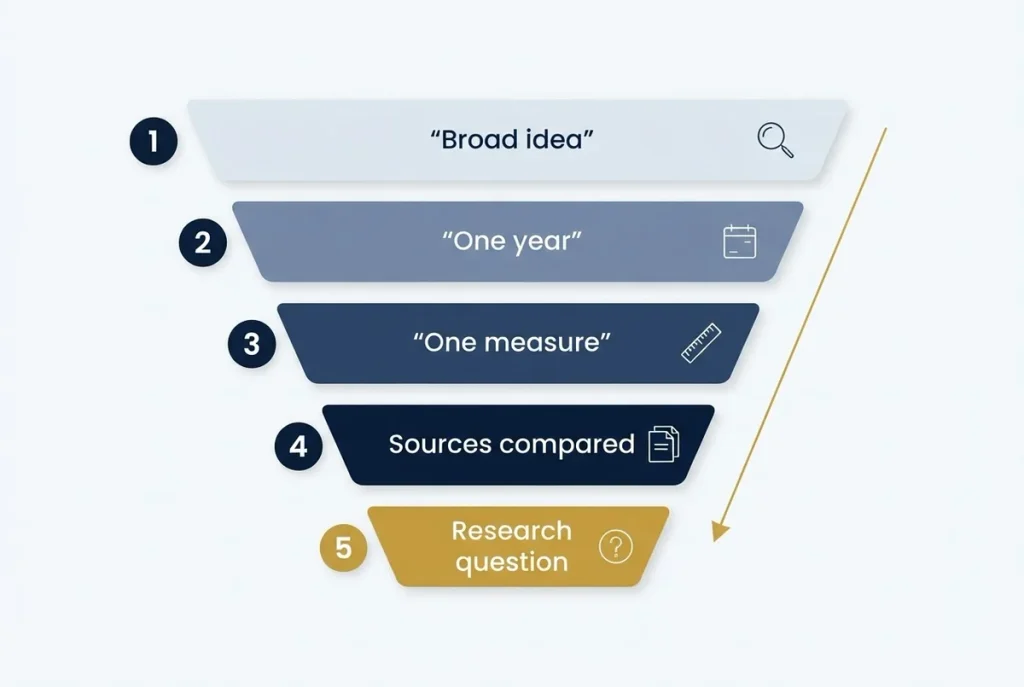
Suppose you begin with “startup funding in Pakistan”. Narrow it like this:
- Name the broad idea: startup funding in Pakistan.
- Pick one year: 2024, because several reports cover it.
- Pick one measure: disclosed funding in US dollars.
- List the sources and note what each counts: equity only, hybrid deals, undisclosed rounds.
- Write the question: why do four published totals for Pakistani startup funding in 2024 range from $22.5 million to $43 million, and which counting rules explain the gap?
Then the final question tells you what to collect, how to code it and which method to read about. Choosing a research methodology helps with that last step.
Four Mistakes That Weaken an Entrepreneurship Thesis
Repeating a student-intention survey. Because the same planned-behaviour model has been run many times, a study without a new measure has an unclear contribution.
Counting registrations as startups. A company incorporation says little about trading, age or size. Use a stated definition instead.
Quoting a figure from a news item alone. Look for the report behind it. If you cannot open it, write “as reported by” and say so in your limits.
Mixing currencies and definitions. Dollars and rupees, equity and hybrid deals, and fiscal and calendar years need separate columns until you convert them on a stated rule.
Frequently Asked Questions About Entrepreneurship Thesis Topics
Can I write an entrepreneurship thesis without interviewing founders?
Yes. Every topic above works from public documents, but a few can add short interviews later. If you add participants, ask your department whether ethics approval is needed.
Which Pakistani definition of a startup should my sample use?
Use the one tied to your question. The tax definition requires PSEB certification and turnover below Rs100 million in each of five years. The SECP definition, as the State Bank paper states it, allows up to ten years and revenue below Rs500 million. State your choice in the method chapter and defend it, which is why topic 1 exists.
How should I cite a figure I found only in a news article?
Cite the article, write “as reported by”, and look for the original report. If the original is behind a paywall or will not open, say so plainly in your limitations.
Your Next Step
Shortlist two topics and test each against three questions. Can you open the original document? Does your supervisor know the method? Can you finish within your programme’s timeline? More subjects are collected in thesis topics by subject area, and a guide to writing a research proposal shows how to turn one topic into a plan.
If you want feedback on a shortlist, send your details through the order form. Any reference material should be used for learning, in line with your university’s policy.